
Follow Your Different
043 The Miracle Equation with Hal Elrod

Today, one of the best-selling self-help authors of all time, Hal Elrold sits with us. We unpack his brand new book, The Miracle Equation and talk about his life-changing story after beating cancer. Listen and believe that miracles do happen.
Miracle Equation
Hal created this equation 6 years prior to the Miracle Morning as a concept that he has been practicing and teaching in a company that he worked for. This is the formula that he used to beat cancer.
Anything is possible, but possible is not enough to get us up in the morning. His unwavering faith and extraordinary effort are his biggest decisions that helped him achieve his goal.
“The miracle equation is not a one-time decision to achieve a one-time goal. It’s a fundamental way of living, a way of bringing fate. It is the fundamental lens to which you approach all of your life’s challenges and all of your opportunities, goals and dreams.” – Hal Elrod
Possible to Probable
The voice of self-doubt and fear is what overrides us. According to Hal,
we have to replace fear with faith. Stepping out on faith is how he closed the
gap and by reinforcing that which he called the “Miracle Mantra”.
“You don’t have to believe you can achieve the goal in order to keep moving forward and ensure you achieve the goal.” – Hal Elrod
Unwavering Faith
Developing the quality and characteristics of a
person is what we need to focus on. For as long as there’s effort and by
maintaining unwavering faith, regardless of what the result is, we can achieve
anything.
This is not a one-time decision. It is a fundamental way of approaching our life in every challenge we encounter and in every goal that we set.
“The highest benefit that you can get from setting and pursuing a goal is not to hit the goal. It is who you become on the journey toward the goal by giving it everything you have no matter what.” – Hal Elrod
To hear more about Hal, one of the best-selling self-help authors of all time, download and listen to this episode.
Bio:
Hal Elrod is one of the highest keynote speakers in America,
a top podcaster, and creator of one of the fastest growing and most engaged
online communities in existence. He is also one of the most inspiring authors
of one of the highest rated, best-selling books in the world, The Miracle
Morning.
Some of his works are:
• Achieve Your Goals podcast
• Best Year Ever Blueprint
• (10 books) of The Miracle Morning book series
Links:
We hope you enjoyed Hal Elrod on this episode
of Follow Your Different™! Christopher loves hearing from his listeners. Feel
free to email him, connect on Facebook, Twitter, Instagram and
subscribe on iTunes!
042 The Future with Mark Pesce
Podcast: Play in new window | Download (Duration: 58:29 — 53.8MB) | Embed
Subscribe: Apple Podcasts | Spotify | Pandora | RSS | More
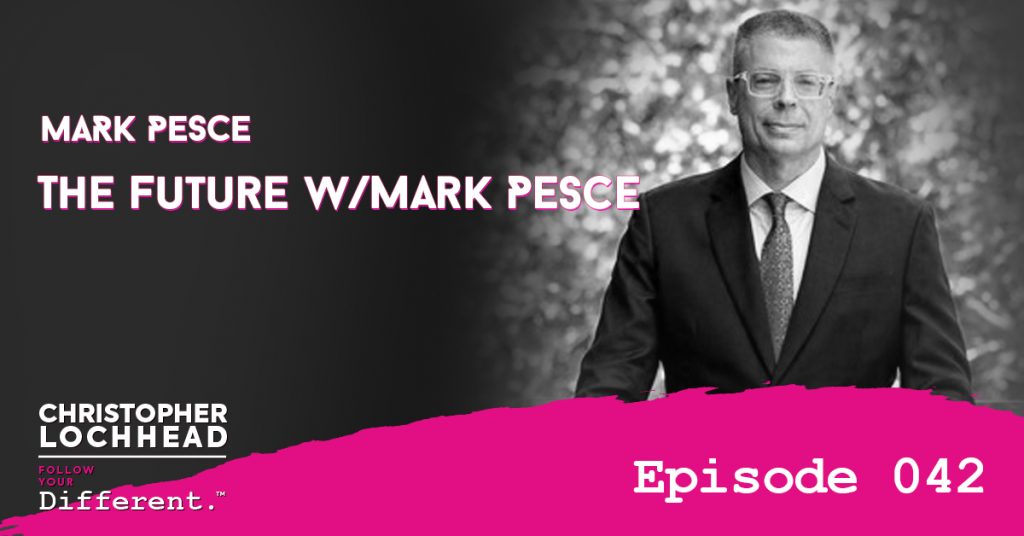
In today’s episode, we hang out with a leading futurist Mark Pesce. He and Christopher discuss how smart the world is, why we should not be afraid of the future, how the next ten years will play out and how technology will transform our health and well-being.
Path to the Future
People get blindsided, uncontrollable and scared of what the future holds. We tend to give up when we feel that everything is not falling into place. Mark wants to show us that there is always a path through.
We have always had this path. All it takes is looking at our past and the clues to help us understand how we are going to find our .
“People come out of that with the sense of urgency that there is something that they can do, something that they can be that allows them to have not just a stake in the future, but a capacity to keep up with that future.” – Mark Pesce
Fear Because of Change
According to Mark, kids these days are so different because of their experiences.
We ask ourselves why the world is changing and why we can’t keep up. The idea of fear in us is because of change. And it is something that can be tolerated as we have the capacity to learn from one another.
“We like to master things and we don’t like it when those things change from underneath us because it makes us feel like we’re losing on mastery.” – Mark Pesce
A Smarter World
The world is getting smart. There are apps, computers, electronics, high speed mobile Internet and sensors everywhere. Mark said that over the span of 40 years, all we have done is to learn how to take all the principles that are embodied with all of these.
We have such connections, wiring and intelligence of the world that when we look at it one way, it seems very threatening. It can seem that the world is going to be so smart and would not need us anymore. But we should always remember that a machine can be dumped a million times faster than a human can.
“The challenge and pressure for us is can we get smart at the same pace the world is getting smart?” – Mark Pesce
To hear more about Mark, the leading futurist, download and listen to this episode.
Bio:
Mark Pesce is a leading futurist, author, entrepreneur and innovator.
He is an award-winning columnist for The Register and producer and host of This Week in Startups Australia. Mark invented VRML, the standard for 3D on the Web and a core component of MPEG-4. He also authored 6 books including:
• VRML: Browsing and Building Cyberspace
• The Playful World
• The Last Days of Reality
Links:
We hope you enjoyed Mark Pesce on this episode of Follow Your Different™! Christopher loves hearing from his listeners. Feel free to email him, connect on Facebook, Twitter, Instagram and subscribe on iTunes!
041 Designing a Legendary Life With the Man Who “Saved Metallica” Phil Towle
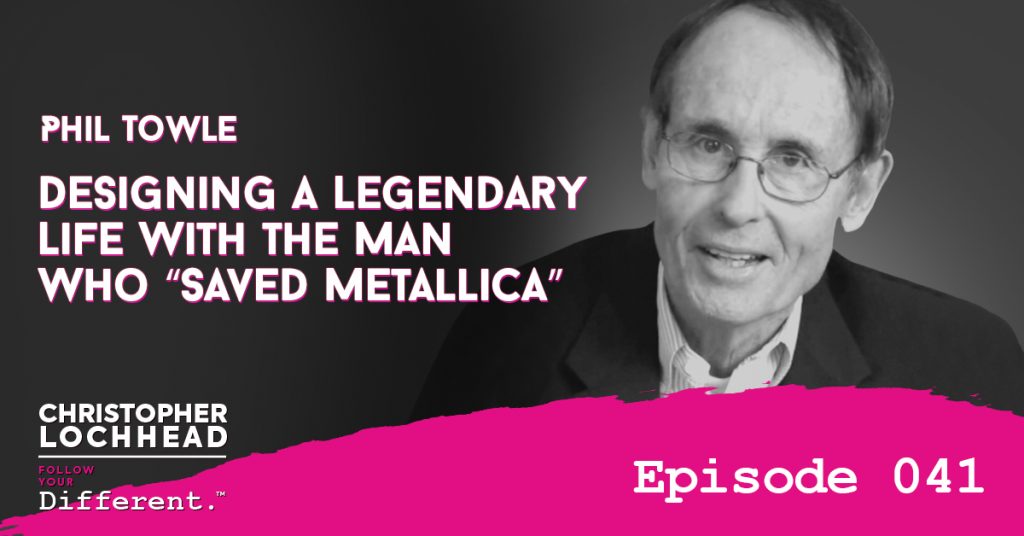
Today, the incredible performance coach Phil Towle sits with us for his very first podcast. He and Christopher have a very big, deep and adult conversation about life design, crisis and failures, building relationships and loads more. Hold tight, this dialogue gets very personal.
Break Down to Break Out
One of Phil’s approaches in coaching is called the ‘Breakdown as a Breakout Opportunity’. He normally starts by asking clients what they’re going through and from there, he can get a picture of what that means to them.
Phil sees this as a breakthrough opportunity. He takes crises as chances to look back since those that we have personally experienced can be the most catalytic.
“The crisis may be in some ways more about my resisting change, getting out of comfort zone and doing something that I need to do to go forward than anything else.” – Phil Towle
When Crises Arise
Phil sees a crisis as very personal as we have to look at our part in the challenge. To deal with it, we need to slow the process down rather than focusing and having the desire to change in an attempt to make life better.
We should ask ourselves, “How did I co-create this? What’s my part of the conflict?” Once identified, we can then position ourselves to make the change. Do we cut and run or do we persevere?
“We co-created crisis out of necessity because we need to make a change, some kind that we’re resisting.” – Phil Towle
Relationships Founded on Authenticity
Building relationships, whether short-term or long-term, do not have to be hard. If we continue to create authenticity in our interactions, we build a kind of intimacy that makes it easier for us to do so. The best way to approach it is to have the desire to make sure that you maintain present interaction in a way that is meaningful.
Have the openness of someone that is constructing a long-term relationship and make sure that you and the other party are honest with each other. Invest in the quality of the experience so that in the case that things go downhill and you decide to abandon the relationship, you will constructively move forward. You will take each other with you and the relationship practically never stops.
“When I’m not constructive, or when I start to build expectations of how I want you to be, then our relationship is misshapen. It takes on a different form that’s likely to end in some kind of trauma because I haven’t respected you. I made you a conformer or tried to make you conform to my agenda.” – Phil Towle
To hear more about Phil’s take on crises, mental health and failures, download and listen to this episode.
Bio:
Phil Towle defines “performance coaching” as a proactive psychological strategy that facilitates making your best better.
Phil works with “Difference makers” committed to using their God-given talents to fulfill their highest possibilities, and those around them determined to transform each hardship, setback and self-imposed limitation, into superior achievement.
His clients include:
- Metallica;
- Dick Vermeil (Superbowl Winning Coach with St. Louis Rams);
- Bill Romanowski (Professional Athlete);
- Rascal Flatts;
- Tom Morello (musician with Rage Against Machine/ Audioslave/ Nightwatchman, and Human Rights Activist)
Links:
Metallica documentary featuring Phil Towle working with the band:“Some Kind of Monster”
We hope you enjoyed Phil Towle on this episode of Follow Your Different™! Christopher loves hearing from his listeners. Feel free to email him, connect on Facebook, Twitter, Instagram and subscribe on iTunes!
040 Veteran Mental Health w/ Duane France

Podcast: Play in new window | Download (Duration: 1:11:29 — 65.6MB) | Embed
Subscribe: Apple Podcasts | Spotify | Pandora | RSS | More
For the second installment of this 3-part series on mental health and well-being, US combat veteran turned mental health counselor, podcaster and author Duane France joins Christopher. They share a powerful conversation about living a life of service, the challenges faced by veterans who leave the military and the power of having purpose and meaning.
“The military’s purpose is not to kill and destroy. It’s to protect and preserve.” – Duane France
On Veteran Stereotypes
When asked about what he would want the average American to know about the people in the military, Duane said that they are just like everybody else. Sadly, people like to stereotype the military veteran in three ways.
One, some would think of the veteran as a berserker suffering from PTSD. Sometimes, other people treat them as victims that need taking care of for the rest of their lives. And then there is the stereotype as a hero.
“There’s just a lot of stereotypes that go along with especially current era military… and it’s just simply not true.” – Duane France
Not So Different
All veterans want is for people to understand what they live through. Duane’s clients would say that they want people to know what they experience and to hear their stories. But at the same time, they don’t know how to tell these, feeling like no one can really understand the struggles of a veteran.
To help a military veteran reintegrate into civilian life, it is best to not treat them differently. They want to be seen not as victims or as villains, but as the average American with interesting stories.
Finding Purpose After Service
No matter how unique their stories go, veterans will always struggle to regain their footing on civilian soil. The transition is the hardest part, but with the help of people around them, they can achieve a new purpose.
Some of them can even become amazing and legendary entrepreneurs.
“When we leave the military, we wanna find a place for ourselves in the world. We wanna find purpose and meaning in our lives because what we did was really meaningful.” – Duane France
To hear more about the separation of war from the warrior and why veterans make great entrepreneurs from Duane, download and listen to the episode.
Bio:
Duane K. L. France is a combat veteran of both Iraq and Afghanistan, as well as a mental health counselor practicing in the state of Colorado.
He’s the host of the HEAD SPACE AND TIMING podcast and the author of Combat Vet Don’t Mean Crazy: Veteran Mental Health in Post-Military Life.
Links:
We hope you enjoyed Duane France on this episode of Follow Your Different™! Christopher loves hearing from his listeners. Feel free to email him, connect on Facebook, Twitter, Instagram and subscribe on iTunes!
039 Mentally Strong Women w/ Amy Morin
Podcast: Play in new window | Download (Duration: 1:07:09 — 61.7MB) | Embed
Subscribe: Apple Podcasts | Spotify | Pandora | RSS | More
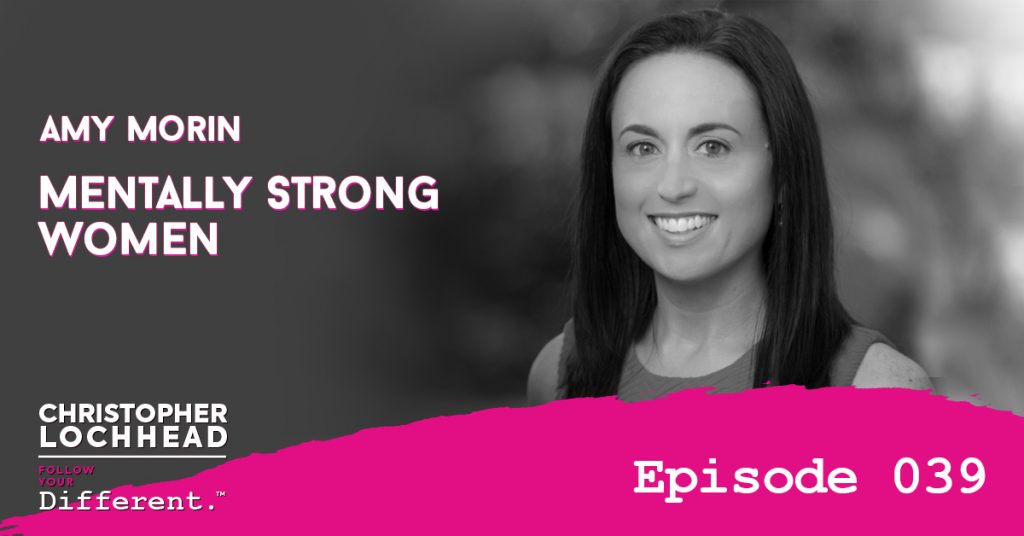
On this first episode of a 3-part series on mental health and well-being, the mega-popular therapist, writer and speaker Amy Morin sits with us. She holds a powerful conversation with Christopher about how women can be super successful, why self-doubt can be a good thing and the power of true vulnerability.
“It’s okay to be a mentally strong woman who doesn’t act like a mentally strong man.” – Amy Morin
Women on Criticism and Rejection
Amy studied a lot for her new book. She found out that women tend to treat rejection and criticism as if they were the same thing.
Walking the path towards mental health and success is not letting others limit one’s potential. We must learn to take criticism where it comes from and separate criticism from people without stakes on our game. Studies also show that when people criticize you, they are likely telling you how they feel about themselves.
When Confidence Becomes Dangerous
According to Amy, people fail to recognize how dangerous confidence can be. Being completely confident that everything would work out without a hitch sometimes leads to some really poor decisions.
“A lot of the mistakes we make are because we’re overconfident about our abilities and we underestimate how tough the challenge is gonna be.” – Amy Morin
Nobody jumps on Get Rich Quick schemes unless they are 100% sure that nothing will go wrong. It goes to show how self-doubt can be used to one’s advantage.
Embracing Your Self-Doubt
Self-doubt can sometimes stop us on our tracks towards success. Being less confident about one’s attributes and qualities is only natural, but self-doubt doesn’t have to be a bad thing.
Studies on how students predict their performance on tests show that those who are confident about acing their tests are likely to do worse than those who show some doubt. This is mainly because they turned their self-doubt into effort and studied harder.
“Having a little self-doubt means, ‘I have to put in more effort, I have to study for this, I have to prepare, I have to sharpen my skills.’ And it keeps you on your toes.” – Amy Morin
Owning One’s Vulnerability
We sometimes liken vulnerability to weakness. But to become mentally strong, we need to embrace its true power.
“To really be vulnerable, you have to let people know that you struggle with things, that you’re not really okay sometimes.” – Amy Morin
Having the means to open up about our own vulnerabilities to the world has made it easier to embrace. But being vulnerable is not something that we should necessarily announce on social media all the time. Sometimes embracing it means having a private conversation between you and a loved one.
To learn more about the secrets to women’s success and Amy’s take on the #MeToo Movement, download and listen to the episode.
Bio:
Amy Morin is a licensed clinical social worker, psychotherapist, and a lecturer at Northeastern University.
The Guardian dubs her as the “self-help guru of the moment.” Forbes refers to her as a “thought leadership star.”
Her knowledge of mental strength stems far beyond her professional experience.
She’s experienced a series of losses in her personal life that gave her first-hand insight into the strategies that build resilience.
In 2013, her article 13 Things Mentally Strong People Don’t Do was read by over 30 million people around the world.
Her best-selling book, also called, 13 Things Mentally Strong People Don’t Do, is being translated into 25 languages.
Her newest book, “13 Things Mentally Strong Parents Don’t Do: Raising Self-Assured Children and Training Their Brains for a Life of Happiness, Meaning, and Success” is a sensation.
Amy’s advice has been featured by a number of media outlets, including Parenting, Time, Fast Company, Good Housekeeping, Elle, Business Insider, Cosmopolitan, Success, Oprah.com, Health, Fox News, US News & World Report, and The Washington Post. She has also provided on-camera interviews for Fox Business, Forbes, TheBlaze TV and an upcoming documentary with Red Bull. She’s a frequent guest on a variety of radio shows as well.
Amy serves as Verywell’s Parenting Teens Expert and Child Discipline Expert. She’s a regular contributor to Forbes, Inc., and Psychology Today.
A sought-after speaker, Amy loves to share the latest research on resilience and the best strategies for overcoming adversity and building mental muscle.
Links:
We hope you enjoyed Amy Morin on this episode of Follow Your Different™! Christopher loves hearing from his listeners. Feel free to email him, connect on Facebook, Twitter, Instagram and subscribe on iTunes!
038 Kerri Walsh Jennings Volleyball Legend: An Inspired Life
Podcast: Play in new window | Download (Duration: 1:44:07 — 95.5MB) | Embed
Subscribe: Apple Podcasts | Spotify | Pandora | RSS | More
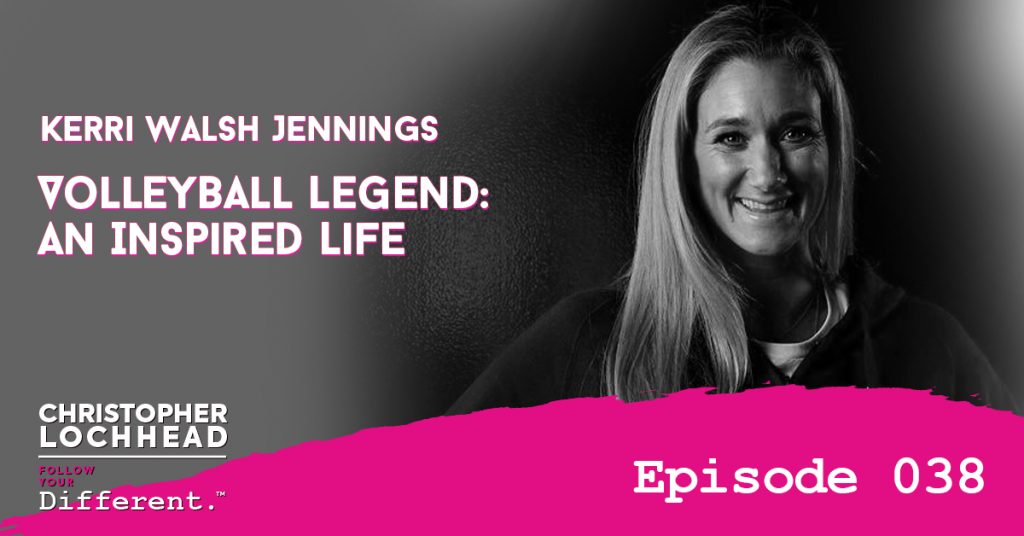
What drives a five-time Olympian? Today, we hear from the true legendary champion Kerri Walsh Jennings. The best beach volleyball player in the world sits with us for a conversation all about drive and inspiration.
“My bronze completes me. My dark side completes me… You need to have both.” – Kerri Walsh Jennings
Discipline Liberates and Consistency Feels Great
One of Kerri’s favorite quotes is Jocko Willink’s “Discipline equals freedom.” A lot of high-performing people get either flak for being so disciplined or pity for being “punished”. But discipline liberates and allows Kerri the space to breathe and accomplish things.
Discipline is all about showing up and doing what it takes on the daily. And it is as beautiful a word as competition despite the negative connotation often attached to the two.
“It makes me feel good to be consistent and to do the hard things when things are hard and to do it until they’re done.” – Kerri Walsh Jennings
Love for Winning Always Wins
Like most athletes, Kerri loves winning. But her relationship with it is as unique as it could get. The joy of winning motivates and inspires her more than the pain of losing.
People would often say that losing motivates them, but Kerri thinks that losing is like a chronic injury or a weight on one’s shoulders. It gets into your psyche in a way that drives you crazy. It is a toxic feeling despite the positives to it.
“I love winning more than I hate losing, which I think is why I’m still going.” – Kerri Walsh Jennings
Feeling at Home in the Olympics
With her veteran status in the Olympics, one would think that she felt the pressure of having basically the entire world watching her either win or lose. But not once has this ever occurred to Kerri.
The Olympics is fun, and she has always found it helpful to create a bubble around her to make her feel safe and not get caught in the noise. She has found her home in the Olympics, and not even the millions of spectators would take her off her game.
To hear more about Kerri’s distinction between inspiration and motivation and a whole lot more, download and listen to the episode.
Bio:
Kerri Walsh Jennings has been called, “the Best Beach Volleyball Player in the World”.
Kerri is a five-time Olympian, three-time Olympic gold medal winner, and a one-time bronze medalist.
She is the beach volleyball career leader in career wins.
And Kerri is half of what has been called “the greatest beach volleyball team of all time,” with her longtime partner Misty May-Treanor.
Walsh Jennings is also an entrepreneur. She is the founder of p1440, a beach volleyball event series launched in September 2018 with eight events in the 2018–2019 season, showcasing the best in women’s and men’s beach volleyball from around the globe.
Links:
Parade – Three-Time Gold Medalist Kerri Walsh Jennings Says Change Is a Process—and an Opportunity
VICE Sports – What Makes Kerri Walsh the Best Beach Volleyball Player in the World?
We hope you enjoyed Kerri Walsh Jennings on this episode of Follow Your Different™! Christopher loves hearing from his listeners. Feel free to email him, connect on Facebook, Twitter, Instagram and subscribe on iTunes!
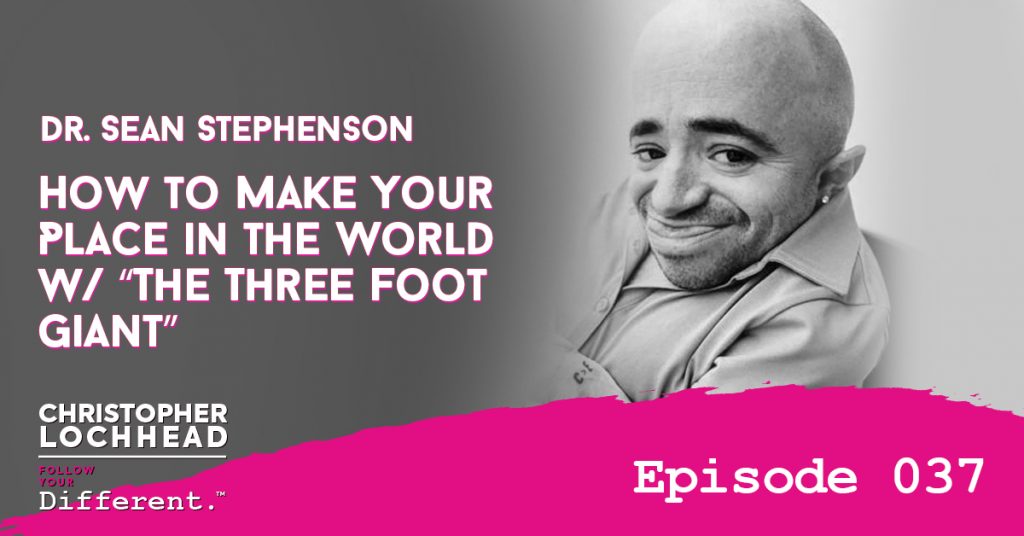
037 How to Make Your Place in the World w/ “The Three Foot Giant” Dr. Sean Stephenson
Podcast: Play in new window | Download (Duration: 1:16:19 — 70.1MB) | Embed
Subscribe: Apple Podcasts | Spotify | Pandora | RSS | More
Is it possible to live multiple lives in this lifetime? Today, the three-foot giant Dr. Sean Stephenson joins us for a wonderful conversation on growth, purpose, and a lot more.
Continuing to Grow
Even after achieving his stature as a public speaker, Sean admits that he’s still growing. He was in business with his father for 22 years and didn’t leave home until he was 31. Perhaps owing to his severe physical disability, he was very close to his family.
His home life was wonderful, but as he got older, it got more difficult. Being in the same roof with his family, he always had a group thinking and felt like he was curbing himself. So he decided to go through a very painful business breakup and step out into the world.
Learning to Walk
We can’t read the label inside the jar. Sean didn’t know how much he was holding back his own opinions or how much he was fully being himself. But when he moved and broke away, he started seeing how there were new levels and layers to him.
The stark differences between his and other people’s experiences growing up shocked him. After all, he was used to a culture where not doing what the family wants equals being a renegade.
“I have decades and decades of education where I help people through their pains and their problems. But in some ways, I’m still learning to walk myself, learning to navigate this world, and I’m loving the experience of making mistakes.” – Dr. Sean Stephenson
Breaking the Mold
It personally sickens him to think that some people would want to live the same life a hundred times over. To continue his self-discovery, he would reorganize his life every five years or so. He wants to look back on the past five years with a stack of embarrassing mistakes to learn from.
Sean confesses that he wouldn’t hang out with his younger versions with interests that wouldn’t necessarily appeal to him now. He loves himself all the more for it. And he can only wish the version of himself five or ten years down the road would feel the same way with the present.
“Maybe there’s a wrongful belief out there that the version of you will always be the same as you get older but I don’t agree with that. I’m constantly breaking the mold and starting over and trying new things and figuring out what do I believe in.” – Dr. Sean Stephenson
To hear about why purpose is sexy and how Sean turned his “disability” into a competitive advantage, download and listen to the episode.
Bio:
Dr. Sean Stephenson was predicted not to survive at birth because of a rare bone disorder that stunted his growth and caused his bones to be extremely fragile (fracturing over 200 times by the age of 18).
Despite his challenges, he took a stand for a quality of life that has inspired millions of people around the world.
Since 1994, his powerful message has been heard at live events in nearly all 50 states and in 16 countries.
Sean has presented at hospitals, universities, prisons, and to companies such as Nike, Whole Foods, Zappos, Walmart, and Sharp Healthcare. He has shared the stage with U.S. Presidents, billionaire business moguls, celebrities, and his Holiness the 14th Dalai Lama.
Sean has appeared on everything from The Oprah Show to Jimmy Kimmel, in addition to online videos with tens of millions of views.
The Biography Channel produced an hour-long feature on his life called, Three Foot Giant.
Mindie Kniss & Sean Stephenson his international best-selling book, Get Off Your “But”, has been translated into over a dozen different languages.
As a board-certified therapist, and doctor of Clinical Hypnosis, Dr. Stephenson sees clients in a unique 12-hour session that gets to the root of their fears, excuses, and insecurities.
Each year Sean hosts live events and group coaching programs to mentor individuals in the art and business of public speaking.
When Sean isn’t working he can be found in the gym, playing NBA 2K with his friends, or watching NBA basketball with his wife and business partner, Mindie Kniss.
Both Chicago-natives, Sean and Mindie have traveled the world, but now call Scottsdale, Arizona, home.
Link:
We hope you enjoyed Dr. Sean Stephenson on this episode of Follow Your Different™! Christopher loves hearing from his listeners. Feel free to email him, connect on Facebook, Twitter, Instagram and subscribe on iTunes!
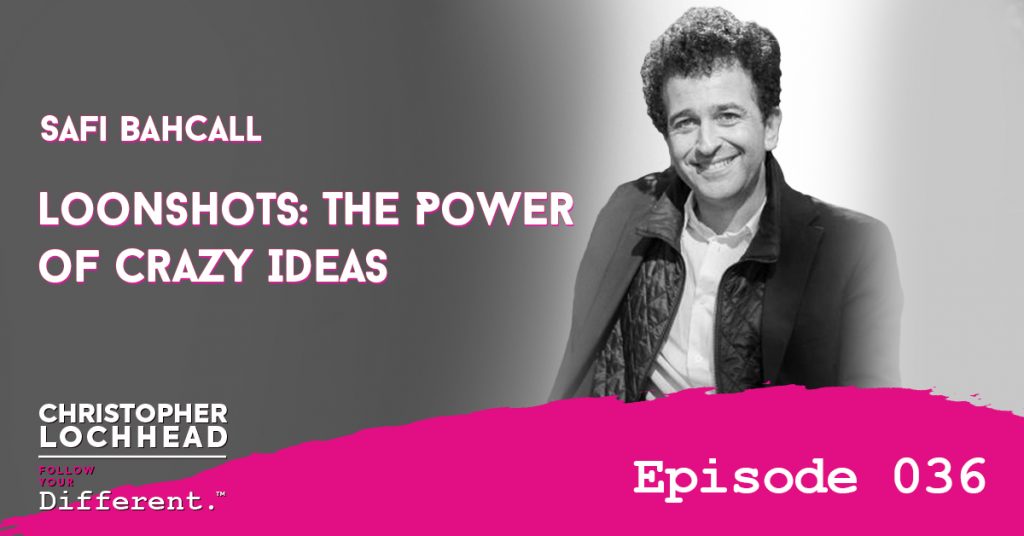
036 Loonshots The Power of Crazy Ideas w/ Safi Bahcall
Podcast: Play in new window | Download (Duration: 1:38:24 — 90.3MB) | Embed
Subscribe: Apple Podcasts | Spotify | Pandora | RSS | More
How can structure drive culture? On today’s episode, the amazing author of
Is It Really Culture?
When Safi first became an entrepreneur, he read every article and book he could find on various subjects like how to become a good leader and build great teams. All those things sounded good, but after a while, he got hungry for something more solid.
“I was trying to understand if there was some science to this. If there was something else besides just culture.” – Safi Bahcall
He observed that companies with completely different cultures would succeed, while those with the same cultures failed. There are elements of culture that are very important. But is it really the culture that drives the success of an organization?
Structure Eats Culture for Lunch
Christopher shares that there are successful companies with the “biddings will continue until morale improves” culture. Then there are other successful organizations that adopt an “everybody loves each other” culture. From this standpoint, there seems to be no such thing as a culture that works and a culture that doesn’t.
“Well, there’s a saying in business that says, ‘Culture eats strategy for breakfast.’ What I would add is that ‘structure eats culture for lunch.’” – Safi Bahcall
It appears that structure enables exponential differences in organizations in a way that culture doesn’t as much.
Structure Drives an Organization’s Culture
To exemplify, Uber had an outlier incentive system. Nobody wanted to work on other people’s project because of the 8X incentive that successful project proponents could earn. No matter how many times teamwork was encouraged, nobody would actually get into it.
But when the team-based incentives began to roll out, the culture changed. People were rewarded based on team performance. This perfectly sums up how structure eats culture for lunch.
“It means that underlying structure can drive the culture, rather than the way around.” – Safi Bahcall
To hear about how water molecules relate to business structure and how genius and serendipity need to meet to produce breakthroughs from Safi, download and listen to the episode.
Bio:
Safi is a second-generation physicist (the son of two astrophysicists) and a biotech entrepreneur.
He received his BA summa cum laude from Harvard and his Ph.D. in physics from Stanford, where he worked with Lenny Susskind in particle physics (the science of the small) and the Nobel laureate Bob Laughlin in condensed matter physics (the science of the many).
He was a Miller Fellow in physics at UC Berkeley (the school of the many). After working for three years as a consultant for McKinsey, Safi co-founded a biotechnology company developing new drugs for cancer. He led its IPO and served as its CEO for 13 years.
Safi has presented at approximately 130 banking conferences, investor events, and medical meetings around the world, as well as at leading academic institutions including physics, mathematics, or medical departments at Harvard, MIT, Stanford, Princeton, UC Berkeley, Caltech, Cornell, Bell Labs, Dana-Farber Cancer Institute, Massachusetts General Hospital, Rockefeller, and the Weizmann Institute of Science in Israel.
He lives with his wife, two children, and roughly 37 Gerald + Piggie books in Cambridge, MA.
Links:
We hope you enjoyed Safi Bahcall on this episode of Follow Your Different™! Christopher loves hearing from his listeners. Feel free to email him, connect on Facebook, Twitter, Instagram and subscribe on iTunes!
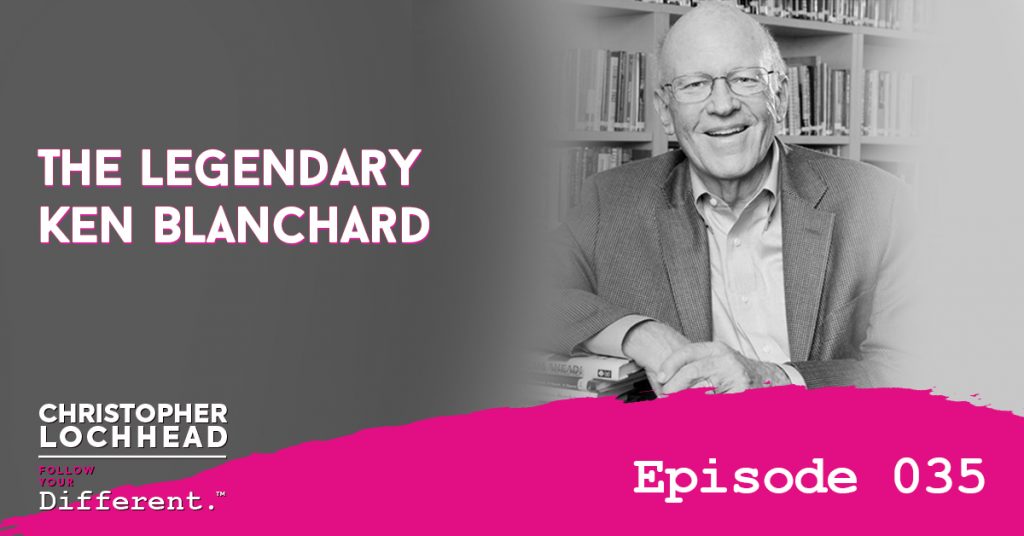
035 The Legendary Ken Blanchard
Podcast: Play in new window | Download (Duration: 1:16:01 — 69.8MB) | Embed
Subscribe: Apple Podcasts | Spotify | Pandora | RSS | More
Why does great service come from the heart? On today’s episode, Christopher sits with his hero Ken Blanchard. One of the greatest authors of all time shares why legendary customer service matters, the power that true servant leadership holds, and so much more.
Exemplifying Simple Truths
Christopher has personally looked up to Ken since reading the life-changing book, The One-Minute Manager. When he dropped out of school and had to seek other ways of learning, Christopher turned to the book that he has given to many others in return.
Simplicity marks everything that Ken writes and teaches. The living legend has written over 60 books, with a new one inspired by the story of Johnny the Bagger, The Simple Truths of Service.
“My mission statement is to be a loving teacher and example of simple truths.” – Ken Blanchard
Great, Simple Service
Everyone can make a difference in customer service without having to do anything complicated and by simply reaching out to customers and making them feel important. Great service that makes a difference comes from the heart. However, the human ego often sends people off track of being servant leaders.
Ego gets in the way of service in two ways. One is through false pride or the “more than” philosophy, where you act like you’re better than everyone else. And then there is fear or self-doubt, where you have a “less than” philosophy.
“A lot of people say, ‘That’s an ego problem?’ Sure, you focus on yourself.” – Ken Blanchard on self-doubt
Writing for People
Growing up, Ken’s parents instilled in him the value of staying grounded. When he became president back in junior high, his father reminded him that great leaders are great because people respect and trust them. His mother also taught him to neither think himself beyond others nor let others think they’re above him.
He has had a lot of valuable learnings in life. And all these motivate him to continue writing books.
“I just love learning for people.” – Ken Blanchard
To hear more about service and being yourself from Ken himself, download and listen to the episode.
Bio:
A prominent, sought-after author, speaker, and business consultant, Dr. Ken Blanchard’s friends, colleagues, and clients characterize him as one of the most insightful, powerful, and compassionate individuals in business today. Ken is one of the most influential leadership experts in the world and is respected for his years of groundbreaking work in the fields of leadership and management.
He is also the co-founder and Chief Spiritual Officer of The Ken Blanchard Companies, an international management training and consulting firm that he and his wife, Margie Blanchard, began in 1979 in San Diego, California.
Ken received a master’s degree from Colgate University and a bachelor’s and Ph.D. from Cornell University. Ken spends time as a visiting lecturer at his alma mater where he is a trustee emeritus of the Board of Trustees. He also teaches students in the Master of Science in Executive Leadership Program at the University of San Diego.
He has received many awards and honors for his contributions in the fields of management, leadership, and speaking. The National Speakers Association awarded him its highest honor, the “Council of Peers Award of Excellence.” He was inducted into the HRD Hall of Fame by Training magazine and Lakewood Conferences, and he received the Golden Gavel Award from Toastmasters International.
Ken also received The Thought Leadership Award for continued support of work-related learning and performance by ISA—The Association of Learning Providers. Ken has been inducted into Amazon’s Hall of Fame as one of the top 25 best-selling authors of all time. The business school at Grand Canyon University bears his name.
An avid golfer, Ken belongs to the Loch Lomond Golf Club in Scotland.
Links:
We hope you enjoyed Ken Blanchard on this episode of Follow Your Different™! Christopher loves hearing from his listeners. Feel free to email him, connect on Facebook, Twitter, Instagram and subscribe on iTunes!
