
Lochhead on Marketing
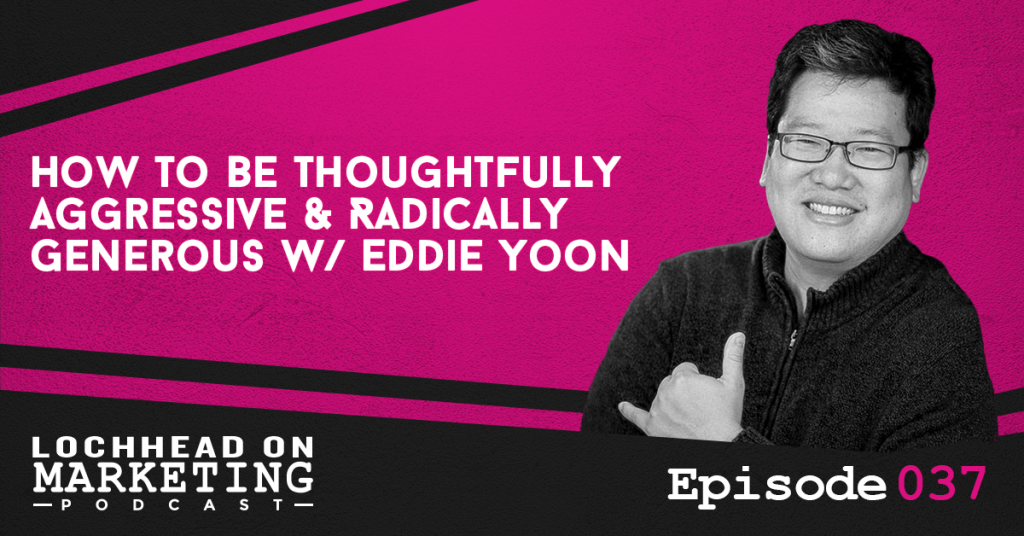
037 How To Be Thoughtfully Aggressive & Radically Generous w/ Eddie Yoon
Podcast (lochheadonmarketing): Play in new window | Download (Duration: 1:09:36 — 47.8MB) | Embed
Subscribe: Apple Podcasts | Spotify | RSS | More
We have is a very special free form conversation with Eddie Yoon, author of Superconsumers. He is also the category design guru to the Fortune 500. Recently, we collaborated on an article for Harvard Business Review “5 Ways to Stimulate Cash Flow in a Downturn.”
In this episode, we bring that article to life as we talk about two big ideas: how to be thoughtfully aggressive and radically generous.
Innovations Through Adversities
Christopher and Eddie share some stories about what is currently happening in the US. Christopher acknowledges the fact that the figures during daily briefings are not just numbers, they are people who have friends, families, and relationships.
“I just feel deep sadness and concern right now for all small businesses and large businesses. I think a lot of innovations will come through it, as it always does in adversities but this is one of those I cant wait to be on the other side of it.” – Eddie Yoon
Thoughtfully Aggressive, Radically Generous
Christopher shares how they have been thinking and researching the book they are working on and how these two ideas started to resonate with people in this time of crisis.
“We have a unique opportunity now to be radically generous, best we can and that can be financially and thoughtfully aggressive. Some of our businesses are threatened. Most businesses are down in meaningful ways. As business leaders, we got to navigate through this the best we can.” – Christopher Lochhead
Eddie shares that in a time of uncertainty, we don’t know what is going to work. However, if we lean into being radically generous, and thoughtfully aggressive, we’ll be fine throughout this.
“When you’re in a crisis, you got to keep it simple and I think these principles are not that simple, but they are emotional. That’s the key part, cause sometimes in fight or flight, your brain doesn’t always work. Emotions are what you can hold on to and that’s something people can use to discern. Is it a radically generous thing or not? Am I being a chicken or should I be more thoughtfully aggressive about it?” – Eddie Yoon
No Best Time To Launch Than Now
For companies and brands who got caught up in the planning stage of launching a new product, Christopher and Eddie give advice that there’s no best time to launch than now.
“I think, that self-awareness is the thing that makes me feel comfortable. Category creation and design is the ultimate growth strategy. You should be doing it anyway.” – Eddie Yoon
To learn more about how to be thoughtfully aggressive and radically generous. and more information about Eddie Yoon, download and listen to this episode
Bio:
Eddie Yoon is the founder of EddieWouldGrow, LLC, a think tank and advisory firm on growth strategy. Previously he was one of the senior partners at The Cambridge Group, a strategy consulting firm.
His work over the past two decades has driven over $8 billion dollars of annual incremental revenue. In particular, 8 of his clients have doubled or tripled in revenue in less than 8 years.
Eddie is one of the world’s leading experts on finding and monetizing superconsumers to grow and create new categories.
He is the author of the book, Superconsumers: A Simple, Speedy and Sustainable Path to Superior Growth (Harvard Business School Press, 2016).
His book was named as one of the Best Business Books of 2017 by Strategy & Business. He is also the author of over 100 articles, including “Make Your Best Customers Even Better” (Harvard Business Review magazine, March 2014) and “Why It Pays to Be a Category Creator” (Harvard Business Review magazine, March 2013).
Additionally, he has appeared on CNBC and MSNBC and been quoted in The Wall Street Journal, The Economist and Forbes and has been a keynote speaker in the U.S., Canada, Kenya, Australia, New Zealand, Denmark, the UK and Japan.
Eddie holds an AB in Political Science and Economics from the University of Chicago. Having been born and raised in Hawaii, he went to the Punahou School in Honolulu. Eddie lives in Chicago with his wife and three children.
Links:
This episode is based on a Harvard Business Review article written by Eddie Yoon, & Christopher Lochhead.
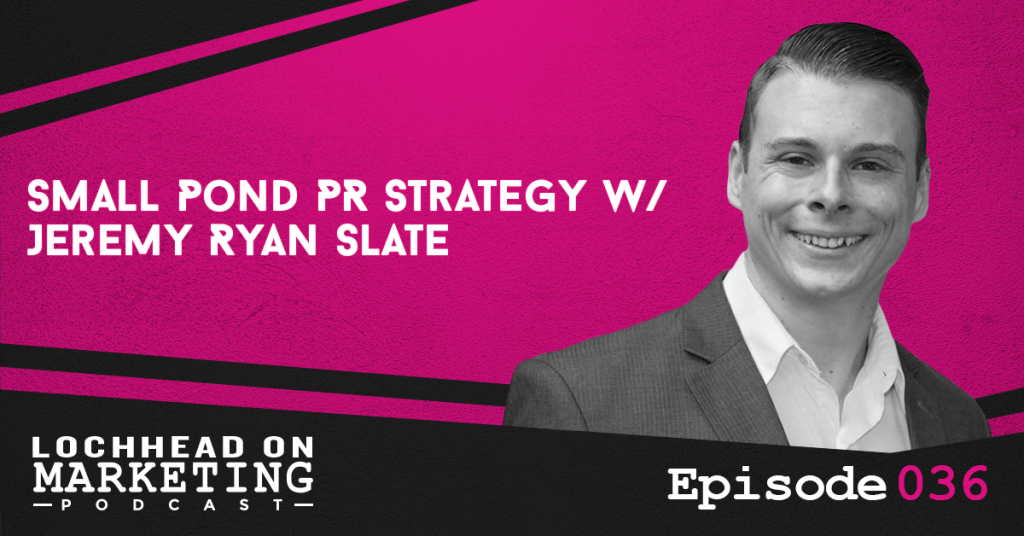
036 Small Pond PR Strategy w/ Jeremy Ryan Slate
Podcast (lochheadonmarketing): Play in new window | Download (Duration: 19:07 — 13.1MB) | Embed
Subscribe: Apple Podcasts | Spotify | RSS | More
In this episode, we have a thoughtful conversation about how to create and execute what Marketing guru and entrepreneurial podcaster Jeremy Ryan Slate calls “A Small Pond PR Strategy.” We dig into why you should go small before you go big.
Small Pond PR Strategy
Jeremy is the host of Create Your Own Life Podcast and owner of firm Command Your Brand Media. He is on a mission to help entrepreneurs get their message out though podcast guesting. Likewise, he also helps podcasters become more profitable.
He is also spreading the word about Small Pond PR Strategy
“You have to figure out what’s your small area. Honestly, one of the best ways that I found to do that is: start writing press releases to promote to the area because they’re hungry for news and you got to tell them about it.” – Jeremy Ryan Slate
Start Small Before Going Big
Jeremy shares that oftentimes, people disconnect with their local community and focus on targeting big-time media outlets such as Forbes or INC. It is the belief that a featured article from these big media will move the needle.
“If you shoot right for that stuff, you have to realize that there are stairs to get in the media and you have to know how to actually get up those stairs and actually get your local areas for you. So, by saying that its a small pond, what I mean is, everybody has a small community group or whatever it may be that they are a part of.” – Jeremy Ryan Slate
To cite an example, Jeremy shares he did an exchange with Rotary International, where he spoke in front of 30 different groups in Peru. He was promoted via the newsletter. This is a great avenue to become an opinion leader in a certain field.
Maximize Press Releases
Jeremy also shared about writing press releases and tapping community newspapers. Christopher also said local bloggers who have an enthusiastic following is also a good medium.
In writing press releases, Jeremy advised to ask these questions:
“What’s newsworthy about our business? If you don’t have a reason your different, or reason that the media should care—an interesting statistic, an interesting achievement, something that you’re doing to help the community.” – Jeremy Ryan Slate
To learn more about Small Pond PR Strategy and more information about Jeremy Ryan Slate, download and listen to this episode
Bio:
Jeremy Ryan Slate is the founder of the Create Your Own Life Podcast, which studies the highest performers in the world.
He studied literature at Oxford University and is a former champion powerlifter turned new media entrepreneur.
Specializes in using podcasting and new media to create celebrity and was ranked #1 in iTunes New and Noteworthy and #1 in the business category, as well as ranked # 78 in the iTunes Top 100.
Jeremy was named one of the top 26 podcasts for entrepreneurs to listen to in 2017 + 18 by CIO Magazine, a top podcast to listen to by INC Magazine in 2019 and Millennial Influencer to follow in 2018 by Buzzfeed.
The Create Your Own Life Podcast has been downloaded over a million times.
He’s also a featured writer for Influencive and Business.com, as well as a contributing editor of New Theory Magazine and Grit Daily.
After his success in podcasting, Jeremy Slate and his wife, Brielle Slate, founded Command Your Brand Media to help entrepreneurs get their message out by appearing as guests on podcasts and to help podcasters be more profitable.
Links:
We hope you enjoyed this episode of Lochhead on Marketing™! Christopher loves hearing from his listeners. Feel free to email him, connect on Facebook, Twitter,Instagram and subscribe on iTunes! You may also subscribe to his newsletter, The Difference, for some amazing content.
035 Your Brand Will Be Defined By What You Do During Coronavirus
Podcast (lochheadonmarketing): Play in new window | Download (Duration: 9:27 — 6.5MB) | Embed
Subscribe: Apple Podcasts | Spotify | RSS | More
Extraordinary times call for legendary leadership. In this episode, we talk about why your brand will be defined by what you do during coronavirus. This is a moment of truth. What leaders do in moments of truth define who they become and what happens to our brand.
“I think people are going to remember what you did or didn’t do during this crisis. How companies treat humanity during this crisis will have a long term impact.” – Christopher Lochhead
Focus on People
Christopher had been speaking with entrepreneurs about the discussions they should focus on to make a difference during this coronavirus crisis. First is: focus on people.
He shares about an Australian CEO who discussed with his people how they can make the most out of their cash on hand and accounts receivable. Half the people would rather get half of their salary than getting laid off.
“I think legendary leaders are open about these things and talk to the people about them. Try to do it in a way that is humane as possible and that extends your cash runway as possible.” – Christopher Lochhead
Focus on Customers
Now is the time to make a difference with customers. Christopher cites an entrepreneur who runs a gym. Rather than making a decision amongst him and his executive team, he asked their customers, if they want to cancel their subscription, do they want to pay half. A good 80 percent of their customers came back and said “we want to keep on paying you at the full rate.”
In addition, they’re doing a lot like what other legendary people in the health and wellness and fitness industry are doing, they are putting a lot of content on the internet.
“By being open real with people, they have endeared themselves to their customers in a very, very powerful way.“ – Christopher Lochhead
Focus on Humanity
What are we doing for humanity? Now is a great time to be radically generous. In fact, the company Dyson produced a new type of respirator in 10 days and have been supplying 15,000 for this pandemic fight.
“We have to ask ourselves what do we have to contribute? It might be money, it might be other things. it might be expertise. In our case, we have a podcast to contribute, so we’re doing that.” – – Christopher Lochhead
To hear more about Christopher’s thoughts on how a company’s action during this crisis will affect their brands, download and listen to this episode.
Bio:
Christopher Lochhead is a #1 Apple podcaster and #1 Amazon bestselling co-author of books: Niche Down and Play Bigger.
He has been an advisor to over 50 venture-backed startups; a former three-time Silicon Valley public company CMO and an entrepreneur.
Furthermore, he has been called “one of the best minds in marketing” by The Marketing Journal, a “Human Exclamation Point” by Fast Company, a “quasar” by NBA legend Bill Walton and “off-putting to some” by The Economist.
In addition, he served as a chief marketing officer of software juggernaut Mercury Interactive. Hewlett-Packard acquired the company in 2006, for $4.5 billion.
He also co-founded the marketing consulting firm LOCHHEAD; was the founding CMO of Internet consulting firm Scient, and served as head of marketing at the CRM software firm Vantive.
Links:
James Dyson designed a new ventilator in 10 days. He’s making 15,000 for the pandemic fight
We hope you enjoyed this episode of Lochhead on Marketing™! Christopher loves hearing from his listeners. Feel free to email him, connect on Facebook, Twitter,Instagram and subscribe on iTunes! You may also subscribe to his newsletter, The Difference, for some amazing content.
034 Digital Leadership & Why Leaders Over-Communicate
Podcast (lochheadonmarketing): Play in new window | Download (Duration: 10:45 — 7.4MB) | Embed
Subscribe: Apple Podcasts | Spotify | RSS | More
Extraordinary times call for legendary leadership. Because of the Coronavirus, shit is getting very weird. As Hunter Thompson said, “When the going gets weird, the weird turns pro” which is why it’s time to become a Digital Leader and over-communicate.
Primary Mode of Communication
In times of crisis, people need to both see and hear from their leaders. Former navy seal and former Chief of Staff for 4-star General Stanley McCrystal, Chris Fussell was on FYD episode 38 and he made a comment on digital leadership in an article he wrote on NY Times.
He made a comment on “digital leadership and said “first, don’t hunker down. Second, demonstrate candor.” Christopher thinks this is good advice especially in times like this, the only way people are experiencing their leaders is digital.
“Going forward once we get through this crisis, it is very clear, digital communication will become, if it is not already, the primary way that your employees hear from you and see you.” – Christopher Lochhead
Leaders Are Not Overcommunicating
Christopher observed that CEOs, CMOs or any business leaders at the moment are not communicating much. This to him is a big mistake. He shares that Fussel and McCrystal are right on, from a tactical point of view. He also encourages leaders, not only to improve public speaking skills but to get comfortable with technology such as Zoom.
“I don’t think you can be a leader anymore unless you’re a digital leader.” – Christopher Lochhead
To cite an example, Chris Fussel talked about McChrystal doing daily briefings. He couldn’t take a top-down approach on communications that he needed to be front and center with all of his people and so he started daily briefings using video and audio.
Becoming a Digital Leader
As a CEO, CMO, of business leader the first a-ha here is that you can’t be a leader unless you’re a digital leader. Since its the only way for people to experience you, you must get comfortable with technology. Make the necessary upgrades on your hardware such as microphone, camera, among others.
Consider having daily CEO briefings. Learn how to motivate your employees and ask the tough questions. Be radically candid and keep in mind, LISTEN, LISTEN, LISTEN.
To hear more about Christopher’s thoughts digital leadership and overcommunicating. download and listen to this episode.
Bio:
Christopher Lochhead is a #1 Apple podcaster and #1 Amazon bestselling co-author of books: Niche Down and Play Bigger.
He has been an advisor to over 50 venture-backed startups; a former three-time Silicon Valley public company CMO and an entrepreneur.
Furthermore, he has been called “one of the best minds in marketing” by The Marketing Journal, a “Human Exclamation Point” by Fast Company, a “quasar” by NBA legend Bill Walton and “off-putting to some” by The Economist.
In addition, he served as a chief marketing officer of software juggernaut Mercury Interactive. Hewlett-Packard acquired the company in 2006, for $4.5 billion.
He also co-founded the marketing consulting firm LOCHHEAD; was the founding CMO of Internet consulting firm Scient, and served as head of marketing at the CRM software firm Vantive.
Links:
What 9/11 Taught Us About Leadership in a Crisis, NY Times
Using the Next Recession to Change the Game
How to Survive a Recession and Thrive Afterward, HBR
Seize Advantage in a Downturn, HBR
Advantage In Adversity: Winning The Next Downturn
We hope you enjoyed this episode of Lochhead on Marketing™! Christopher loves hearing from his listeners. Feel free to email him, connect on Facebook, Twitter, Instagram and subscribe on iTunes! You may also subscribe to his newsletter, The Difference, for some amazing content.
033 Marketing Is The Leadership Department
Podcast (lochheadonmarketing): Play in new window | Download (Duration: 11:59 — 8.2MB) | Embed
Subscribe: Apple Podcasts | Spotify | RSS | More
Coronavirus has created and is still creating both horrible human and economic costs, around the world. However, it is during these times, where real leaders stand up and become legendary. Extra-ordinary times, call for legendary leadership.
The difference in marketing can make in these tough times, is incalculable. In this episode, let’s talk about why Marketing is the Leadership Department. The goal is to share ideas but most importantly, to spark dialogue and thinking amongst you and your colleagues,
Let’s Face It
Let’s state the obvious. We are likely heading into a downturn: revenues are likely coming down, as well as budgets and spending. Both private and public enterprises are definitely affected.
“From a human perspective, the coronavirus is going to cause more loss and suffering that’s just where we are at.” – Christopher Lochhead
Marketing as Leaders
As this is the perfect time for marketing leaders to stand up, here are some of Christopher’s thoughts on how to make it legendary.
1) Real leaders stand up
If you’re a CEO, please think about leading your company and your category through marketing. If you’re a CMO, please think about yourself as the personal press secretary for your CEO. In challenging times, the CEO and CMO want to be stapled to each other because marketing sets the tone for the company
“Marketing unifies all communications and spokespeople.” – Christopher Lochhead
On the offensive side, legendary marketing in bad times can drive the agenda for the category and position the company to gain a meaningful category share.
2) Now is a good time to do some good
If you or your company is in a position to help, see if you can. Let’s all try and be kind to each other. This is the right time to ask ourselves if we’re doing all that we can for our people. This epidemic is going to affect us in one way or another.
“I know of several high-profile Silicon Valley tech companies that are donating technology, money and/or resources, of one sort or another to try and help with this situation.” – Christopher Lochhead
3) Look to make smart budget cuts / re-allocations
Use this situation as an excuse to stop doing any activities that don’t give returns to the company. Most marketing plans have at least 20% of stupid in them. Cut more than you think you have to. Measure twice, cut once.
4) Practice radical transparency
Now is the time for clear, plain decisive language with your people, customers, partners, and investors. It is attractive, endearing and it makes people want to help this troubled company because the most legendary leaders are radically transparent.
5) Get thoughtfully aggressive
Research from Firms like McKinsey and Bain, published in places like the HBR suggest that the pathway to success is “Act fast, make changes or cuts if needed, then be thoughtfully aggressive, ahead of the recovery. The research says: Between 9%-14% of companies (depending on the study) actually outperformed competitors by at least 10% in sales and profit growth
Aim to be one of them!
6) Evangelize the category
Evangelize the problem. Most of your competitors will cut big M, marketing and over-focus on “demand generation.” That will open the door for you to grab category, POV leadership, We are all focusing on demand generation right now. That will probably open the door,
“CEOs often say to me, ‘Our problem is we are too much of a vitamin, not enough of an aspirin’ In downtimes, you want to make sure that people think that your category is a must-have, not a nice to have” – Christopher Lochhead
7) Drive short-term revenue
Get your 5 smartest marketers and your 5 smartest salespeople in a room for a day. Brain storm short term campaign ideas. Pick the simplest, quickest to execute ideas and get busy driving the pipeline and the cash register
To hear more about Christopher’s thoughts on why marketing is the leadership department, download and listen this episode.
Bio:
Christopher Lochhead is a #1 Apple podcaster and #1 Amazon bestselling co-author of books: Niche Down and Play Bigger.
He has been an advisor to over 50 venture-backed startups; a former three-time Silicon Valley public company CMO and an entrepreneur.
Furthermore, he has been called “one of the best minds in marketing” by The Marketing Journal, a “Human Exclamation Point” by Fast Company, a “quasar” by NBA legend Bill Walton and “off-putting to some” by The Economist.
In addition, he served as a chief marketing officer of software juggernaut Mercury Interactive. Hewlett-Packard acquired the company in 2006, for $4.5 billion.
He also co-founded the marketing consulting firm LOCHHEAD; was the founding CMO of Internet consulting firm Scient, and served as head of marketing at the CRM software firm Vantive.
Links:
Using the Next Recession to Change the Game
How to Survive a Recession and Thrive Afterward
ADVANTAGE IN ADVERSITY: WINNING THE NEXT DOWNTURN
We hope you enjoyed this episode of Lochhead on Marketing™! Christopher loves hearing from his listeners. Feel free to email him, connect on Facebook, Twitter, Instagram and subscribe on iTunes! You may also subscribe to his newsletter, The Difference, for some amazing content.
032 Want to do Legendary Marketing? Learn to Sell!
Podcast (lochheadonmarketing): Play in new window | Download (Duration: 6:27 — 4.4MB) | Embed
Subscribe: Apple Podcasts | Spotify | RSS | More
Did you know, one of the top reasons why CMOs and marketing leaders get fired is: the sales force thinks they are a joke. In this episode, we talk about why it is important for marketers to become great at sales.
Marketing Is Sales Scaled
If you think about what marketing is, it is actually selling at scale. Christopher thinks that in 30 to 90 seconds, a marketer should be able to lay down a point of view that captures the imagination of the audience. If you can’t, you have a serious “sales” issue.
“I think, as counterintuitive as this might sound, the number one skill set required to be legendary at marketing, is to have a black belt in sales.” – Christopher Lochhead
Spend Time in The Field
Christopher thinks that as a marketer, you should spend a disproportionate amount of time in the field. If you spend time with customers, you get a pulse on their problems and what opportunities are out there.
“When you spend a lot of time in the field, the needs of the category sort of get into your bones, into your soul. It also enables you to have more empathy for both customers and your sales organization.” – Christopher Lochhead
Train and Set Goals
As important as getting adequate sales traning and gathering first hand information, marketers should also set a goal to become a requested person during sales calls. This means that you get the approval and respect of the sales force, which in turn means you are a legendary marketer.
To add, Christopher provided mentioned The Ziglar Show Podcast (Kevin Miller), The Brutal Truth about Sales & Selling (Brian Burns) and book What They Don’t Teach You at Harvard Business School (Mark McCormack), as great resources to improve your marketing skills.
Bio:
Christopher Lochhead is a #1 Apple podcaster and #1 Amazon bestselling co-author of books: Niche Down and Play Bigger.
He has been an advisor to over 50 venture-backed startups; a former three-time Silicon Valley public company CMO and an entrepreneur.
Furthermore, he has been called “one of the best minds in marketing” by The Marketing Journal, a “Human Exclamation Point” by Fast Company, a “quasar” by NBA legend Bill Walton and “off-putting to some” by The Economist.
In addition, he served as a chief marketing officer of software juggernaut Mercury Interactive. Hewlett-Packard acquired the company in 2006, for $4.5 billion.
He also co-founded the marketing consulting firm LOCHHEAD; was the founding CMO of Internet consulting firm Scient, and served as head of marketing at the CRM software firm Vantive.
We hope you enjoyed this episode of Lochhead on Marketing™! Christopher loves hearing from his listeners. Feel free to email him, connect on Facebook, Twitter, Instagram and subscribe on iTunes! You may also subscribe to his newsletter, The Difference, for some amazing content.
031 8 Stages of Digital Marketing w/ Ryan Deiss
Podcast (lochheadonmarketing): Play in new window | Download (Duration: 43:08 — 59.3MB) | Embed
Subscribe: Apple Podcasts | Spotify | RSS | More
In this episode, we have a thoughtful conversation about how to turbocharge your pipeline and drive revenue with Ryan Deiss, founder of DigitalMarketer.com. He has some provocative and engaging thoughts around what marketers can and should do to drive revenue today.
We talk about the 8 stages of digital marketing and common mistakes marketers do within these stages.
How To Get Attention
Ryan shares that other than creating substantial and valuable content, companies should advertise. Facebook and Google ads are his recommendations because it represents 86% of the total digital ad spent annually.
He also points out the importance of having the right offer, at the right time.
“You have to do great content marketing and then you have to pay to get this great content, noticed.” – Ryan Deiss
8 Stages of Digital Marketing
One of the biggest problems companies do today is: they take a prospect too quickly from “interest” to “HEY BUY NOW.” Ryan teases out, exactly, what marketers need to do to own the whole process from interest to purchase and beyond.
The 8 stages of digital marketing are as follows:
Stage 1 – Awareness
Stage 2- Engagement
Stage 3 – Subscription
Stage 4 – Conversion
Stage 5 – Excitement
Stage 6 – Ascencion
Stage 7 – Advocacy
Stage 8 – Promotion
He discusses each on this episode with easy to digest, real-life examples.
Playing The Blame Game
Ryan also discusses the importance of owning these stages, as this is similar to the customer value journey. Most of the time, Marketing passes leads to Sales, which expects them to close the deal. Sales, on the other hand, know the importance of diligently following the stages and reverts back to Marketing.
He proposes that every company identifies what stage a certain lead is at and work their way around, encompassing other departments such as Product and Customer Care.
“That is what it takes to win today. The companies that do it, they’re just gonna be the ones who will win and the ones who complain this is hard, they will lose.” – Ryan Deiss
To hear more about the 8 stages of digital marketing, download and listen to the episode.
Bio:
Ryan Deiss is a best selling author, founder of multiple companies collectively employing hundreds around the globe, and one of the most dynamic speakers on marketing in the United States today.
He is the founder and CEO of DigitalMarketer.com and Founder and Managing Partner of RivalBrands.com and plattr.com. Ryan is the creator of the “Customer Value Optimization” methodology and have introduced and popularized many of the digital selling strategies that modern companies now take for granted.
Additionally, he is also the founder and host of the Traffic & Conversion Summit, the largest digital marketing conversion conference in North America.
Links:
We hope you enjoyed this episode of Lochhead on Marketing™! Christopher loves hearing from his listeners. Feel free to email him, connect on Facebook, Twitter, Instagram and subscribe on iTunes! You may also subscribe to his newsletter, The Difference, for some amazing content.
030 How To Make Marketing Decisions
Podcast (lochheadonmarketing): Play in new window | Download (Duration: 7:21 — 10.1MB) | Embed
Subscribe: Apple Podcasts | Spotify | RSS | More
In this episode, let’s talk about the strategic lens required to make marketing decisions.
Marketing Decisions
Marketers, over and over again, continue to make this big mistake: they come up with marketing decisions without having a discussion around its context. Context, in terms of the “lens” they will use to come up with the decision.
“If you’re a regular listener and if you know me, you know one of my favorite expressions is, thinking about thinking is the most important kind of thinking.” – Christopher Lochhead
Overly Simplistic Lens
When people go and make a decision, they have an implied assumption that everyone on their team are on the same page. This holds true in different types of teams, whether its a department or a board room discussion.
In marketing, in particular, people use different kinds of lenses. Christopher points out that most people, even seniors executives, board members or giant public companies, use an overly simplistic lens in making a decision.
“Do I like it or do I not like it? Essentially the same lens that they use for naming a cat.” – Christopher Lochhead
Strategic Thinking
Christopher emphasizes that asking the questions whether you like something or not like something is just the same approach to naming a pet cat. This shouldn’t be done, especially when we’re talking about picking a category or designing a creative campaign or anything in between.
Hence, he is proposing the following lens when coming up with a marketing decision:
1) When you’re looking at any kind of marketing strategy or execution, ask, is this legendary?
2) Does this, execution, strategy or campaign enable us to design and dominate our category?
3) Does this decision drive near both term and long term revenue and customer loyalty?
To hear more about how to make marketing decisions, download and listen to the episode.
Bio:
Christopher Lochhead is a #1 Apple podcaster and #1 Amazon bestselling co-author of books: Niche Down and Play Bigger.
He has been an advisor to over 50 venture-backed startups; a former three-time Silicon Valley public company CMO and an entrepreneur.
Furthermore, he has been called “one of the best minds in marketing” by The Marketing Journal, a “Human Exclamation Point” by Fast Company, a “quasar” by NBA legend Bill Walton and “off-putting to some” by The Economist.
In addition, he served as a chief marketing officer of software juggernaut Mercury Interactive. Hewlett-Packard acquired the company in 2006, for $4.5 billion.
He also co-founded the marketing consulting firm LOCHHEAD; was the founding CMO of Internet consulting firm Scient, and served as head of marketing at the CRM software firm Vantive.
We hope you enjoyed this episode of Lochhead on Marketing™! Christopher loves hearing from his listeners. Feel free to email him, connect on Facebook, Twitter, Instagram and subscribe on iTunes! You may also subscribe to his newsletter, The Difference, for some amazing content.
029 Disagree and Commit
Podcast (lochheadonmarketing): Play in new window | Download (Duration: 10:06 — 13.9MB) | Embed
Subscribe: Apple Podcasts | Spotify | RSS | More
Every big decision involves a group of people.and so, in business, if you’re going to do something legendary, whether its a strategy or a campaign, it will be a group decision.
In this episode, Christopher Lochhead shares why it is a legendary business trait to be able to get people to disagree and commit.
Everybody has a Marketing Opinion
Recently, Christopher had a discussion on with legendary tech executive Elisa Steele on Follow Your Different Episode 129. She talks about the power of being able to disagree and commit. She also talks about the importance of being a consensus builder.
“Getting people to disagree and commit is one of the most important skills an executive can have. Why? Because everyone has a Marketing Opinion.” – Christopher Lochhead
CMO’s get a lot of “HELP” from internal stakeholders. Debate, discussion, and disagreement are GOOD, when you are working on strategies, creative ideas, campaign ideas or category design. However, consensus is BAD.
“If everyone agrees, by definition it sucks. If someone isn’t scared, upset or at least concerned, it’s probably not legendary.” – Christopher Lochhead
How Do You Get In Front of This
Christopher advises that from the 1st meeting, tell the people involved the following:
1) we want to do something legendary
2) we want to generate legendary ideas/creative “ideation stage”
3) and when we decide, we are going to execute like “a pack of speedy, crazed wolverines:”
It is essential to lay upfront during the first meeting that the objective is not to please everybody but to create a strategic desition that will reap legendary results. It is also important to address who is the final decision maker.
Strategic Decision Over Consensus
Addressing these concerns from the very beginning will definitely receive negative responses from a lot of people, including some board members or senior executives. Christopher says that “this is okay.” We are aiming for strategic decisions, not consensus.
It would be nice to acknowledge that businesses need “feedback.” However, it would also be better to get everyone’s commitment that they will support and execute the final strategic decision. Be firm on expecting everybody to commit, even if they hate the decision or the direction taken. This trait would separate legendary leaders from the ordinary ones.
To hear more about why it is a legendary trait to learn how to disagree and commit, download and listen to the episode.
Bio:
Christopher Lochhead is a #1 Apple podcaster and #1 Amazon bestselling co-author of books: Niche Down and Play Bigger.
He has been an advisor to over 50 venture-backed startups; a former three-time Silicon Valley public company CMO and an entrepreneur.
Furthermore, he has been called “one of the best minds in marketing” by The Marketing Journal, a “Human Exclamation Point” by Fast Company, a “quasar” by NBA legend Bill Walton and “off-putting to some” by The Economist.
In addition, he served as a chief marketing officer of software juggernaut Mercury Interactive. Hewlett-Packard acquired the company in 2006, for $4.5 billion.
He also co-founded the marketing consulting firm LOCHHEAD; was the founding CMO of Internet consulting firm Scient, and served as head of marketing at the CRM software firm Vantive.
We hope you enjoyed this episode of Lochhead on Marketing™! Christopher loves hearing from his listeners. Feel free to email him, connect on Facebook, Twitter, Instagram and subscribe on iTunes! You may also subscribe to his newsletter, The Difference, for some amazing content.
