
Lochhead on Marketing
046 Don’t stand in front of an empty fire place & expect it to be hot | Marketing PodStorm #8
Podcast (lochheadonmarketing): Play in new window | Download (Duration: 7:04 — 4.8MB) | Embed
Subscribe: Apple Podcasts | Spotify | RSS | More
Today on our Marketing PodStorm, let’s talk about why standing in front of an empty fireplace expecting it to be hot is kind of dumb. You see, oftentimes, CEOs, CFOs, and even CMOs cut down marketing during a downturn.
Marketing In Desperate Times
We understand that some of our business is in a situation where budget cuts are needed to ensure survival. However, Christopher points out that it is not one of the wisest moves to cut down the marketing budget, especially in times that you need income.
“Decreasing marketing investments at a time when you desperately need revenue is like a person who’s freezing, standing in front of an empty fireplace, saying ‘gee, I wonder when this thing is going to get hot?’” – Christopher Lochhead
The Worst Thing To Do
Probably the worst thing that you can do in a downturn is to make your category and brand disappear. This is the time when you have to make your company visible, because the more visible you are, the more people will assume your company is doing great, thus, buy from you more.
“I understand many of us, have to make some cut. Be careful, if you weed-wack too much marketing, you won’t just cut your weed, you’ll cut all your grass. You want to be visible now. You have to find smart, creative ways to make your category and brand super visible now.” – Christopher Lochhead
Customers Buy From Brand Leaders
Marketing in a downturn creates the perception that your business is strong. It establishes dominance and assurance that you will be here for the long haul. The consistent marketing will create “the fear of missing out” among consumers, which drives sales.
“People want to buy from category queens and kings, from category and market leaders.” – Christopher Lochhead
Christopher further cites some articles from Harvard Business Review and comments on the big market budget cuts of huge corporations, like Google. He discusses more why he thinks it is a bad idea to do such.
To know more about marketing during a downturn, download and listen to this episode.
Bio:
Christopher Lochhead is a #1 Apple podcaster and #1 Amazon bestselling co-author of books: Niche Down and Play Bigger.
He has been an advisor to over 50 venture-backed startups; a former three-time Silicon Valley public company CMO and an entrepreneur.
Furthermore, he has been called “one of the best minds in marketing” by The Marketing Journal, a “Human Exclamation Point” by Fast Company, a “quasar” by NBA legend Bill Walton and “off-putting to some” by The Economist.
In addition, he served as a chief marketing officer of software juggernaut Mercury Interactive. Hewlett-Packard acquired the company in 2006, for $4.5 billion.
He also co-founded the marketing consulting firm LOCHHEAD; was the founding CMO of Internet consulting firm Scient, and served as head of marketing at the CRM software firm Vantive.
We hope you enjoyed this episode of Lochhead on Marketing™! Christopher loves hearing from his listeners. Feel free to email him, connect on Facebook, Twitter, Instagram, and subscribe on iTunes! You may also subscribe to his newsletter, The Difference, for some amazing content.
045 Questions and Cocktails: Facebook Live Q & A (Part 2) | Marketing PodStorm #7
Podcast (lochheadonmarketing): Play in new window | Download (Duration: 21:45 — 14.9MB) | Embed
Subscribe: Apple Podcasts | Spotify | RSS | More
During the PodStorm, were doing a live Facebook Question and Answer session, every Friday, 11:30 a.m. PST. Here is the second part of our recording, for Q&A about marketing and category design. We talk about all things ranging from new category creation, how to craft problems positively, and creating demand during a crisis.
How to know if you have a new category?
As counterintuitive as it might sound, now is a great time to launch a new category. Christopher encourages you to ask yourself a couple of key questions: number 1, “what problem do I solve?” or “do I solve that in a different or unique way?” and “What kind of market insights do you have?” If you don’t think of it as a problem, maybe you create an opportunity.
“Nobody buys a solution unless they see a problem. You might consider asking what kind of insights do you have. One is technical insight. Somebody creates a new algorithm or somebody creates hardware. Another one is Market Insight, for example, ‘I want to be able to hire somebody to do an odd job, takes something from point a to point b, come over and help me with something.’ Do you have a technical insight or do you have a market insight? Regardless of what it is, begin to evangelize that insight, that difference.” – Christopher Lochhead
How do you talk about problems in a positive way?
Evangelizing a problem in a positive way can lead to mass differentiation and category creation. Christopher advises legendary marketers to frame the problem as deeply relatable. This way, we want to be seen as a hero, mobilizing people to come together to solve said problem.
“Here’s what I’ve learned, what you want to do in the way you talk about problems is, do it such that you create ‘us.’ You make the problem an enemy, a ‘them.’ You want to define the problem very powerfully, in a way that resonates with people, and then you say, this aggression will not stand, man.” – Christopher Lochhead
How do you create demand in a situation where your revenue is dropping?
Christopher chides that this is one tough question. We know many companies are having this problem. He drops a bunch of ideas that although might not exactly answer this question, but hopefully might stimulate some thinking.
“The first idea, take a handful of your smartest people and lock them and brainstorm 3-5 things that you go near term to stimulate revenue. If you are in the B2B space, create a white space analysis. What you do, you take your existing customer base, do a quick analysis to find out which of your products and services they are currently using. Once you know what they are using, then you immediately target existing customers. If you’re in the B2C, be visible in your neighborhood.” – Christopher Lochhead
To hear more about the Facebook live Q&A session (Part 2) with Christopher Lochhead, download and listen to this episode.
Bio:
Christopher Lochhead is a #1 Apple podcaster and #1 Amazon bestselling co-author of books: Niche Down and Play Bigger.
He has been an advisor to over 50 venture-backed startups; a former three-time Silicon Valley public company CMO and an entrepreneur.
Furthermore, he has been called “one of the best minds in marketing” by The Marketing Journal, a “Human Exclamation Point” by Fast Company, a “quasar” by NBA legend Bill Walton and “off-putting to some” by The Economist.
In addition, he served as a chief marketing officer of software juggernaut Mercury Interactive. Hewlett-Packard acquired the company in 2006, for $4.5 billion.
He also co-founded the marketing consulting firm LOCHHEAD; was the founding CMO of Internet consulting firm Scient, and served as head of marketing at the CRM software firm Vantive.
We hope you enjoyed this episode of Lochhead on Marketing™! Christopher loves hearing from his listeners. Feel free to email him, connect on Facebook, Twitter, Instagram and subscribe on iTunes! You may also subscribe to his newsletter, The Difference, for some amazing content.
044 Questions and Cocktails: Facebook Live Q & A (Part 1) | Marketing PodStorm #6
Podcast (lochheadonmarketing): Play in new window | Download (Duration: 17:37 — 12.1MB) | Embed
Subscribe: Apple Podcasts | Spotify | RSS | More
During the PodStorm, were doing a live Facebook Question and Answer session, every Friday, 11:30 a.m. PST. We did our first one, we’re going to share it with you in two parts. We talk about CEOs who don’t get marketing, the relationship between CMOs and CEOs during times of crisis, and more about evangelizing the brand.
What do I do if my CEO doesn’t get it about marketing?
Christopher shares that very little happens without legendary marketing. He stresses the difference of working on something exponential versus something that is incremental. In marketing terms, the more exponential it is, the more explanation it requires. In that situation, that’s called legendary marketing or category design.
“If your CEO, doesn’t get it, QUIT. If your CEO doesn’t get it about marketing and isn’t willing to be a leader, isn’t willing to get out in front and be the company designing and dominating the category and if you cant get your CEO there pretty quickly, its time to get out and go.” – Christopher Lochhead
What relationship should a CMO and a CEO have, particularly during a recession?
Christopher says that CMO is like the Press Secretary for the President of the United States. He shares quite a few examples, being three times CMO himself who sat in that position during a crisis.
“Strategic communication frames the context for everything that is going on in a company. If the CEO and CMO aren’t working in lockstep, then framing that strategic context is not going to work very well.” – Christopher Lochhead
Tell me more about evangelizing the category
Most companies have overrotated on brand. The marketing world have oftentimes marketed their brands and not necessarily their categories. He points out that in times like this, companies do not just fight over market share, they fight over a minimizing wallet share.
“Look, I’m a 3x CMO, I think branding is important. However, categories are about customers. When we talk all the time about brands, it is equivalent to a dinner party and talking all about yourself, as opposed to talking about others. Categories, fundamentally are about problems, or opportunities, being experienced by others. That is point A. Point B: with categories, it is the way the human brain works. We first understand the category is, then we start thinking about brands. Hierarchy. Our brain works on, category, subcategory and then brand. For example, drink, whiskey, brand. In other words, if I’m not interested in the category, then I’m not going to be interested in the brand.” – Christopher Lochhead
To hear more about the Facebook live Q&A session (Part 1) with Christopher Lochhead, download and listen to this episode.
Bio:
Christopher Lochhead is a #1 Apple podcaster and #1 Amazon bestselling co-author of books: Niche Down and Play Bigger.
He has been an advisor to over 50 venture-backed startups; a former three-time Silicon Valley public company CMO and an entrepreneur.
Furthermore, he has been called “one of the best minds in marketing” by The Marketing Journal, a “Human Exclamation Point” by Fast Company, a “quasar” by NBA legend Bill Walton and “off-putting to some” by The Economist.
In addition, he served as a chief marketing officer of software juggernaut Mercury Interactive. Hewlett-Packard acquired the company in 2006, for $4.5 billion.
He also co-founded the marketing consulting firm LOCHHEAD; was the founding CMO of Internet consulting firm Scient, and served as head of marketing at the CRM software firm Vantive.
We hope you enjoyed this episode of Lochhead on Marketing™! Christopher loves hearing from his listeners. Feel free to email him, connect on Facebook, Twitter, Instagram and subscribe on iTunes! You may also subscribe to his newsletter, The Difference, for some amazing content.
043 Drive Revenue Now | Marketing PodStorm #5
Podcast (lochheadonmarketing): Play in new window | Download (Duration: 8:06 — 5.6MB) | Embed
Subscribe: Apple Podcasts | Spotify | RSS | More
Welcome to Lochhead on Marketing, where we are trying the first world’s Marketing PodStorm — 30 days of strategies and ideas to help you create the future that you want because we believe that nothing legendary is going to happen, at any kind of scale, without legendary marketing.
Today, let’s talk about a few, very simple ideas that can help drive revenue for both B2C companies and B2B companies.
Get Radically Visible
As we are trying to come back and slowly opening up the economy, Christopher encourages B2C companies to get radically visible in their communities.
“The way to do that is to be thoughtfully aggressive and radically generous. A couple of ideas, sponsor some shit, food bank fundraiser, any kind of charity fundraiser. Be associated with helping to make good things happen in your community in a way that is very generous and that let’s people know you are back in business.” – Christopher Lochhead
Get Practical and Tactical
On the B2B side, Christopher shares similar, simple thoughts. He encourages B2B professionals to go back to the old school: cold calling and cold emailing.
“If you are in the B2B space, I highly recommend you get on a named account model because, we could do a whole podcast on it, but the net of this is, when you are on a named account model, your salespeople and your marketing people know exactly who to go after, especially in this case, we’re trying to drive revenue now.” – Christopher Lochhead
Final Advice
Christopher gives out clear examples of what you can do for your business at this time, whether you are in B2B or B2C. He shares that there are potential buyer avatars out there that are willing to drive revenues for your company.
“Reach out and touch ‘em. Try to do something creative and something radically generous to get their attention and hopefully set up some phone calls.” – Christopher Lochhead
Bio:
Christopher Lochhead is a #1 Apple podcaster and #1 Amazon bestselling co-author of books: Niche Down and Play Bigger.
He has been an advisor to over 50 venture-backed startups; a former three-time Silicon Valley public company CMO and an entrepreneur.
Furthermore, he has been called “one of the best minds in marketing” by The Marketing Journal, a “Human Exclamation Point” by Fast Company, a “quasar” by NBA legend Bill Walton and “off-putting to some” by The Economist.
In addition, he served as a chief marketing officer of software juggernaut Mercury Interactive. Hewlett-Packard acquired the company in 2006, for $4.5 billion.
He also co-founded the marketing consulting firm LOCHHEAD; was the founding CMO of Internet consulting firm Scient, and served as head of marketing at the CRM software firm Vantive.
We hope you enjoyed this episode of Lochhead on Marketing™! Christopher loves hearing from his listeners. Feel free to email him, connect on Facebook, Twitter, Instagram, and subscribe on iTunes! You may also subscribe to his newsletter, The Difference, for some amazing content.
Gain the visibility and control you need in your business: https://netsuite.com/different
Turn data into doing: https://splunk.com/d2e
042 Marketing Simple | Beware The “Bag Full of Door Knobs”| Marketing PodStorm #4
Podcast (lochheadonmarketing): Play in new window | Download (Duration: 8:40 — 5.9MB) | Embed
Subscribe: Apple Podcasts | Spotify | RSS | More
Welcome to Lochhead on Marketing, where we are trying the first world’s Marketing PodStorm — 30 days of strategies and ideas to help you create the future that you want because we believe that nothing legendary is going to happen, at any kind of scale, without legendary marketing.
Today, let’s talk about marketing simple aka beware the bag full of doorknobs.
Biznobabble
A lot of companies communicate and market in very confusing ways. Christopher says a lot of companies share their marketing messages in a “carnival barker kind of approach.”
“A lot of companies, even if they are a little more sophisticated, they are still barking a lot at people with a lot of stuff, in the tech world, we tend to speak on Biznobabble.” – Christopher Lochhead
One of the things that Christopher likes to do is read on a company’s website, specifically the “About Us” and it does show how messed up their marketing messages are.
“I made this one up and I placed it in Playbigger, as this is illustrative of the problem:
Megatech dingdong corporation is headquartered in San Jose California and as a leading developer and global supplier of innovative highspeed world-class cloud infrastructure platform solutions to global worldwide customers and all industries
Megatech Dingdong big data application infrastructure platform solutions are highly scalable, reliable, flexible, secure and powerful, built by world-class team, with a deep understanding of global communications standards and software and hardware expertise and design architecture development and standard-based social IOT mobile, wireless, container enabled distributed hyper-converged cloud blah blah blah yada yada yada.” – Christopher Lochhead, reading an excerpt of Play Bigger
Communicate Clearly
Christopher shares that today, particularly now is the time to communicate clearly because when people are confused, the chances of them buying is from minimal to zero. It is now, more than ever, that companies have to communicate in clear and powerful ways
“When people are confused, they have to think about it and ‘think about it,’ it is code for ‘I’m not sure’ or ‘I don’t get it’ which is also code for, ‘I’m not buying!’.” – Christopher Lochhead
Getting Super Simple
How could you get super simple? Christopher advises companies to focus on the problem your company is solving and remember that legends market the problem, not the product. Market one simple product or service to solve that problem and use short, simple and powerful words.
To know more about marketing simple and how to avoid a bag full of doorknobs, download and listen to this episode.
Bio:
Christopher Lochhead is a #1 Apple podcaster and #1 Amazon bestselling co-author of books: Niche Down and Play Bigger.
He has been an advisor to over 50 venture-backed startups; a former three-time Silicon Valley public company CMO and an entrepreneur.
Furthermore, he has been called “one of the best minds in marketing” by The Marketing Journal, a “Human Exclamation Point” by Fast Company, a “quasar” by NBA legend Bill Walton and “off-putting to some” by The Economist.
In addition, he served as a chief marketing officer of software juggernaut Mercury Interactive. Hewlett-Packard acquired the company in 2006, for $4.5 billion.
He also co-founded the marketing consulting firm LOCHHEAD; was the founding CMO of Internet consulting firm Scient, and served as head of marketing at the CRM software firm Vantive.
Links:
We hope you enjoyed this episode of Lochhead on Marketing™! Christopher loves hearing from his listeners. Feel free to email him, connect on Facebook, Twitter, Instagram, and subscribe on iTunes! You may also subscribe to his newsletter, The Difference, for some amazing content.
041 Marketing Lightning Strikes| Marketing PodStorm #3
Podcast (lochheadonmarketing): Play in new window | Download (Duration: 12:00 — 11.0MB) | Embed
Subscribe: Apple Podcasts | Spotify | RSS | More
Welcome to Lochhead on Marketing, where we are trying the first world’s Marketing PodStorm — 30 days of strategies and ideas to help you create the future that you want because we believe that nothing legendary is going to happen, at any kind of scale, without legendary marketing.
In this episode, let’s discuss if you are either part of the noise or how you can rise above the noise with the power of a marketing lightning strike!
Reach and Frequency
It turns out that most marketing executions are predicated on an ancient idea on reach and frequency. The theory is, the more people who see your marketing efforts, the more successful your company will be.
“The reality is we get somewhere between 40,000 to 60,000 marketing messages a day. Reach and frequency really doesn’t work anymore.” – Christopher Lochhead
Christopher shares the idea of a lightning strike. It is taking a disproportionate amount of your marketing resources and execute in a very short period of time, against a small number of targets to get the maximum leverage.
Play Bigger: What is a Lightning Strike?
Now, let’s talk about how to stand out;
An excerpt from Play Bigger reads:
“A great lightning strike is a category-defining event. It evangelizes a new problem or an old problem that can be solved in a new way. It tells the world that this company knows how to define the problem and knows how to solve it. It makes potential customers believe that the company has the solution, and makes would-be competitors panic and call emergency board meetings. A strike is an event or coordinated series of events in a small window of time. It can take many forms. It can be tied to a product unveiling or a new round of funding. It could be a manufactured industry summit for the sole purpose of the strike.”
Do It Tight
The idea for a lightning strike comes from the movie industry. They stir up events to get maximum attention the two weeks before a movie launches.
What do you need? Christopher shares the following
- Pick a timing.
- Get super clear on your target audience.
- Make your target list as small as possible. You’re looking for leverage. You want to move your market category to action, by activating the most powerful, influential people in your category. If you get their attention and imagination and you get them talking. The idea is, “if you’re one of our Super Consumers, there is not a chance you’ll miss our lightning strike. You looking to create fast, word of mouth, leverage.
- Think of ALL of the components of the marketing mix that you use: Ads, PR, Social, Direct mail, email, podcasts, blogs, etc. Do a few legendary marketing executions that combined, will have maximum impact
To hear more about specific real-life lightning strikes event, download and listen to this episode.
Bio:
Christopher Lochhead is a #1 Apple podcaster and #1 Amazon bestselling co-author of books: Niche Down and Play Bigger.
He has been an advisor to over 50 venture-backed startups; a former three-time Silicon Valley public company CMO and an entrepreneur.
Furthermore, he has been called “one of the best minds in marketing” by The Marketing Journal, a “Human Exclamation Point” by Fast Company, a “quasar” by NBA legend Bill Walton and “off-putting to some” by The Economist.
In addition, he served as a chief marketing officer of software juggernaut Mercury Interactive. Hewlett-Packard acquired the company in 2006, for $4.5 billion.
He also co-founded the marketing consulting firm LOCHHEAD; was the founding CMO of Internet consulting firm Scient, and served as head of marketing at the CRM software firm Vantive.
We hope you enjoyed this episode of Lochhead on Marketing™! Christopher loves hearing from his listeners. Feel free to email him, connect on Facebook, Twitter, Instagram and subscribe on iTunes! You may also subscribe to his newsletter, The Difference, for some amazing content.
040 Making Your Market Category A Must Have | Marketing PodStorm Episode 2
Podcast (lochheadonmarketing): Play in new window | Download (Duration: 6:41 — 4.6MB) | Embed
Subscribe: Apple Podcasts | Spotify | RSS | More
Welcome to Lochhead on Marketing, where we are trying the first world’s Marketing PodStorm — 30 days of strategies and ideas to help you create the future that you want because we believe that nothing legendary is going to happen, at any kind of scale, without legendary marketing.
In this episode, let’s talk about, arguably, the most important issue facing your marketing as you go forward powerfully: is your category a must-have, a nice to have or a don’t really need to have?
Customers Prioritize Categories When…
Christopher shares an important insight from a lot of CEOs and CMOs saying “our problem is that we are too much of a vitamin and not enough of an aspirin.” As it turns out, the more strategic, valuable, and urgent the market perceives a category, the greater the chances these customers will prioritize and buy from that business.
“I think there’s something very important to understand about what’s going on right now in the economy. We are all in a game of wallet share, much more than a game of market share. Customers’ wallets, as a result of the recession, are much smaller. They are going on a prioritization, deciding what is more important and what they can live without.” – Christopher Lochhead
Becoming a Must-have Is Job Number 1
Christopher mentions his observation about the mistake most companies are making as the economy starts to open up. They are evangelizing their brand, not their category.
“A brand is about us, is about our company it is about our product. The category is about customers, their problems, their opportunities. Categories are about customers, brands are about us. Right now, savvy marketers are focused on their customers and making their space, their category, critical.” – Christopher Lochhead
A Couple of Examples
The Washington Post has a very powerful tagline “democracy dies in darkness.” They are not hard-selling their brand, services, and company. The Washington Post is laying down a point of view about democracy and evangelizing this point of view results to elevating the value of Free Press.
“By evangelizing the category and keeping your brand more on the background, you also elevate your brand above everybody else in the category because, in the mind of the consumer, the company or the person evangelizing the category must be the category queen or king.” – Christopher Lochhead
To know more about how to make your market category a must-have, download and listen to this episode.
Bio:
Christopher Lochhead is a #1 Apple podcaster and #1 Amazon bestselling co-author of books: Niche Down and Play Bigger.
He has been an advisor to over 50 venture-backed startups; a former three-time Silicon Valley public company CMO and an entrepreneur.
Furthermore, he has been called “one of the best minds in marketing” by The Marketing Journal, a “Human Exclamation Point” by Fast Company, a “quasar” by NBA legend Bill Walton and “off-putting to some” by The Economist.
In addition, he served as a chief marketing officer of software juggernaut Mercury Interactive. Hewlett-Packard acquired the company in 2006, for $4.5 billion.
He also co-founded the marketing consulting firm LOCHHEAD; was the founding CMO of Internet consulting firm Scient, and served as head of marketing at the CRM software firm Vantive.
We hope you enjoyed this episode of Lochhead on Marketing™! Christopher loves hearing from his listeners. Feel free to email him, connect on Facebook, Twitter,Instagram and subscribe on iTunes! You may also subscribe to his newsletter,The Difference, for some amazing content.
039 This Recession Will Not Stand, Man | Marketing PodStorm Episode 1
Podcast (lochheadonmarketing): Play in new window | Download (Duration: 13:10 — 9.0MB) | Embed
Subscribe: Apple Podcasts | Spotify | RSS | More
Welcome to Lochhead on Marketing, where we are trying the first world’s Marketing PodStorm — 30 days of strategies and ideas to help you create the future that you want because we believe that nothing legendary is going to happen, at any kind of scale, without legendary marketing.
In this episode, let’s talk about what is possible: it is possible to emerge from this downturn as a stronger business because this recession is not going to stand, man!
The HydraFacial Story
The legendary Peter Drucker once said: “the entrepreneur always searches for change, response to it and exploits it as an opportunity.” As hard as it is, particularly in this unprecedented time, legendary leaders are looking for opportunity and in many cases, they are finding it.
Christopher Lochhead conversed recently Clint Carnell, CEO of HydraFacial at Follow Your Different Episode 160, and Clint shares how they are dealing with the current C19 crisis, through radical business transformation.
How To Deal With “Ambush”
Last year was HydraFacial’s best year ever. When C19 hit, their entire category got stopped. Clint describes this as “being ambushed.” What do you do if this happens to your business?
“First of all, you summon your entrepreneurial spirit and you get, what my buddy Eddie Yoon call, thoughtfully aggressive and radically generous.” – Christopher Lochhead
HydraFacial partnered with a small company and they created the world’s first reusable cotton mask, infused with copper, which has natural anti-bacterial properties. Second, they entered the ventilator manufacturing business. Lastly, their call centers were converted to “helplines” to support the community during this crisis.
Roaring Out This Recession
Walter Frick in an article he wrote for Harvard Business Review cited amazing facts and figures that prove it is possible to turn your business around this recession.
“Recessions of 1980, 1990, and 2000, 17% of the 4,700 public companies they studied fared particularly badly: They went bankrupt, went private, or were acquired. But just as striking, 9% of the companies didn’t simply recover in the three years after a recession—they flourished, outperforming competitors by at least 10% in sales and profits growth. A more recent analysis by Bain using data from the Great Recession reinforced that finding. The top 10% of companies in Bain’s analysis saw their earnings climb steadily throughout the period and continue to rise afterward. A third study, by McKinsey, found similar results.” – Ranjay Gulati, Nitin Nohria, and Franz Wohlgezogen, Roaring Out of Recession
Christopher believes that you can come out of this downturn stronger when you commit and believe you can be a part of that 10%.
To know more about Christopher and why this recession will not stand, download, and listen to this episode.
Bio:
Christopher Lochhead is a #1 Apple podcaster and #1 Amazon bestselling co-author of books: Niche Down and Play Bigger.
He has been an advisor to over 50 venture-backed startups; a former three-time Silicon Valley public company CMO and an entrepreneur.
Furthermore, he has been called “one of the best minds in marketing” by The Marketing Journal, a “Human Exclamation Point” by Fast Company, a “quasar” by NBA legend Bill Walton and “off-putting to some” by The Economist.
In addition, he served as a chief marketing officer of software juggernaut Mercury Interactive. Hewlett-Packard acquired the company in 2006, for $4.5 billion.
He also co-founded the marketing consulting firm LOCHHEAD; was the founding CMO of Internet consulting firm Scient, and served as head of marketing at the CRM software firm Vantive.
Links:
How to Survive a Recession and Thrive Afterward, Walter Frick, Harvard Business Review
We hope you enjoyed this episode of Lochhead on Marketing™! Christopher loves hearing from his listeners. Feel free to email him, connect on Facebook, Twitter,Instagram and subscribe on iTunes! You may also subscribe to his newsletter,The Difference, for some amazing content.
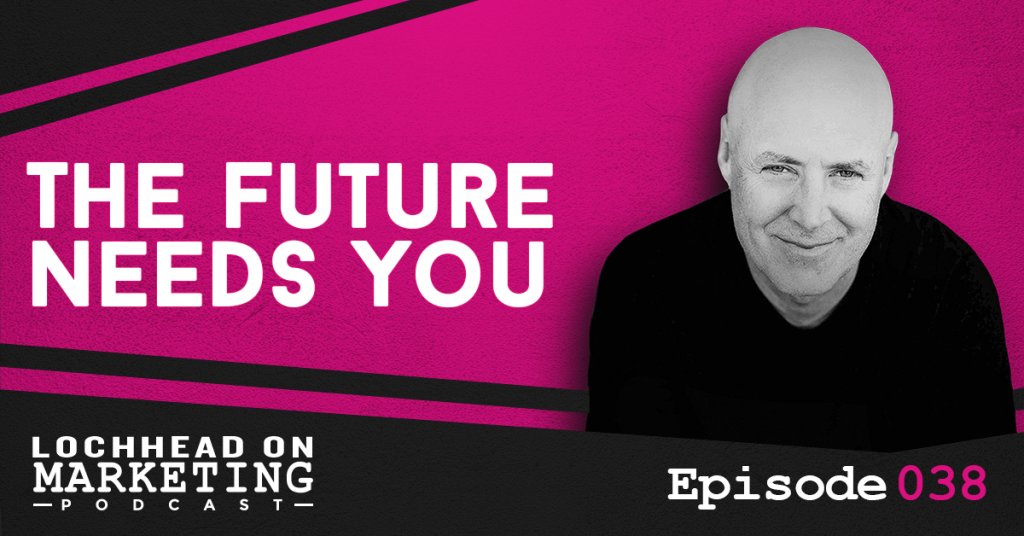
038 The Future Needs You
Podcast (lochheadonmarketing): Play in new window | Download (Duration: 7:11 — 4.9MB) | Embed
Subscribe: Apple Podcasts | Spotify | RSS | More
Today, let’s talk about why the future needs you and frankly, why the future needs some legendary marketing. Entrepreneurs, pay attention to this episode because the future needs you and your innovations to move the human race forward.
Going Back To How It Was
We hear a lot of discussion about how the business people plan to reopen businesses and how the entire workforce will get back to work. Christopher candidly gives his viewpoint for this: there is no going back to how it was before.
“I think frankly, there is nothing to go back to. It’s not about going back to work, it is about creating the future and I think that is where legendary marketing comes in.” – Christopher Lochhead
What Greatest Marketers Do
Christopher says the greatest marketers over time are the ones who move the world from the way it is now, to the way they want it to be. Further, he shares that legendary marketing is about making an exponential difference as opposed to creating an incremental change.
“I think we are witnessing the very beginning of the creation of a new future. Much is going to be different as we move forward. Work, the way we knew it, is different, Society, the way we knew it is different. I think people’s priorities are going to shift. I think what they value is going to shift. I think, therefore, what they are interested in buying is going to shift.” – Christopher Lochhead
The Power of Entrepreneurship
As a strong believer in the power of entrepreneurship and innovation to move the human race forward Christopher shares that most legendary marketers in the world have done exceptional work in doing exactly that.
“I think as we come out of this crisis there is a chance that we will begin to see the emergence of a whole new set of technologies, services, products and categories that design a more human future, frankly, a world that works for more of us, in a way that it never did before.” – Christopher Lochhead
To hear more about Why The Future Needs You and more information about Christopher, download and listen to this episode.
Bio:
Christopher Lochhead is a #1 Apple podcaster and #1 Amazon bestselling co-author of books: Niche Down and Play Bigger.
He has been an advisor to over 50 venture-backed startups; a former three-time Silicon Valley public company CMO and an entrepreneur.
Furthermore, he has been called “one of the best minds in marketing” by The Marketing Journal, a “Human Exclamation Point” by Fast Company, a “quasar” by NBA legend Bill Walton and “off-putting to some” by The Economist.
In addition, he served as a chief marketing officer of software juggernaut Mercury Interactive. Hewlett-Packard acquired the company in 2006, for $4.5 billion.
He also co-founded the marketing consulting firm LOCHHEAD; was the founding CMO of Internet consulting firm Scient, and served as head of marketing at the CRM software firm Vantive.
We hope you enjoyed this episode of Lochhead on Marketing™! Christopher loves hearing from his listeners. Feel free to email him, connect on Facebook, Twitter,Instagram and subscribe on iTunes! You may also subscribe to his newsletter,The Difference, for some amazing content.
