
Posts by Christopher Lochhead
050 How to Discover a New Category| Marketing PodStorm #12
Podcast (lochheadonmarketing): Play in new window | Download (Duration: 8:29 — 5.8MB) | Embed
Subscribe: Apple Podcasts | Spotify | RSS | More
In this episode of the PodStorm. let’s talk about how to discover a category, create massive differentiation, and build a super valuable company, particularly in challenging times.
Designed, Not Discovered
Christopher gets all sorts of questions such as “how do I know if I have a category?” “I think I might have something, how do I discover a category?” “How do I know if this is a new category?” “How do I redesign an existing category, etc.” The first thing Christopher shares to us is: categories are not discovered.
“They are created, they are designed and legendary entrepreneurs, legendary marketers, legendary innovators, teach the world how to see things the way they do. And so that category is not discovered like a new piece of land. It’s created, you’re bringing something new forward.” – Christopher Lochhead
Future of Our Choosing
Christopher points out that designing a market category is like choosing the future. Legendary marketers are like visitors from the future, moving the market into a certain point of view they choose, in order to solve a certain problem,
“The first thing I’d point you to, is, what is it the insight that you’re differentiating on? What’s what we call missing in the market category that you see? And sometimes that missing is giant, we discover some kind of plutonium of sorts.” – Christopher Lochhead
Technical and Market Insights
In the book Play Bigger, Christopher wrote about his learnings from Anne Miura-ko, Co-founder of Floodgate Capital. He gives out examples to identify and differentiate the types of insights.
“What Anne says essentially is that there are two kinds of insight: there’s a market insight where you see a missing in a market and there’s a technical or innovation insight.” – Christopher Lochhead
After identifying what kind of insight you have, Christopher advises that you must be able to explain the problem you are solving to a three-year-old.
“Because clarity of focus, clarity of thinking, clarity of language, is critical if you’re going to do pretty much anything legendary.” — Christopher Lochhead
To know more about how to discover and design a category, download and listen to this episode.
Bio:
Christopher Lochhead is a #1 Apple podcaster and #1 Amazon bestselling co-author of books: Niche Down and Play Bigger.
He has been an advisor to over 50 venture-backed startups; a former three-time Silicon Valley public company CMO and an entrepreneur.
Furthermore, he has been called “one of the best minds in marketing” by The Marketing Journal, a “Human Exclamation Point” by Fast Company, a “quasar” by NBA legend Bill Walton and “off-putting to some” by The Economist.
In addition, he served as a chief marketing officer of software juggernaut Mercury Interactive. Hewlett-Packard acquired the company in 2006, for $4.5 billion.
He also co-founded the marketing consulting firm LOCHHEAD; was the founding CMO of Internet consulting firm Scient, and served as head of marketing at the CRM software firm Vantive.
We hope you enjoyed this episode of Lochhead on Marketing™! Christopher loves hearing from his listeners. Feel free to email him, connect on Facebook, Twitter, Instagram, and subscribe on iTunes! You may also subscribe to his newsletter, The Difference, for some amazing content.
049 Do A Marketing Stunt | Marketing PodStorm #11
Podcast (lochheadonmarketing): Play in new window | Download (Duration: 8:23 — 5.8MB) | Embed
Subscribe: Apple Podcasts | Spotify | RSS | More
In this episode, let’s talk about the power of a well-timed stunt to gain attention, rise above the noise, and drive revenue. This is how we get our creative juices flowing. Do something that is maybe a little provocative, maybe a little risque. It should be designed to get a lot of attention, and maybe even drive some PR.
Black Friday Sale, Not!
Christopher shares about different brands and their provocative stunts. Max Temkin, founder of the Cards Against Humanity appeared on Follow Your Different Episode 60. Max and his team probably are the masters in terms of marketing stunts when they jacked up their prices, on Black Friday Sale.
“As a way of sort of doing the opposite of what every B2C company and brand does — and as a way of sort of calling bs on consumerism — they increased the price of Cards Against Humanity on Black Friday, and got a ton of PR for it. People thought it was hysterical. They paid the price. They stood out.” – Christopher Lochhead
Sponsoring The Golden Gate Bridge
CarsDirect.Com also pulled off one legendary stunt when they sent out press releases about their proposal to sponsor the Golden Gate Bridge. This press release stirred up a lot of controversies and reaction from the media, but they still ended up getting a lot of publicity for it.
“Now notice, they put forward a proposal, it wasn’t actually happening. By putting that press release out, they caused a tremendous amount of controversy.” – Christopher Lochhead
Aliens Will Eat Fat People First
Another marketing stunt that got into a lot of controversies is the Ad of 24 Hour Fitness featuring an alien and caption that says, “when they come, they’ll eat the fat ones first.”
“Their CEO is interviewed on the news. And he was talking about how they’re just trying to have fun and shine a light on obesity and that people need to get fit and healthy and the like. And a lot of people were upset and there was all this kerfuffle again, but what were they talking about? 24 Hour Fitness.” – Christopher Lochhead
Christopher encourages companies to be provocative, be thoughtful be potentially willing to piss some people off (depending on your brand).
To hear more about doing a marketing stunt, download and listen to this episode.
Bio:
Christopher Lochhead is a #1 Apple podcaster and #1 Amazon bestselling co-author of books: Niche Down and Play Bigger.
He has been an advisor to over 50 venture-backed startups; a former three-time Silicon Valley public company CMO and an entrepreneur.
Furthermore, he has been called “one of the best minds in marketing” by The Marketing Journal, a “Human Exclamation Point” by Fast Company, a “quasar” by NBA legend Bill Walton and “off-putting to some” by The Economist.
In addition, he served as a chief marketing officer of software juggernaut Mercury Interactive. Hewlett-Packard acquired the company in 2006, for $4.5 billion.
He also co-founded the marketing consulting firm LOCHHEAD; was the founding CMO of Internet consulting firm Scient, and served as head of marketing at the CRM software firm Vantive.
Links:
Follow Your Different Episode 60 – Max Temkin
Times Cards Against Humanity Pulled Amazing Publicity Stunts
Our Favorite Crazy Stunts From Salesforce Leader Marc Benioff
WKRP In Cincinnati – Turkey Drop Scene
We hope you enjoyed this episode of Lochhead on Marketing™! Christopher loves hearing from his listeners. Feel free to email him, connect on Facebook, Twitter, Instagram, and subscribe on iTunes! You may also subscribe to his newsletter, The Difference, for some amazing content.
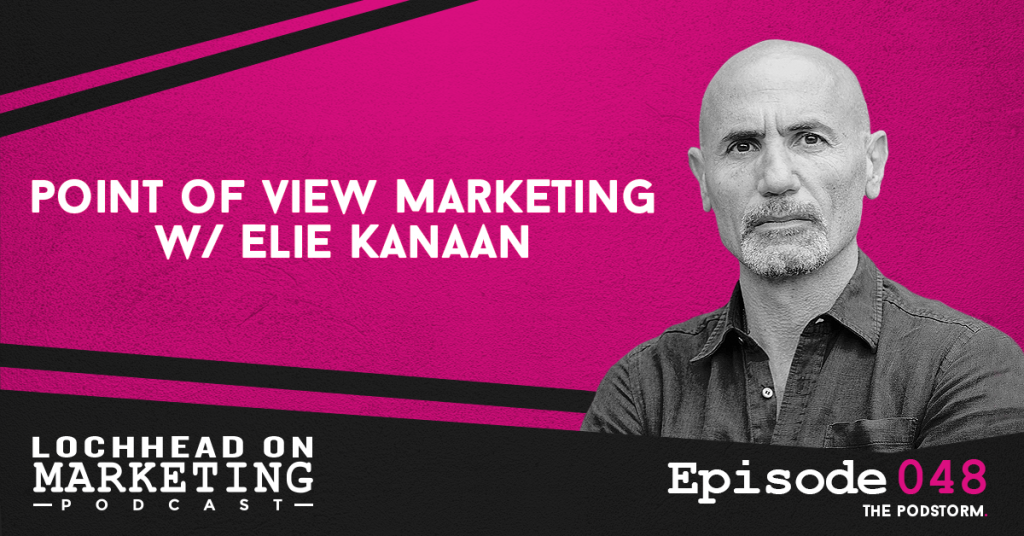
048 How to Market with a Powerful Point of View | Marketing PodStorm #10
Podcast (lochheadonmarketing): Play in new window | Download (Duration: 31:53 — 21.9MB) | Embed
Subscribe: Apple Podcasts | Spotify | RSS | More
In today’s PodStorm episode, let’s go deep on how to market with a powerful point of view. POVs can be viewed as a mechanism for distinguishing your brand and most importantly, to design and dominate your market category. As wacky as it might sound, downturns can be very powerful times to do exactly that.
To discuss this in more detail, we invited Elie Kanaan. He is one of the most talented CMOS and category designers, who now works as the Head of Marketing for Ogury Europe.
One Big Challenge
Eli believes marketing a provocative POV is one of the biggest challenges any leader faces. Aside from marketing a POV, you must also know how to turn that POV into results. He says that a powerful POV starts with the CEO and CMOs should be fully supportive of it.
“I believe there are three different journeys that need to happen within the company that is led by the standard CEO, CMO. First, there’s a product transformation journey. Then, there’s a marketing transformation journey and there is a sales transformation journey. So for that, the CEO and the CMO needs to get on board, the Chief Product Officer, the Chief Technology Officer, and the Chief Revenue Officer. So those would be secondary, but equally important when it comes to execution.” – Elie Kanaan
Bringing Everyone Onboard
In presenting a POV, you need to do remember that everyone must believe and understand, your idea with bring good money to the company. Once this is defined, everybody on the board sees the light aka your powerful POV.
Aside from this, a POV becomes a strategy for the whole company and not some mere marketing message or tactic that you employ for a limited time period. A POV is a fixed lens where a company looks into a problem.
“When we declare a point of view, and we’re evangelizing a problem, that’s something that doesn’t really change. That’s it. That’s a vision, right? This distinction between a point of view that really points to a true north North, ‘what’s the mission’ or on ‘what’s the problem we’re solving?’ ‘Why should customers care’ ‘Why is this thing a new opportunity’ ‘Why is this thing, a new way of thinking about something that’s gonna make a difference for customers?’ As opposed to a message called, ‘hey, this month only buy one, get one free, right?’ That’s a message.” – Christopher Lochhead
Different Is Non-Negotiable
The next thing to do is: you have to convince everyone that your idea is different. Unique is different and hard to copy, but oftentimes, leaders confuse being different to what Eli and Christopher call as a “better drop.”
“Our minds have been molded into having a better conversation all the time because of alI the shitty marketing that happened before. I mean, there’s some good marketing that happened, but a lot of the marketing is better. This is one of the biggest pitfalls in creating the category — either on the marketing side or the product or the sales side. The Product Team wants to do better products, the Sales want to sell better features, Marketing have better value propositions. /you know, we always set it together actually, is that better is negotiable. Different isn’t.” – Elie Kanaan
To learn more about how to market a powerful and provocative point of view, download and listen to this episode.
Bio:
Elie, is an engineering mind coupled with a passion for human psychology. His life, career and interests have been a direct consequence of these two attributes.
After graduating from Stanford University with a Master in Computer Sciences, he started his career as a developer at Oracle, when Oracle was a small company.
Quickly he realized that his calling was in creating and building market categories, mostly with category kings: Client/Server Database (Oracle/Sybase), Business Technology Optimisation (Mercury), Business Intelligence (Business Objects), Enterprise Resource Planning (SAP), and Virtualization (VMware).
Elie is now working as a CMO for Ogury, helping them design their category and dominate it.
On a more personal level, Elie was born in Ivory Coast in Africa, grew up in Lebanon, studied and worked in California, married with an Ukrainian woman, lived in Belgium, and now living in Paris, with the loves of his life, his wife Vlada and their three sons, Ezekiel, Eyal, and Eliya.
Elie is a philosopher at heart. He has a deep and meaningful quote or story for every situation drawn from his multi-cultural background and household.
Links:
We hope you enjoyed this episode of Lochhead on Marketing™! Christopher loves hearing from his listeners. Feel free to email him, connect on Facebook, Twitter, Instagram, and subscribe on iTunes! You may also subscribe to his newsletter, The Difference, for some amazing content
047 We’re in a cocoon | Marketing PodStorm #9
Podcast (lochheadonmarketing): Play in new window | Download (Duration: 9:04 — 6.2MB) | Embed
Subscribe: Apple Podcasts | Spotify | RSS | More
It appears that we are in a great time of transition. There is that “before February” and then there is “whatever comes after Coronavirus.” The present moment seems like we’re in a cocoon. We are at a cocoon time — an incredible in-between zone — where, in business sense, there is a good chance to have massive winners and horrible losers.
Let’s talk about the mindset required to become one of those massive winners.
There’s No “Going Back”
We hear a lot of talk in the media, about opening back the economy and “going back to work.” Christopher strongly believes there is no “going back” to whatever we had, pre-coronavirus. We are currently live in a cocoon and we are facing a lot of changes in terms of how we do work
“I think what’s going on here is that almost every part of the way that we live, play and work has the potential, the strong potential to be materially different as result of C-19. I think there are megatrends that were going on anyway that are being materially accelerated,” – Christopher Lochhead
The most obvious change is a distance working or working from home. Another industry facing a massive change in the food industry and the supply chain.
What’s Likely To Be Different?
Christopher encourages you to think about every major component of your work and personal life and consider, what is likely to be different.
“You see, there are two headsets out there. There’s a strategic mindset of people who say ‘well I’m going to bet on the world, being the same’ and ‘look, maybe somethings are the same.’ Then, there’s another headset that says, ‘we think the world is going to be different.” – Christopher Lochhead
Christopher believes there is an acceleration of different niches, which he also calls a Nichenado, an explosion of new innovation, of new categories of new niches.
What About Those Differences?
Christopher challenges you to ask yourself what you can do to ensure you can design and dominate your market category in the future. He further shares the concept of “backcasting” (as opposed to forecasting) which is a concept of Mike Maples of FloodGate Capital. You can listen to him on Follow Your Different Episode 163.
“What were the opportunities? What were the problems created or accelerated by C-19 and how can we be a part of solving them? Most importantly, how do you create the future of your choosing?” – Christopher Lochhead
To know more about why we live in a cocoon and how we can create the future of our choosing, download, and listen to this episode.
Bio:
Christopher Lochhead is a #1 Apple podcaster and #1 Amazon bestselling co-author of books: Niche Down and Play Bigger.
He has been an advisor to over 50 venture-backed startups; a former three-time Silicon Valley public company CMO and an entrepreneur.
Furthermore, he has been called “one of the best minds in marketing” by The Marketing Journal, a “Human Exclamation Point” by Fast Company, a “quasar” by NBA legend Bill Walton and “off-putting to some” by The Economist.
In addition, he served as a chief marketing officer of software juggernaut Mercury Interactive. Hewlett-Packard acquired the company in 2006, for $4.5 billion.
He also co-founded the marketing consulting firm LOCHHEAD; was the founding CMO of Internet consulting firm Scient, and served as head of marketing at the CRM software firm Vantive.
We hope you enjoyed this episode of Lochhead on Marketing™! Christopher loves hearing from his listeners. Feel free to email him, connect on Facebook, Twitter, Instagram, and subscribe on iTunes! You may also subscribe to his newsletter, The Difference, for some amazing content.
046 Don’t stand in front of an empty fire place & expect it to be hot | Marketing PodStorm #8
Podcast (lochheadonmarketing): Play in new window | Download (Duration: 7:04 — 4.8MB) | Embed
Subscribe: Apple Podcasts | Spotify | RSS | More
Today on our Marketing PodStorm, let’s talk about why standing in front of an empty fireplace expecting it to be hot is kind of dumb. You see, oftentimes, CEOs, CFOs, and even CMOs cut down marketing during a downturn.
Marketing In Desperate Times
We understand that some of our business is in a situation where budget cuts are needed to ensure survival. However, Christopher points out that it is not one of the wisest moves to cut down the marketing budget, especially in times that you need income.
“Decreasing marketing investments at a time when you desperately need revenue is like a person who’s freezing, standing in front of an empty fireplace, saying ‘gee, I wonder when this thing is going to get hot?’” – Christopher Lochhead
The Worst Thing To Do
Probably the worst thing that you can do in a downturn is to make your category and brand disappear. This is the time when you have to make your company visible, because the more visible you are, the more people will assume your company is doing great, thus, buy from you more.
“I understand many of us, have to make some cut. Be careful, if you weed-wack too much marketing, you won’t just cut your weed, you’ll cut all your grass. You want to be visible now. You have to find smart, creative ways to make your category and brand super visible now.” – Christopher Lochhead
Customers Buy From Brand Leaders
Marketing in a downturn creates the perception that your business is strong. It establishes dominance and assurance that you will be here for the long haul. The consistent marketing will create “the fear of missing out” among consumers, which drives sales.
“People want to buy from category queens and kings, from category and market leaders.” – Christopher Lochhead
Christopher further cites some articles from Harvard Business Review and comments on the big market budget cuts of huge corporations, like Google. He discusses more why he thinks it is a bad idea to do such.
To know more about marketing during a downturn, download and listen to this episode.
Bio:
Christopher Lochhead is a #1 Apple podcaster and #1 Amazon bestselling co-author of books: Niche Down and Play Bigger.
He has been an advisor to over 50 venture-backed startups; a former three-time Silicon Valley public company CMO and an entrepreneur.
Furthermore, he has been called “one of the best minds in marketing” by The Marketing Journal, a “Human Exclamation Point” by Fast Company, a “quasar” by NBA legend Bill Walton and “off-putting to some” by The Economist.
In addition, he served as a chief marketing officer of software juggernaut Mercury Interactive. Hewlett-Packard acquired the company in 2006, for $4.5 billion.
He also co-founded the marketing consulting firm LOCHHEAD; was the founding CMO of Internet consulting firm Scient, and served as head of marketing at the CRM software firm Vantive.
We hope you enjoyed this episode of Lochhead on Marketing™! Christopher loves hearing from his listeners. Feel free to email him, connect on Facebook, Twitter, Instagram, and subscribe on iTunes! You may also subscribe to his newsletter, The Difference, for some amazing content.
163 How to build a breakthrough | Mike Maples, Jr. Floodgate Capital
Podcast: Play in new window | Download (Duration: 1:31:07 — 62.6MB) | Embed
Subscribe: Apple Podcasts | Spotify | Pandora | RSS | More
Today, the 1st in a two-part series on entrepreneurship, we have entrepreneur, Co-Founder of FloodGate and host of “Starting Greatness” Mike Maples, Jr. He recently wrote “How to build a breakthrough: the secret of back-casting” and we’re going to go deep on it today!
Watch out for our next episode, we’re having founder/CEOs Osman Rashid. He started $8B, publicly-traded Chegg and now Convo.com.
Status of Silicon Valley
Christopher and Mike starts their discussion about the state of Silicon Valley. Both agreed that most of Silicon Valley companies are the first adopters of sheltering in place and work from home arrangements. It has definitely benefitted some companies who have adjusted early on.
However, they also Mike also describes this coronavirus pandemic as a “hand of God” who “punished” some companies and catapulted some to success.
“I’ve never really seen a situation where you have a tale of two types of businesses. Most recessions, they affect some worse than others, but they affect everybody badly to some degree. Whereas what we’re seeing in this one is: it’s almost like a lot of things that were already starting to gather, got accelerated forward — telemedicine, remote distributed work, distance learning, remote work infrastructure. So you could make the case that this has had a dramatic impact in both directions ironically.” – Mike Maples Jr.
Moving Forward By Looking Backward
Mike recently created an interesting piece about moving forward by looking backward. He mentions that the future doesn’t happen to us. It happens because of us. He further explains why he wrote the piece and how it can help entrepreneurs plan their future.
“Great founders design the future. Design is the right word. It’s not just about drawings or how things look or even how they function or perform. It’s about people with a determined idea of what a better future should be. Not only building that better future, but convincing people in the present to change the trajectory, that they’re on.” – Mike Maples Jr.
Create A Movement To Move A Market
For Mike, entrepreneurs don’t discover markets. They create movements that become markets. They move people to their point of view and they move people from the present to a better future.
“I thought it might be useful to try to help entrepreneurs get some lessons that I’d received from some of the super performers that I’ve worked with on how do you build a breakthrough. I’ve spent a lot of time over the years trying to deconstruct what they do and how it’s different from what normal startups look like. That is why I wrote this post on backcasting.” – Mike Maples Jr.
To know more about how backcasting can help you design the future that you want and for more information about Mike, download and listen to this episode.
Bio:
Mike Maples, Jr is a Partner at Floodgate. He has been on the Forbes Midas List since 2010 and was also named one of “8 Rising Stars” by FORTUNE Magazine.
Before becoming a full-time investor, Mike was involved as a founder and operating executive at back-to-back startup IPOs, including Tivoli Systems (IPO TIVS, acquired by IBM) and Motive (IPO MOTV, acquired by Alcatel-Lucent.)
Some of Mike’s investments include Twitter, Twitch.tv, ngmoco, Weebly, Chegg, Bazaarvoice, Spiceworks, Okta, and Demandforce.
Mike is known for coining the term “Thunder Lizards,” which is a metaphor derived from Godzilla that describes the tiny number of truly exceptional companies that are wildly disruptive capitalist mutations. Mike likes to think of himself as a hunter of the “atomic eggs” that beget these companies.
Interests: Calligraphy, cinematography, and sporting clays.
Links:
How to build a breakthrough, Medium
We hope you enjoyed this episode of Follow Your Different™! Christopher loves hearing from his listeners. Feel free to email him, connect on Facebook, Twitter, Instagram and subscribe on iTunes!
045 Questions and Cocktails: Facebook Live Q & A (Part 2) | Marketing PodStorm #7
Podcast (lochheadonmarketing): Play in new window | Download (Duration: 21:45 — 14.9MB) | Embed
Subscribe: Apple Podcasts | Spotify | RSS | More
During the PodStorm, were doing a live Facebook Question and Answer session, every Friday, 11:30 a.m. PST. Here is the second part of our recording, for Q&A about marketing and category design. We talk about all things ranging from new category creation, how to craft problems positively, and creating demand during a crisis.
How to know if you have a new category?
As counterintuitive as it might sound, now is a great time to launch a new category. Christopher encourages you to ask yourself a couple of key questions: number 1, “what problem do I solve?” or “do I solve that in a different or unique way?” and “What kind of market insights do you have?” If you don’t think of it as a problem, maybe you create an opportunity.
“Nobody buys a solution unless they see a problem. You might consider asking what kind of insights do you have. One is technical insight. Somebody creates a new algorithm or somebody creates hardware. Another one is Market Insight, for example, ‘I want to be able to hire somebody to do an odd job, takes something from point a to point b, come over and help me with something.’ Do you have a technical insight or do you have a market insight? Regardless of what it is, begin to evangelize that insight, that difference.” – Christopher Lochhead
How do you talk about problems in a positive way?
Evangelizing a problem in a positive way can lead to mass differentiation and category creation. Christopher advises legendary marketers to frame the problem as deeply relatable. This way, we want to be seen as a hero, mobilizing people to come together to solve said problem.
“Here’s what I’ve learned, what you want to do in the way you talk about problems is, do it such that you create ‘us.’ You make the problem an enemy, a ‘them.’ You want to define the problem very powerfully, in a way that resonates with people, and then you say, this aggression will not stand, man.” – Christopher Lochhead
How do you create demand in a situation where your revenue is dropping?
Christopher chides that this is one tough question. We know many companies are having this problem. He drops a bunch of ideas that although might not exactly answer this question, but hopefully might stimulate some thinking.
“The first idea, take a handful of your smartest people and lock them and brainstorm 3-5 things that you go near term to stimulate revenue. If you are in the B2B space, create a white space analysis. What you do, you take your existing customer base, do a quick analysis to find out which of your products and services they are currently using. Once you know what they are using, then you immediately target existing customers. If you’re in the B2C, be visible in your neighborhood.” – Christopher Lochhead
To hear more about the Facebook live Q&A session (Part 2) with Christopher Lochhead, download and listen to this episode.
Bio:
Christopher Lochhead is a #1 Apple podcaster and #1 Amazon bestselling co-author of books: Niche Down and Play Bigger.
He has been an advisor to over 50 venture-backed startups; a former three-time Silicon Valley public company CMO and an entrepreneur.
Furthermore, he has been called “one of the best minds in marketing” by The Marketing Journal, a “Human Exclamation Point” by Fast Company, a “quasar” by NBA legend Bill Walton and “off-putting to some” by The Economist.
In addition, he served as a chief marketing officer of software juggernaut Mercury Interactive. Hewlett-Packard acquired the company in 2006, for $4.5 billion.
He also co-founded the marketing consulting firm LOCHHEAD; was the founding CMO of Internet consulting firm Scient, and served as head of marketing at the CRM software firm Vantive.
We hope you enjoyed this episode of Lochhead on Marketing™! Christopher loves hearing from his listeners. Feel free to email him, connect on Facebook, Twitter, Instagram and subscribe on iTunes! You may also subscribe to his newsletter, The Difference, for some amazing content.
044 Questions and Cocktails: Facebook Live Q & A (Part 1) | Marketing PodStorm #6
Podcast (lochheadonmarketing): Play in new window | Download (Duration: 17:37 — 12.1MB) | Embed
Subscribe: Apple Podcasts | Spotify | RSS | More
During the PodStorm, were doing a live Facebook Question and Answer session, every Friday, 11:30 a.m. PST. We did our first one, we’re going to share it with you in two parts. We talk about CEOs who don’t get marketing, the relationship between CMOs and CEOs during times of crisis, and more about evangelizing the brand.
What do I do if my CEO doesn’t get it about marketing?
Christopher shares that very little happens without legendary marketing. He stresses the difference of working on something exponential versus something that is incremental. In marketing terms, the more exponential it is, the more explanation it requires. In that situation, that’s called legendary marketing or category design.
“If your CEO, doesn’t get it, QUIT. If your CEO doesn’t get it about marketing and isn’t willing to be a leader, isn’t willing to get out in front and be the company designing and dominating the category and if you cant get your CEO there pretty quickly, its time to get out and go.” – Christopher Lochhead
What relationship should a CMO and a CEO have, particularly during a recession?
Christopher says that CMO is like the Press Secretary for the President of the United States. He shares quite a few examples, being three times CMO himself who sat in that position during a crisis.
“Strategic communication frames the context for everything that is going on in a company. If the CEO and CMO aren’t working in lockstep, then framing that strategic context is not going to work very well.” – Christopher Lochhead
Tell me more about evangelizing the category
Most companies have overrotated on brand. The marketing world have oftentimes marketed their brands and not necessarily their categories. He points out that in times like this, companies do not just fight over market share, they fight over a minimizing wallet share.
“Look, I’m a 3x CMO, I think branding is important. However, categories are about customers. When we talk all the time about brands, it is equivalent to a dinner party and talking all about yourself, as opposed to talking about others. Categories, fundamentally are about problems, or opportunities, being experienced by others. That is point A. Point B: with categories, it is the way the human brain works. We first understand the category is, then we start thinking about brands. Hierarchy. Our brain works on, category, subcategory and then brand. For example, drink, whiskey, brand. In other words, if I’m not interested in the category, then I’m not going to be interested in the brand.” – Christopher Lochhead
To hear more about the Facebook live Q&A session (Part 1) with Christopher Lochhead, download and listen to this episode.
Bio:
Christopher Lochhead is a #1 Apple podcaster and #1 Amazon bestselling co-author of books: Niche Down and Play Bigger.
He has been an advisor to over 50 venture-backed startups; a former three-time Silicon Valley public company CMO and an entrepreneur.
Furthermore, he has been called “one of the best minds in marketing” by The Marketing Journal, a “Human Exclamation Point” by Fast Company, a “quasar” by NBA legend Bill Walton and “off-putting to some” by The Economist.
In addition, he served as a chief marketing officer of software juggernaut Mercury Interactive. Hewlett-Packard acquired the company in 2006, for $4.5 billion.
He also co-founded the marketing consulting firm LOCHHEAD; was the founding CMO of Internet consulting firm Scient, and served as head of marketing at the CRM software firm Vantive.
We hope you enjoyed this episode of Lochhead on Marketing™! Christopher loves hearing from his listeners. Feel free to email him, connect on Facebook, Twitter, Instagram and subscribe on iTunes! You may also subscribe to his newsletter, The Difference, for some amazing content.
043 Drive Revenue Now | Marketing PodStorm #5
Podcast (lochheadonmarketing): Play in new window | Download (Duration: 8:06 — 5.6MB) | Embed
Subscribe: Apple Podcasts | Spotify | RSS | More
Welcome to Lochhead on Marketing, where we are trying the first world’s Marketing PodStorm — 30 days of strategies and ideas to help you create the future that you want because we believe that nothing legendary is going to happen, at any kind of scale, without legendary marketing.
Today, let’s talk about a few, very simple ideas that can help drive revenue for both B2C companies and B2B companies.
Get Radically Visible
As we are trying to come back and slowly opening up the economy, Christopher encourages B2C companies to get radically visible in their communities.
“The way to do that is to be thoughtfully aggressive and radically generous. A couple of ideas, sponsor some shit, food bank fundraiser, any kind of charity fundraiser. Be associated with helping to make good things happen in your community in a way that is very generous and that let’s people know you are back in business.” – Christopher Lochhead
Get Practical and Tactical
On the B2B side, Christopher shares similar, simple thoughts. He encourages B2B professionals to go back to the old school: cold calling and cold emailing.
“If you are in the B2B space, I highly recommend you get on a named account model because, we could do a whole podcast on it, but the net of this is, when you are on a named account model, your salespeople and your marketing people know exactly who to go after, especially in this case, we’re trying to drive revenue now.” – Christopher Lochhead
Final Advice
Christopher gives out clear examples of what you can do for your business at this time, whether you are in B2B or B2C. He shares that there are potential buyer avatars out there that are willing to drive revenues for your company.
“Reach out and touch ‘em. Try to do something creative and something radically generous to get their attention and hopefully set up some phone calls.” – Christopher Lochhead
Bio:
Christopher Lochhead is a #1 Apple podcaster and #1 Amazon bestselling co-author of books: Niche Down and Play Bigger.
He has been an advisor to over 50 venture-backed startups; a former three-time Silicon Valley public company CMO and an entrepreneur.
Furthermore, he has been called “one of the best minds in marketing” by The Marketing Journal, a “Human Exclamation Point” by Fast Company, a “quasar” by NBA legend Bill Walton and “off-putting to some” by The Economist.
In addition, he served as a chief marketing officer of software juggernaut Mercury Interactive. Hewlett-Packard acquired the company in 2006, for $4.5 billion.
He also co-founded the marketing consulting firm LOCHHEAD; was the founding CMO of Internet consulting firm Scient, and served as head of marketing at the CRM software firm Vantive.
We hope you enjoyed this episode of Lochhead on Marketing™! Christopher loves hearing from his listeners. Feel free to email him, connect on Facebook, Twitter, Instagram, and subscribe on iTunes! You may also subscribe to his newsletter, The Difference, for some amazing content.
Gain the visibility and control you need in your business: https://netsuite.com/different
Turn data into doing: https://splunk.com/d2e
