
Lochhead on Marketing
142 Marketing’s Job Is NOT Serving Internal Customers
Podcast (lochheadonmarketing): Play in new window | Download (Duration: 13:45 — 9.4MB) | Embed
Subscribe: Apple Podcasts | Spotify | RSS | More
On this episode, let’s talk about one of the things that drives me the craziest and more importantly, ruins marketing results and careers on a regular basis. That is, why marketing’s job is NOT serving internal customers.
Speaking of which, I want to thank you from the bottom of my heart for making our new books into bestsellers at Amazon Books. You can check the whole list Category Pirates mini-books at Amazon Books, and expect more in the near future!
Welcome to Lochhead on Marketing. The number one charting marketing podcast for marketers, category designers, and entrepreneurs with a different mind.
The Concept of Internal Customers is Dumb
The idea of an Internal Customer is dumb. Listen to it: Internal Customer. First of all, what does a customer do that an internal department or “internal customer” doesn’t? That’s right, customers actually pay you money.
Companies who are so internally focused and direct marketing inwardly, that they are confused as to what it should be targeting is a company destined for disaster.
So point number one is this:
“There is only one customer, and those are your actual customers.” – Christopher Lochhead
You can put whatever modifier in front of customer you want, but customers or consumers and putting a stupid modifier in front of them is well, frankly stupid.
What Marketing should be doing
That said, what really is marketing?
Firstly, Marketing is a leadership function. Its job is to lead the company, lead the category and ultimately design and dominate a legendary category that matters around solving problems or creating opportunities for customers.
Second, marketing organizations often get trapped in this feeling of being an internal service bureau. That’s ridiculous. Marketing is no is no more of a internal service function than finance than engineering or products. d in this being of being an internal service bureau. HR is not a service function either. It’s a leadership function.
So the first thing to understand is marketing is a leadership function, whose job is to partner with the rest of the organization in creating, designing, and dominating a market category that makes a giant difference for customers who pay us money.
How Marketing works within the Organization
Now, what does that mean for how marketing works within the organization? You do it as leaders, as you partner with other leaders.
So is Sales Enablement important? Yes, of course it’s important. As a marketing leader, we want the sales organization to love us. Are there a certain set of things that we want to deliver to sales to help them be successful in their job? Of course, there are. But we’re not order takers, we’re leaders. And we’re partners. We’re in a co creation relationship.
You’re in the business of co-creating a legendary relationship. Are there some service elements of that? Sure, there are. But that is not the primary paradigm, the primary paradigm is a co-creation relationship.
That’s the relationship marketing wants to have with sales, that is to say, both of which should get together and say, what are our objectives for the year for the quarter for the month? How do we partner together to produce legendary revenue with the exact kind of customers that we want? So in that regard, marketing and sales work together, hand in glove.
To hear more on how Marketing should be done in your business, download and listen to this episode.
Bio
Christopher Lochhead is a #1 Apple podcaster and #1 Amazon bestselling co-author of books: Niche Down and Play Bigger.
He has been an advisor to over 50 venture-backed startups; a former three-time Silicon Valley public company CMO and an entrepreneur.
Furthermore, he has been called “one of the best minds in marketing” by The Marketing Journal, a “Human Exclamation Point” by Fast Company, a “quasar” by NBA legend Bill Walton and “off-putting to some” by The Economist.
In addition, he served as a chief marketing officer of software juggernaut Mercury Interactive. Hewlett-Packard acquired the company in 2006, for $4.5 billion.
He also co-founded the marketing consulting firm LOCHHEAD; the founding CMO of Internet consulting firm Scient, and served as head of marketing at the CRM software firm Vantive.
We hope you enjoyed this episode of Lochhead on Marketing™! Christopher loves hearing from his listeners. Feel free to email him, connect on Facebook, Twitter, Instagram, and subscribe on iTunes!
141 Why Most Marketing Fails, and what CEOs and CMOs need to know to fix it
Podcast (lochheadonmarketing): Play in new window | Download (Duration: 8:30 — 5.8MB) | Embed
Subscribe: Apple Podcasts | Spotify | RSS | More
On this episode, let’s talk about why most marketing fails, and what we can do about it.
Speaking of marketing, I want to thank you from the bottom of my heart for making our new books into bestsellers at Amazon Books. You can check the whole list Category Pirates mini-books at Amazon Books, and expect more in the near future!
Welcome to Lochhead on Marketing. The number one charting marketing podcast for marketers, category designers, and entrepreneurs with a different mind.
The Marketing Folklore
When most people say marketing, they usually have a preconceived notion to what it is. That is, to compete for an existing demand with a better product and a better brand in an existing market category.
The reason most people think like this is that it is what is taught in business schools and MBAs. That’s what is said a lot in marketing books and the like. So it has become a belief, almost a folklore, that things should be done as such.
Competing for Leftovers
The problem with this line of thinking is that it’s a very bad idea.
We did a data science project published in the HBr, as well as in our newsletter Category Pirates, and discovered something fascinating. We found that in tech categories, on average, the category king or queen wins 76% of the total value created, as measured by market cap in the entire category.
This means, if you’re not doing category design, you’re playing in someone else’s category. When somebody says marketing, what they’re really saying is, we are going to fight for the remaining 24% of the value.
The issue now is that most companies don’t realize that they’re only fighting for a small piece of the pie.
“Because the vast majority of marketers don’t know that that’s what they’re doing. When they hear the word marketing, they make an unconscious, undiscussed unanalyzed choice to compete in a category designed by somebody else, which only allows for 24% of the value.
And that is why most marketing fails.” – Christopher Lochhead
Bio
Christopher Lochhead is a #1 Apple podcaster and #1 Amazon bestselling co-author of books: Niche Down and Play Bigger.
He has been an advisor to over 50 venture-backed startups; a former three-time Silicon Valley public company CMO and an entrepreneur.
Furthermore, he has been called “one of the best minds in marketing” by The Marketing Journal, a “Human Exclamation Point” by Fast Company, a “quasar” by NBA legend Bill Walton and “off-putting to some” by The Economist.
In addition, he served as a chief marketing officer of software juggernaut Mercury Interactive. Hewlett-Packard acquired the company in 2006, for $4.5 billion.
He also co-founded the marketing consulting firm LOCHHEAD; the founding CMO of Internet consulting firm Scient, and served as head of marketing at the CRM software firm Vantive.
We hope you enjoyed this episode of Lochhead on Marketing™! Christopher loves hearing from his listeners. Feel free to email him, connect on Facebook, Twitter, Instagram, and subscribe on iTunes!
140 Microsoft Buying Activision Blizzard: What Most People Don’t Get
Podcast (lochheadonmarketing): Play in new window | Download (Duration: 12:12 — 8.4MB) | Embed
Subscribe: Apple Podcasts | Spotify | RSS | More
This episode is based on some of the thinking in the #1 bestseller: The Category Design Toolkit: Beyond Marketing: 15 Frameworks For Creating & Dominating Your Niche
Since Microsoft announced that its purchasing Activision Blizzard for $70 billion, a lot of people have called this stupid. Others said Microsoft overpaid, and other various things. So on this episode of Lochhead on Marketing, let’s break down why this acquisition is actually a legendary move and examine the difference between acceleration deals in growing categories, and consolidation deals in slow growth to declining categories.
Let’s also look at Microsoft buying Activision Blizzard from the future, as opposed to from the present.
Welcome to Lochhead on Marketing. The number one charting marketing podcast for marketers, category designers, and entrepreneurs with a different mind.
Did Microsoft Overpay for Activision Blizzard?
Most people think that Microsoft overpaid with the $70 billion price tag on Activision Blizzard. Not necessarily.
People tend to look at this as a consolidation deal, where Microsoft buying a company at a decline, which is not. The important point of the deal was to facilitate Category Acceleration. The goal of this deal or purchase is to buy a leading position in a category with a massive future potential. They are not buying people, products, customers, or even the revenue; they’re buying a dominant position in a category with massive growth potential going forward.
These types of deals are often employed by Category Designers that are actively pursuing the next Category King. A practice that Satya Nadella, the CEO of Microsoft, seems to be well aware of.
The Big Play for the Metaverse
So why did Microsoft purchase Activision Blizzard?
Simply put, Microsoft is making a huge bet on the new Metaverse. For them, the gaming category will be the gateway into getting a solid foothold in the metaverse. Here’s what Satya Nadella has said on the matter:
“Gaming is the most dynamic and exciting category in entertainment across all platforms today, and will play a key role in the development of Metaverse platforms”
Digital Natives and the Digital Gaming Industry
In 2020, the online gaming category in the US reached a peak of 166 billion. Why is that? Well, it’s because of the 140 million Native Digitals in the US alone, 70% of which identify as gamers. Digital Gaming has been a booming business lately that it has far outstripped Hollywood. Also, there are now colleges and universities that offer scholarships to a new category of athletes who play eSports.
Yes, Native Analogs. Young people today are getting college scholarships for playing video games.
Getting a Head Start on the Metaverse
You all probably know about the Metaverse by now, and watched the bizarre presentation that Mark Zuckerberg did. In that presentation, he said Facebook is investing 10 billion on the Metaverse. Microsoft just one-upped them and did 70 billion.
Consider this as well: aside from Facebook, most of Meta’s category-defining products and services were not internal projects. Their key brands and properties were startups that they have acquired once the category has proven successful and already dominate as Category Kings.
In terms of the Metaverse, Meta might be on to something. Unfortunately, it will take a lot of time to develop and visualize what they want their metaverse to be like. Microsoft, by buying Activision Blizzard, sort of stole the march from them and established an initial goal for their idea of the metaverse, and an existing system to implement it on. In other words, this deal suddenly puts Microsoft in the pole position and the driver’s seat.
To hear more about Microsoft buying Activision Blizzard and why it all makes sense, download and listen to this episode.
Bio
Christopher Lochhead is a #1 Apple podcaster and #1 Amazon bestselling co-author of books: Niche Down and Play Bigger.
He has been an advisor to over 50 venture-backed startups; a former three-time Silicon Valley public company CMO and an entrepreneur.
Furthermore, he has been called “one of the best minds in marketing” by The Marketing Journal, a “Human Exclamation Point” by Fast Company, a “quasar” by NBA legend Bill Walton and “off-putting to some” by The Economist.
In addition, he served as a chief marketing officer of software juggernaut Mercury Interactive. Hewlett-Packard acquired the company in 2006, for $4.5 billion.
He also co-founded the marketing consulting firm LOCHHEAD; the founding CMO of Internet consulting firm Scient, and served as head of marketing at the CRM software firm Vantive.
We hope you enjoyed this episode of Lochhead on Marketing™! Christopher loves hearing from his listeners. Feel free to email him, connect on Facebook, Twitter, Instagram, and subscribe on iTunes!
139 How To Inspire Legendary Marketing Work
Podcast (lochheadonmarketing): Play in new window | Download (Duration: 11:22 — 7.8MB) | Embed
Subscribe: Apple Podcasts | Spotify | RSS | More
On this episode, let’s talk about how to inspire legendary creative marketing people to do their legendary creative marketing work.
Welcome to Lochhead on Marketing. The number one charting marketing podcast for marketers, category designers, and entrepreneurs with a different mind.
Letting Legendary Creative Marketing People Do Legendary Creative Marketing Work
Years ago, I was the head of marketing for a red-hot internet company called Scient. We had engaged with a group of creative marketers, designers, and copywriters led by the legend himself, John Bielenberg.
At the beginning of the project, this is what I said to him:
“Look, I know you guys are standalone, in terms of the incredible legendary marketing creative you guys create. So what I’m asking you to do is go away, and design the most legendary piece of work you’ve ever done.”
In this case, it was a brochure that will serve as “grenade”: it was the kind of piece that when you got it, you knew you got it, and you never forgot getting it.
They did just that. So when they came back a week or two to present their work, I asked the question that I always ask, “Do you think what you’re about to show us is legendary work?” John smiled and looked at me and said, “Yes, we do,” and he showed us this most legendary brochure that he created.
Acknowledge Your Legendary Creative Marketing Team’s Efforts
Another thing to address is to let your creatives know that you are aware that their best works don’t usually see the light of day. This is either due to poor follow-through by the higher-ups, or poor feedback from people who weren’t involved in the project, but higher up the food chain.
So acknowledge this and then tell them, that once they deliver a legendary creative marketing piece that will blow away everyone, you will fight tooth-and-nail for it to see the light of day.
Once they do so, remind them to remind you to not fuck it up.
The Takeaway
So what’s the lesson here?
First, when you’re talking to creative people about doing creative work, let them know that you want them to do their most legendary work. Feedback and instructions are good, but it’s best to let their creative juices run wild.
Second, let them know that you also know that most of their most legendary work has never seen the light of day. This is because most of the companies they worked for or the clients that they had didn’t have the courage to execute their legendary work. They didn’t have the courage to say to them, once they presented truly legendary work, “Don’t let us fuck this up.”
Now, here’s the other AHA about this. If you as a marketing leader/CEO/CMO get a reputation with the creative people in your company for A) inspiring it and asking them to do legendary work, and then B) with very few modifications, actually execute the legendary work, guess what happens the next time they have to do something creative. They know that you want their most legendary work. Also, they know that if they put the thinking and their heart and their soul and their blood, sweat, tears and whiskey into that work, that you are not going to be the leader who takes that legendary work and lets it get crushed and watered down so that it never sees the light of day.
And when legendary creative people know that you want them to do their legendary work and that you’re actually going to implement it, guess what?
They’re going to keep giving you legendary work.
Bio
Christopher Lochhead is a #1 Apple podcaster and #1 Amazon bestselling co-author of books: Niche Down and Play Bigger.
He has been an advisor to over 50 venture-backed startups; a former three-time Silicon Valley public company CMO and an entrepreneur.
Furthermore, he has been called “one of the best minds in marketing” by The Marketing Journal, a “Human Exclamation Point” by Fast Company, a “quasar” by NBA legend Bill Walton and “off-putting to some” by The Economist.
In addition, he served as a chief marketing officer of software juggernaut Mercury Interactive. Hewlett-Packard acquired the company in 2006, for $4.5 billion.
He also co-founded the marketing consulting firm LOCHHEAD; the founding CMO of Internet consulting firm Scient, and served as head of marketing at the CRM software firm Vantive.
We hope you enjoyed this episode of Lochhead on Marketing™! Christopher loves hearing from his listeners. Feel free to email him, connect on Facebook, Twitter, Instagram, and subscribe on Apple Podcast! You may also subscribe to his newsletter, The Difference, for some amazing content.
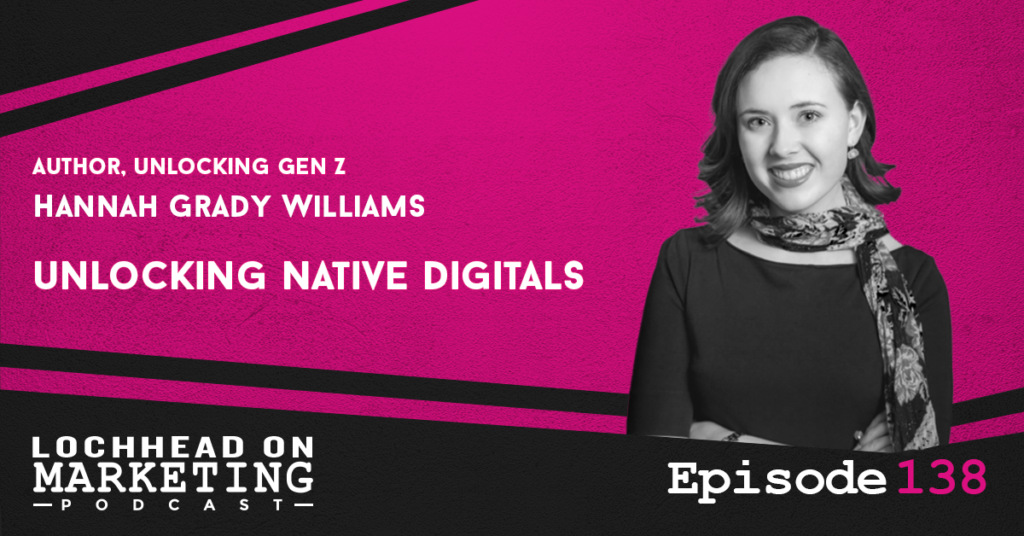
138 Unlocking Native Digitals with Hannah Grady Williams, author of Unlocking Gen Z
Podcast (lochheadonmarketing): Play in new window | Download (Duration: 1:31:35 — 62.9MB) | Embed
Subscribe: Apple Podcasts | Spotify | RSS | More
Welcome to part two of the Native Digitals series here at Lochhead on Marketing. On this episode, we have a conversation with Hannah Grady Williams on how your business can tap into the Native Digitals workforce. For those who are not familiar of what Native Digitals are, give part one of this series a quick listen (LOM 137).
Hannah Grady Williams is the Gen Z CEO Advisor, sort of like a Gen Z whisperer for CEOs and executive. She is the author of a new book called A Leader’s Guide to Unlocking Gen Z: Inside strategies to empower your team.
If you are over the age of 35, which is a Native Analog, this is a must-listen podcast. Because Hannah has a tremendous amount of insight for how Native Analogs can bridge the gap to work, recruit, and build our companies with a whole new slew of Native Digitals workforce.
Generation Differences: Gen X vs Gen Z, Native Digital vs Native Analog
When asked if the generation differences also coincide with the category of Native Analogs and Native Digitals, Hannah says that there are overlaps, but they are not completely the same. These overlaps are more on how each generation treats technology.
“Well, Gen Z, you think about all the kids sitting around the table constantly on their phones, not paying attention to anything. To you, you think it’s a distraction or something that’s taking my mind and my presence away from the people around me. The way I see it is a door that opens me to experiences I never could have had in my natural environment. As I’ve grown older, I’ve realized that distinction of the way that my generation looks at the world.” – Hannah Grady Williams
How Native Digitals Use Technology, and Why Analogs Don’t Get It
Hannah then talks about the time his brother mentioned what he has learned from Tik Tok. If you are a casual user, you might think that the platform is just all dance and viral memes. Yet there are people who use the platform to share important life lessons and tips they have learned themselves, in digestible, bite-size content.
Sadly, most parents’ reaction to someone just spending their time on social media is to just strip their phones or tablets from them. Rather than engaging with them and understanding, they just stop the activity. Because again, to them that is all just distraction.
“What they don’t realize, you know, if I’m looking from a Gen Xers perspective, or a Boomer’s perspective, I think of technology maybe the same way as any other technological innovation that might distract you from family time at the dinner table. But the way my generation sees it is, not only are we getting access to an entirely new world of people. It’s actually a portal to a new world. it’s a portal, it’s a new way of thinking.” – Hannah Grady Williams
Millennials and Gen Z are the New Category of Humans
Hannah states that Native Digitals is a great way of describing the New Age of Humans that we have now. She also thinks that it will become more pronounced once the next generation Gen Alpha, comes around.
Hannah then brings up a book called Ready Player One. It is about living immersed in a digital world and treating the real world as the alternative. While the real-world economy is at a downfall, it didn’t really matter to its citizens. As their life is spent in their digital selves, they saw no need to be lavish in real life.
While it is an exaggerated version, it does mirror how Native Digitals prioritize their digital lives over their physical ones. You see people buying expensive digital products while in real life, they barely buy new clothes and the like.
That’s what Native Analogs should take note this early. Otherwise, they might be left hanging once almost everything goes fully digital.
To hear more from Hannah Grady Williams and how your business can reel in the Gen Z and Native Digitals of the world, download and listen to this episode.
Bio
Hannah Williams’s story began in a blue pickup truck when her father handed 12-year-old Hannah the phone and asked her to close a deal on an investment property. After this unexpected introduction to the world of entrepreneurship.
She found herself thrust into a climate of innovation, challenge, and opportunity and she enrolled in college at age 14 and graduated with a degree in international business at age 18. Now, as a 23-year old Gen Z, she has consulted businesses from start-ups to Fortune 500 companies and is on a mission to help leaders leverage Gen Z talent as a competitive advantage and build #RadicalEmpathy in the workplace.
Links
Email: ha****@*************ms.com
LinkedIn: in/Hannah-Williams-Experience-Consultant
Read Hannah’s New Book!
A Leader’s Guide to Unlocking Gen Z
We hope you enjoyed this episode of Lochhead on Marketing™! Christopher loves hearing from his listeners. Feel free to email him, connect on Facebook, Twitter, Instagram, and subscribe on iTunes!
137 New Category of Humans: Native Digitals Are Transforming The World & No One’s Paying Attention!
Podcast (lochheadonmarketing): Play in new window | Download (Duration: 44:34 — 30.6MB) | Embed
Subscribe: Apple Podcasts | Spotify | RSS | More
Originally published in ?☠️ Category Pirates: It’s not a weekly newsletter. It’s a weekly mini-book.
Lately, there has been a fundamental, dare I say, seminal change in the category design of human beings. That is to say, the definition of what a human is has changed. You see, if you’re 35 and up, you are the last of a dying breed called Native Analogs. If you’re 35 or younger, you are the first generation of Native Digitals.
Native Digital’s experience life in a digital first way, and an analog way, second. Native Digitals have come of age integrated with the machines. Your smartphone and technology overall are like part of who you are as a person.
Most Native Analogs do not get this. Most people are not ready for the fact that everything is moving from an analog paradigm to a native digital world.
Wait, haven’t we had this dialogue before? Yes, we did in FYD episode 250. But this change is so radical, that it bears repeating, so we are doing it here as well. So in this two-part series of Lochhead on Marketing, we explore Native Digitals versus Native Analogs, and how it is important to realize that we are shifting to a digital paradigm faster than you think.
Category Neglect
First off, we start as to why it is important to recognize category shifts like the one we are experiencing now. Most category kings and queens tend to fall into a trap, in which they ignore new categories that may be adjacent or indirectly related to theirs.
When a new category arises (seemingly out of nowhere), the incumbent doesn’t topple over because they were unaware of the new category queen. More often than not, they fall because they dismissed what was happening right before their very eyes.
It’s not ignorance. It is arrogance coupled with the gravitational pull of “the way it is.” Because the people profiting in the present want things to stay the same.
This is called Category Neglect. Category Neglect doesn’t come from people being stupid or lacking sufficient data and resources to spot the headwinds and tailwinds of the future. It comes from a refusal to acknowledge which direction the wind is really blowing.
Why do they fall to such a seemingly obvious trap? This happens because the gravitational pull is too strong. A company gets used to earning hundreds of millions, or billions of dollars per year, and thinks it can do no wrong.
The company becomes deeply invested in the present. Anything that threatens the way it is now is dismissed.
Native Analogs vs Native Digitals
One of the most profound shifts happening in the world today is rooted in the ever-escalating debate between generations young and old. It is a shift hiding in plain sight. Just like the Tymshare executives staring out the window at Apple’s cranes building the headquarters of the company that would ultimately put them out of business, most people over 35 years old can’t see this shift happening.
Instead, they say to themselves, “Eh, we’ve got nothing to worry about.”
As Category Pirates, we feel it is our obligation to sound the alarm when we see rocky shores ahead. Some of us are facing a once-in-a-generation set of headwinds that could not just stymie growth, but sink our entire ship. If those of us over age 35 aren’t careful, this divide could result in one of the greatest instances of Category Neglect.
However, those who see this mega shift and act on it, on the other hand, will sail into the sunset a lot of happy pirates, make more money, and make a way bigger difference in the world.
With that said, let’s first give a better definition of what a Native Analog and Native Digital are. We’ll also define where their biggest difference lies.
There are two types of people on planet earth today.
- The first are Native Analogs. These are Baby Boomers and Gen Xers, born anywhere from the 1940s all the way up to the early ‘80s. Today, they range between the ages of 40 to 75, and make up approximately 136.8 million Americans.
- The second are Native Digitals. These are Millennials and Gen Zers, born between the early 1980s to as recently as the 2010s. These demographics are around 35 years of age on the high end, down to as young as 6 years old. They make up approximately 140.1 million Americans.
The difference?
Native analogs grew up in a time where technology was an addition or a distraction from their real lives.
Native digitals grew up in a time where their “real” lives were a distraction from their digital lives.
This is a profound shift—and no one seems to be talking about it. Even more stunning, some of the largest native digital brands on the planet are run by Native Analogs. Who don’t get it either.
To learn why it is important to know more about Native Digitals and how it can affect your category and businesses, download and listen to this episode. You can also check it out at Category Pirates.
Bio
Christopher Lochhead is a #1 Apple podcaster and #1 Amazon bestselling co-author of books: Niche Down and Play Bigger.
He has been an advisor to over 50 venture-backed startups; a former three-time Silicon Valley public company CMO and an entrepreneur.
Furthermore, he has been called “one of the best minds in marketing” by The Marketing Journal, a “Human Exclamation Point” by Fast Company, a “quasar” by NBA legend Bill Walton and “off-putting to some” by The Economist.
In addition, he served as a chief marketing officer of software juggernaut Mercury Interactive. Hewlett-Packard acquired the company in 2006, for $4.5 billion.
He also co-founded the marketing consulting firm LOCHHEAD; the founding CMO of Internet consulting firm Scient, and served as head of marketing at the CRM software firm Vantive.
We hope you enjoyed this episode of Lochhead on Marketing™! Christopher loves hearing from his listeners. Feel free to email him, connect on Facebook, Twitter, Instagram, and subscribe on iTunes!
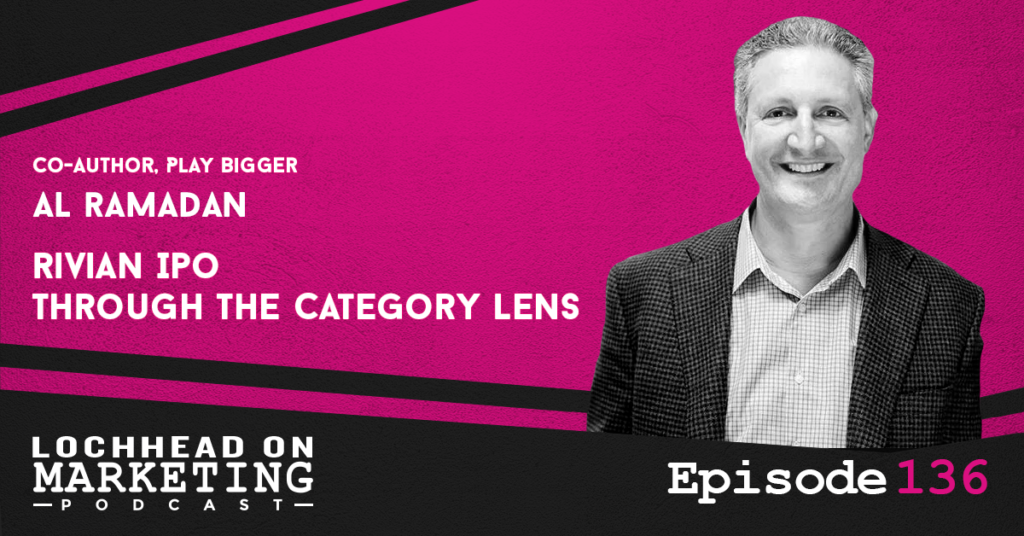
136 Rivian IPO Through The Category Lens
Podcast (lochheadonmarketing): Play in new window | Download (Duration: 1:06:38 — 45.8MB) | Embed
Subscribe: Apple Podcasts | Spotify | RSS | More
In Lochhead on Marketing episode 127, we talked with Al Ramadan, Co-founder of Play Bigger Advisors and co-author of Play Bigger, the book. On that episode, we unpacked the upcoming Rivian IPO.
Now that Rivian has gone public, we thought it would be cool to get together again, and unpack what happened through a category design lens. Specifically, how Rivian was able to use their IPO not just as a financing event, but a category-defining event.
Welcome to Lochhead on Marketing. The number one charting marketing podcast for marketers, category designers, and entrepreneurs with a different mind.
The Rivian IPO: An Update after the Launch
Al Ramadan recaps what Rivian IPO was during the public offering, which had a market cap of $60 billion at the time. This was already a very impressive number, considering that it was still an IPO.
What people didn’t anticipate is that after Rivian’s launch, they blew well past that and now sits over $100 billion in valuation. As a result, they are now the third largest automotive company behind Tesla and Toyota.
All in all, it is an incredible IPO, and one to observe in the future as it develops.
Betting on Potential vs Performance
Despite all that, there are those who are still skeptic of what had happen, and consider it as a fluke or a big risk. But it all boils down to betting on the potential of an idea, rather than just prior performance. Right now, some investors are seeing things in a new light.
“I think it’s hard for investors to understand because that’s been just been the way they are. They look at multiples of revenue or multiples of trucks shipped, or all of those other vital metrics within an organization. But the new investors I think, are starting to look past that.” – Al Ramadan
Paving the Way into a New Category
What Al finds interesting is that currently, 70% or more of the market cap for the electronic car category is cornered by Tesla. Yet Rivian might have to potential to great its own category within it, and be the category king for it.
Because Rivian is not just planning on the electronic cars and trucks. They are also including everything else that comes along with it. We’re talking charging networks and stations, dealerships, and the like. It’s taking into consideration the whole ecosystem, as supposed to just that one product.
“So if you go into this with the mindset of like, I’m going to value this as an automotive industry as it was over the last 125 years, you’re gonna miss big time.” – Al Ramadan
To hear more from Christopher and Al and their thoughts and updates on the Rivian IPO, download and listen to this episode.
Bio
Al Ramadan is a co-founding partner of Play Bigger Advisors and coauthor of the book, Play Bigger. He also co-founded Quokka Sports, which revolutionized the way people experience sport online.
Al then joined Macromedia and Adobe, where he spent almost ten years changing the way people think about great digital experiences. At Adobe, Al led teams that created the Rich Internet Applications category and helped develop the discipline of experience design.
In the early ‘90s he applied data science to Australia’s Americas Cup — an innovation in sports performance analytics. His work in sailing led directly to the idea for Quokka. He lives in Santa Cruz, California.
We hope you enjoyed this episode of Lochhead on Marketing™! Christopher loves hearing from his listeners. Feel free to email him, connect on Facebook, Twitter, Instagram, and subscribe on Apple Podcast! You may also subscribe to his newsletter, The Difference, for some amazing content.
135 Sales Kick Off: The 2 Questions You Must Answer for Your 2022 Kick Off Event
Podcast (lochheadonmarketing): Play in new window | Download (Duration: 8:50 — 6.1MB) | Embed
Subscribe: Apple Podcasts | Spotify | RSS | More
In this episode, let’s talk about Sales Kick Off. Since it’s that time of the year where most sales, marketing, and executive teams are working on sales kickoff events for the new year and/or a company kickoff event.
While most people work on the practical and tactical aspect of things, there’s a strategic question that we need to address. If we get the answer right, it can lead to a very successful sales kickoff and a successful year.
Welcome to Lochhead on Marketing. The number one charting marketing podcast for marketers, category designers, and entrepreneurs with a different mind.
Sales Kick Off Events
Like most companies, you are also probably working on this as early as the 4th quarter of the year. If you’re in a well-established company, you probably have all the basics down, in terms of systems, workflows, and all related processes.
While those parts are also important, the focus in these kinds of kickoffs is the context that it operates in. Why are you doing this sales kickoff? Is it for something new, or maybe an important change in your company that will affect how you interact with your clients and customers?
Why Should I Stay?
That said, we have a very unique context going into 2022. You have probably heard about the “Great Resignation”. People have been quitting their jobs to find better work or pursue other careers. Those who stayed are probably getting recruitment emails from competition due to this sudden lack of high-value individuals in certain industries.
So heading into 2022, the context of your sales kickoff needs to answer the question, “Why should I stay?”
In order to answer that question, you should look on what truly motivates people. The first point is, people who are invested in the company are motivated by a mission. They want to feel like they’re a part of something greater than themselves. That what they do for the company makes a difference.
The second point is that they want to feel connected to their colleagues. Granted, this is harder nowadays due to COVID and social distancing. So instead of being physically around people, find a way to align people’s goals, so that they get to interact with each other while having the same mission. This ties to the first point as well.
If your company is still on a full remote capacity right now, you can also be creative with technology. Instead of socializing in the pantry like before, set up zoom meetings for your team where you can just talk about the recent activities you have done outside of work. Or maybe share what you have been doing lately, so that other people in the team are aware of your contributions and could help with your struggles.
In the situation where we’re primarily using a digital first native digital way to do that, think about using the technology and creative ways to bond people to each other into the mission and point of view.
Bio
Christopher Lochhead is a #1 Apple podcaster and #1 Amazon bestselling co-author of books: Niche Down and Play Bigger.
He has been an advisor to over 50 venture-backed startups; a former three-time Silicon Valley public company CMO and an entrepreneur.
Furthermore, he has been called “one of the best minds in marketing” by The Marketing Journal, a “Human Exclamation Point” by Fast Company, a “quasar” by NBA legend Bill Walton and “off-putting to some” by The Economist.
In addition, he served as a chief marketing officer of software juggernaut Mercury Interactive. Hewlett-Packard acquired the company in 2006, for $4.5 billion.
He also co-founded the marketing consulting firm LOCHHEAD; the founding CMO of Internet consulting firm Scient, and served as head of marketing at the CRM software firm Vantive.
We hope you enjoyed this episode of Lochhead on Marketing™! Christopher loves hearing from his listeners. Feel free to email him, connect on Facebook, Twitter, Instagram, and subscribe on Apple Podcast! You may also subscribe to his newsletter, The Difference, for some amazing content.
134 The Problem With Most Marketing Plans
Podcast (lochheadonmarketing): Play in new window | Download (Duration: 11:17 — 7.8MB) | Embed
Subscribe: Apple Podcasts | Spotify | RSS | More
In this episode, let’s talk about the problem with most marketing plans, and what you can do about it.
Welcome to Lochhead on Marketing. The number one charting marketing podcast for marketers, category designers, and entrepreneurs with a different mind.
Planning Based on the Past
Let’s talk about the problem with most marketing plans: mainly, most of them start with last year’s template.
The big problem with most marketing plans is they take last year’s marketing plan and they extend it forward. In category design, one of our favorite expressions is to reject the premise. In the end, we challenge ourselves to push and poke and stretch our thinking. Also, just because it worked in 2020 or 2021, it is not evidence that it will work in 2022.
More importantly, when you start your planning by rejecting the premise, you create a blank sheet of paper.
Crowding Out Innovation
It is also difficult to create a different future when the past is your lens. So if a prior marketing plan is the start point for a plan for the future, by definition you’re taking the past and figuring out how to re-implement it going forward.
That might be feasible for maintaining certain market margins and the like, but it risks crowding out innovation in your marketing plan.
We’re also not telling you to reject the past and just YOLO your future. Going forward, you should have a dialogue on what worked and not worked based on the data from the past, find a way to highlight those points, but at the same time look for things that have not been explored in the market. That way, you can produce a breakthrough in a new field or even create a new category out if it, without having to go for broke.
Three Pillars of a Great Marketing Plan
Once you have rejected the premise and open yourself up to thoughtful data-centric analysis of what works and doesn’t, it’s time to think about going forward. How do you design a marketing plan that creates the future of your choosing?
To do so, try to anchor it around these three pillars.
- Information Wars: This is what sets the strategic context. It’s the combination of ways in which you educate the world about the category you’re designing, and learning from your Superconsumers to accelerate your effectiveness both in the air and on the ground. This is more focused on POV marketing / word of mouth than anything else.
- Air Wars: In many ways, marketing is “Sales at scale.” Air Wars are the high-level strategic marketing you do in service of the new and different category you are creating in the world. All the while positioning yourself as the leader. These efforts are more focused on demand creation.
- Ground Wars: This is tactical marketing (often at the point-of-sale and heavily integrated with sales) that supports your strategic efforts marketing the category and driving near-term revenue. These efforts are more focused on demand capture and lead generation.
If you want to learn more about these three pillars, check out this Category Pirates article about it.
Conclusion
So in closing, what would I leave you with?
Don’t use the past as a template for creating the future.
Allow yourself to think in unconstrained, super creative, super innovative ways around “what is the strategic context?” “What’s the POV that you are using to drive your category and your brand and ultimately, the success of the company?” How are you scaling through air wars, so that you begin to make your strategic point of view move from being a new thing to an of course. And the ground Wars is all about how you make the cash register sing and drive near-term revenue. And guess what? To succeed, you got to get all three right.
Bio
Christopher Lochhead is a #1 Apple podcaster and #1 Amazon bestselling co-author of books: Niche Down and Play Bigger.
He has been an advisor to over 50 venture-backed startups; a former three-time Silicon Valley public company CMO and an entrepreneur.
Furthermore, he has been called “one of the best minds in marketing” by The Marketing Journal, a “Human Exclamation Point” by Fast Company, a “quasar” by NBA legend Bill Walton and “off-putting to some” by The Economist.
In addition, he served as a chief marketing officer of software juggernaut Mercury Interactive. Hewlett-Packard acquired the company in 2006, for $4.5 billion.
He also co-founded the marketing consulting firm LOCHHEAD; the founding CMO of Internet consulting firm Scient, and served as head of marketing at the CRM software firm Vantive.
We hope you enjoyed this episode of Lochhead on Marketing™! Christopher loves hearing from his listeners. Feel free to email him, connect on Facebook, Twitter, Instagram, and subscribe on Apple Podcast! You may also subscribe to his newsletter, The Difference, for some amazing content.
