
Lochhead on Marketing
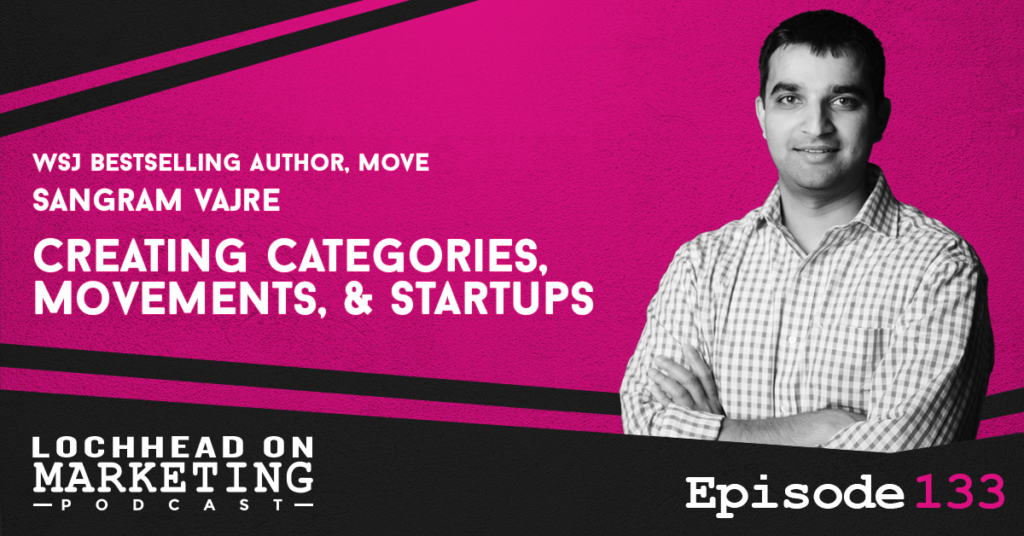
133 Creating Categories, Movements, & Startups with Sangram Vajre, WSJ Bestselling Author of MOVE
Podcast (lochheadonmarketing): Play in new window | Download (Duration: 1:40:24 — 68.9MB) | Embed
Subscribe: Apple Podcasts | Spotify | RSS | More
On this episode of Lochhead on Marketing, we go on a deep dive into category design, community building, to starting a company and becoming a category leader with Sangram Vajre.
Sangram Vajre is the co-founder of Terminus. He is also the author of a WSJ bestselling book called MOVE: The 4-Question Go-To-Market Framework.
We touch on the different startup marketing topics, including how to avoid the SaaS Valley of Death. We also talk about how to build a scalable marketing and sales model. Most importantly, we talk about how to leverage your competition to build your category.
Welcome to Lochhead on Marketing, the number one charting marketing podcast for marketers, category designers, and entrepreneurs with a different mind.
Sangram Vajre on his Bestselling Book, MOVE
Sangram shares the one question that he always gets when he talks about his book. That is, why did he put THAT specific quote on the cover?
The particular quote was made by me, and it read: “Love the guys, but hate this book.”
Sangram explains that he has a good reason for putting it up right in front for everyone to see.
“I think you and I both know that everybody feels like they’re walking on eggshells. They can’t say anything. Everything has to has to be politically correct. Everything has to be in agreement.
I think people have forgotten a good way to discourse. That it’s okay for two people to have completely different opinions. And that’s the point of being people. Otherwise, we’ll be animals eating each other.” – Sangram Vajre
Coming in from Another Angle
Sangram then explains that while his heart bleeds category design and creation, he believes that not every company should be a category creator. To him, there are some that are not destined to be category creators, and that is fine. They could still be a better company; they just have to approach it from a different angle.
That’s where his book, MOVE, comes to play.
“There are 99% of the companies out there in the world, who probably are following suit to become a better company. And this book is for them. If you want to build a category, go and read Play Bigger. But if you want to build a great high performing revenue team in your organization, I hope you’ll take a look at my book.” – Sangram Vajre
Sangram Vajre on Engaging the Community to Create a Bestseller
Sangram talks about his process on making this bestseller of a book. He says that he has always believed that without a community, you’re just a commodity.
“I truly believe that every company needs to think about building a community before they think about the product they want to build. Because your community is what’s going to give you the float that you need to get your business going.” – Sangram Vajre
So consult the community, he did. He would send out early parts of his book and asked people for their feedback. Those that gave him feedback, he made sure to acknowledge in his book. So when the book became a WSJ bestselling book, his community who gave their feedbacks are now part of it, which gave his community an even greater sense of belonging.
To hear more from Sangram Vajre and how to become a high-performing company in your market, download and listen to this episode.
Bio
Sangram Vajre is the co-founder and chief evangelist of Terminus. Before Terminus, Vajre led the marketing team at Pardot through its acquisition by ExactTarget and then Salesforce.
He is also the author of Account-Based Marketing For Dummies and is the mastermind behind #FlipMyFunnel.
Links
LinkedIn: in/SangramVajre
Twitter: @SangramVajre
Check out his book: MOVE: The 4-Question Go-To-Market Framework
We hope you enjoyed this episode of Lochhead on Marketing™! Christopher loves hearing from his listeners. Feel free to email him, connect on Facebook, Twitter, Instagram, and subscribe on Apple Podcast! You may also subscribe to his newsletter, The Difference, for some amazing content.
132 3 Meta Problems With Facebook
Podcast (lochheadonmarketing): Play in new window | Download (Duration: 12:43 — 8.7MB) | Embed
Subscribe: Apple Podcasts | Spotify | RSS | More
This episode is based on the top 1% Category Pirates ?☠️ newsletter.
On this episode, let’s talk about at least three Meta problems with Facebook. How, in light of their recent situation, they managed to launch a new category out of nowhere. The question is, was it a legendary move?
Welcome to Lochhead on Marketing, the number one charting marketing podcast for marketers, category designers, and entrepreneurs with a different mind.
Launching Meta
There’s an interesting thing that most people don’t realize and has not been reported on the mainstream press. That is, never in the history has a trillion dollar publicly-traded company launched a new category, that is so forward-leaning.
So whatever you want to say about Zuckerberg, what he pulled off there was legendary and by the book, at least from a purely category design perspective.
That said, given the fact that the new category is the metaverse and the fact that he named renamed and rebranded the company as Meta is genius. When you tie your company name to your category, you have real staying power in that category.
The 3 Meta Problems with Facebook
With that out of the way, there are at least three very serious problems with this launch.
Ignoring the Elephant in the Room
Zuckerberg ignored the elephant in the room, and just launched Meta in spite of recent situations developing even as we speak. If you’re interested in this, The Wall Street Journal is keeping an ongoing series on the matter called The Facebook Files.
The most glaring one is the recent whistleblower that exposed the company as someone who exploits its users and their data. Yet for Zuckerberg to just get up and launch a new category, brand, and giant demo is incredible, and not in a good way. Pretending that Facebook does not have a self-inflicted existential wound doesn’t make it go away.
The fact that he didn’t address it is stunning. It shows how much out-of-touch they really are.
Mercenary, not a Missionary
Zuckerberg’s announcement made it clear that he’s a mercenary, not a missionary. This is where he drops off on being a legendary category designer. Because category designers, as you know, are always on a mission.
While making money, building highly-valuable companies, and being economically successful is what we’re trying to do in business, entrepreneurship, and marketing, most legendary category designers and innovators are on a mission to make a difference. They use their category, and therefore their company and products to do so.
If you listen to the Metaverse presentation, it’s 100% about Facebook. They are not solving a new big problem that they have a solution to. There wasn’t a new big opportunity and a way to make a difference for others. Sure, there was an innovation on how VR and the tech behind it was being used, but he never anchored it to why it matters to us.
This is because the new category of Facebook’s Meta is not about us, the users. It is solely for them, and how it benefits Facebook. If you listen carefully, it’s all about me, me, me. That is classic mercenary talk.
Public Trust
Out of the three problems, this one should be the most obvious. If you simply Google around, you’ll find that Facebook is the least trusted social media company. Yet in the whole presentation, he has not mentioned anything about trust, or try to comfort us in anyway.
So the question is, can one of the most nefarious companies in history convince the world to bet their digital lives and future on a dubious, distrusted bedrock of technology from Facebook, without even building trust. He didn’t even try. Like the first problem, he didn’t even address it.
If you’d like to hear more about the 3 Meta Problems with Facebook, download and listen to this episode. We’ll also go into a deep dive about Meta and the issues surrounding it in Category Pirates. So stay tuned.
Bio
Christopher Lochhead is a #1 Apple podcaster and #1 Amazon bestselling co-author of books: Niche Down and Play Bigger.
He has been an advisor to over 50 venture-backed startups; a former three-time Silicon Valley public company CMO and an entrepreneur.
Furthermore, he has been called “one of the best minds in marketing” by The Marketing Journal, a “Human Exclamation Point” by Fast Company, a “quasar” by NBA legend Bill Walton and “off-putting to some” by The Economist.
In addition, he served as a chief marketing officer of software juggernaut Mercury Interactive. Hewlett-Packard acquired the company in 2006, for $4.5 billion.
He also co-founded the marketing consulting firm LOCHHEAD; the founding CMO of Internet consulting firm Scient, and served as head of marketing at the CRM software firm Vantive.
We hope you enjoyed this episode of Lochhead on Marketing™! Christopher loves hearing from his listeners. Feel free to email him, connect on Facebook, Twitter, Instagram, and subscribe on Apple Podcast! You may also subscribe to his newsletter, The Difference, for some amazing content.
131 Maybe The Most Important Equation Ever
Podcast (lochheadonmarketing): Play in new window | Download (Duration: 9:22 — 6.4MB) | Embed
Subscribe: Apple Podcasts | Spotify | RSS | More
On this episode, let’s talk about what might be the most important equation in business and in marketing.
Welcome to Lochhead on Marketing, the number one charting marketing podcast for marketers, category designers, and entrepreneurs with a different mind.
Maybe The Most Important Equation Ever
I want to share with you a little bit of math that I learned very early in my career. It was incredibly eye-opening, and has been a bedrock that I have tried to stand on ever since. And the equation goes like this:
Results do not equal No Results plus an Excuse.
Now, this might seem obvious, but if you look around, you’ll find the contrary to that.
You might also think, what’s the harm of having a great excuse when you can’t achieve the results you want? Well, here’s the interesting thing: That mindset can perpetuate. Over time, you’ll start thinking that it’s perfectly okay to not reach the result you want, as long as there was a valid excuse not to do so.
Who You Are in Business
Here’s the AHA moment in business, entrepreneurship, and in category design: Who you are is based on your results.
It may sound harsh, but think about the people that you work with, particularly those who you admire. Chances are, you respect and admire them the most because they can be counted on to produce results.
If we use sales as an example, it’s easy to see one’s value for the business. That is, if they hit their target numbers or not. If they do hit their numbers and beyond, they are recognized and rewarded for it. You also gain the reputation as someone who achieves their goals, or if you already have said reputation, it is further reinforced.
The reason this matter is, in marketing and category design, there are winners and losers. In every category, there tends to be one category king or queen who gets roughly 70% of the market, and everybody else are fighting for roughly a quarter of it.
So train yourself. The excuse doesn’t matter when it’s on the line. The most legendary people produce results no matter what. That’s the mindset.
Don’t be Afraid to Ask
If you’re a product manager, developer, or engineer, it can be easy to measure goals and objectives. You either meet the requirements, or you don’t. Though for marketing, the goal or objective might not be as clear.
If you’re not sure about the goal of your marketing is, don’t be afraid to ask. After that, make sure the rest of your team is clear to that goal. That beats running around doing things that might not even be related to your goal, which wastes time and resources.
So to recap:
Results do not equal No Results plus an Excuse.
Results equal Reputation. Which means you are your results and your results drive your reputation.
Bio
Christopher Lochhead is a #1 Apple podcaster and #1 Amazon bestselling co-author of books: Niche Down and Play Bigger.
He has been an advisor to over 50 venture-backed startups; a former three-time Silicon Valley public company CMO and an entrepreneur.
Furthermore, he has been called “one of the best minds in marketing” by The Marketing Journal, a “Human Exclamation Point” by Fast Company, a “quasar” by NBA legend Bill Walton and “off-putting to some” by The Economist.
In addition, he served as a chief marketing officer of software juggernaut Mercury Interactive. Hewlett-Packard acquired the company in 2006, for $4.5 billion.
He also co-founded the marketing consulting firm LOCHHEAD; the founding CMO of Internet consulting firm Scient, and served as head of marketing at the CRM software firm Vantive.
We hope you enjoyed this episode of Lochhead on Marketing™! Christopher loves hearing from his listeners. Feel free to email him, connect on Facebook, Twitter, Instagram, and subscribe on Apple Podcast! You may also subscribe to his newsletter, The Difference, for some amazing content.
130 Thinking About Thinking Is The Most Important Kind Of Thinking
Podcast (lochheadonmarketing): Play in new window | Download (Duration: 17:26 — 12.0MB) | Embed
Subscribe: Apple Podcasts | Spotify | RSS | More
In this episode of Lochhead on Marketing, let’s talk about why thinking about thinking is the most important kind of thinking.
Context Matters More Than Content
This might be obvious, but it bears repeating: context matters more than content. In any strategy discussion, the context of which is what leads to some kind of outcome or content.
Most people, particularly those who are entrepreneurial, have a strong bias to action, which can be healthy and powerful. However, it does have it downsides sometimes.
“A strong bias to action means that sometimes, and I know I’ve been guilty of this more times than I will ever know, we spring to action without doing enough thinking. More importantly, without doing enough thinking and dialoguing around what the context is for whatever it is we’re talking about.” – Christopher Lochhead
Accept or Reject the Premise
The next piece to think of when discussing the context, is that whether you accept or reject the premise of said context? It could be a product, a service, or and prevalent idea.
Here’s what I know.
“Legendary category designers, legendary entrepreneurs, creators, and marketers reject the premise. They start by rejecting the premise. So somebody says something and you go, that’s interesting. And in our mind, we go, I reject the whole thing.” – Christopher Lochhead
Now, you may end up circling back to that premise and either accepting it entirely, or just part of it. Though the reason why starting by rejecting the premise is so powerful, is that all premise, context, and established thinking is based on past experience, insight, or research. Of course, there are many cases where accepting the premise is the wise thing to do.
Yet here’s the rub: how do you create a different future, if the premise or context you start with is tied to the past?
So we reject the premise, we reject the rules of the past and open ourselves up to a whole new kind of thinking.
Listen to the Words
In business and marketing, almost every sentence that somebody says to us use “accept the premise” language. Part of rejecting the premise is listening to the words they say.
One example is “go to market”. You might ask, what’s wrong with that premise? If you think about it, that premise suggests that there is a market out there, and we need to go and grab it. Which means that you are competing for other businesses that are also going to the same market.
Yet wouldn’t it be better to create your own market? That way, you get the lion’s share of it outright, and you don’t have to compete for it. Moreover, the customers/users then come to you, and not the other way around.
To hear more about how thinking about thinking is the most important kind of thinking, download and listen to this episode.
Bio
Christopher Lochhead is a #1 Apple podcaster and #1 Amazon bestselling co-author of books: Niche Down and Play Bigger.
He has been an advisor to over 50 venture-backed startups; a former three-time Silicon Valley public company CMO and an entrepreneur.
Furthermore, he has been called “one of the best minds in marketing” by The Marketing Journal, a “Human Exclamation Point” by Fast Company, a “quasar” by NBA legend Bill Walton and “off-putting to some” by The Economist.
In addition, he served as a chief marketing officer of software juggernaut Mercury Interactive. Hewlett-Packard acquired the company in 2006, for $4.5 billion.
He also co-founded the marketing consulting firm LOCHHEAD; the founding CMO of Internet consulting firm Scient, and served as head of marketing at the CRM software firm Vantive.
We hope you enjoyed this episode of Lochhead on Marketing™! Christopher loves hearing from his listeners. Feel free to email him, connect on Facebook, Twitter, Instagram, and subscribe on Apple Podcast! You may also subscribe to his newsletter, The Difference, for some amazing content.
129 Presentations: Why They Suck & What To Do About It with Dushka Zapata & Dan Roam
Podcast (lochheadonmarketing): Play in new window | Download (Duration: 1:09:53 — 48.0MB) | Embed
Subscribe: Apple Podcasts | Spotify | RSS | More
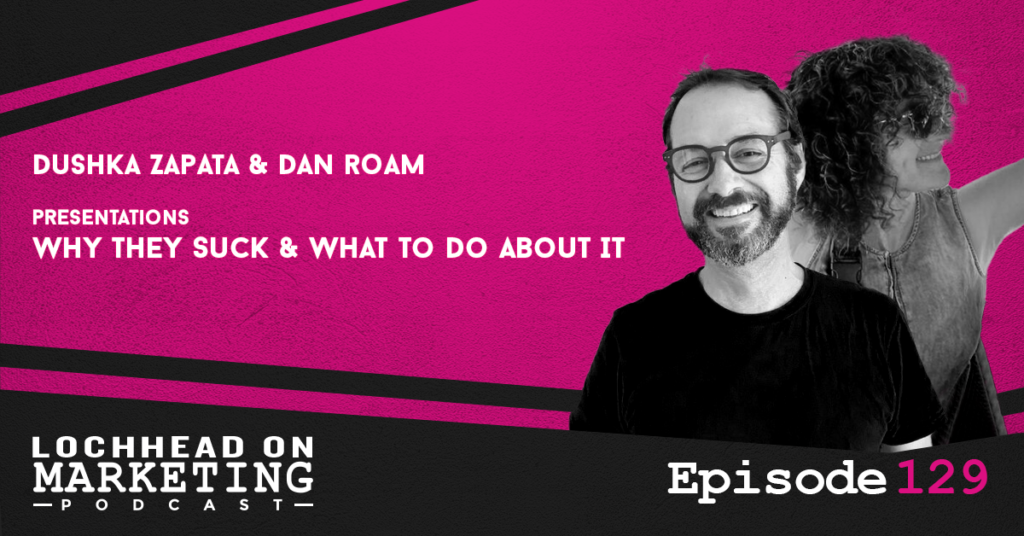
If you’re a regular listener, you know that we have very few guests on this podcast. That is because I believe that 90% of what we get taught about marketing and entrepreneurship is either wrong or not very helpful. So I want to make sure that whoever we have is legendary, and also very helpful. Well, today at Lochhead on Marketing, you not only get one, but two legendary guests, Dushka Zapata and Dan Roam.
Dushka Zapata has been on Follow Your Different, and is one of my absolute favorite people in the world. She’s the author of many legendary books. Her most recent is called The Love of Your Life is You: A step by step workbook to loving yourself. When she’s not writing, she has had an extraordinary career as a PR communications executive and coach.
Dan Roam is a multi-time bestselling author as well. His most recent book is called The Back of a Napkin: Solving problems and selling ideas with pitchers.
In this episode of Lochhead on Marketing, we talk about presentations, and what the template and architecture of a legendary presentation is. Pay special attention to Dushka and Dan’s thoughts on the real reason most people suck at presentations, and what they think you can do about it.
The Principle Behind The Back of the Napkin
The conversation starts of with a brief introduction of what Dushka and Dan do, besides writing bestselling books. Dushka describes her work as drawing a connection between what executives say and the company’s brand. In essence, she helps people say what they want to say in the simplest terms possible.
Dan shares that his work is pretty much the same, in which he draws clarity out of these executive’s ideas. Except that he literally draws them out on whiteboards, paper, and if nothing is in reach, napkins.
Dushka then brings up the principle of The Back of the Napkin, and Dan explains it in detail.
“Why it’s called the back of the napkin is (because) some of the very, very best ideas, whether they’re related to business, or organizations, or leadership or anything else come from a simple sketch, (gets) invariably drawn on a bar somewhere between a couple of people who are sitting there talking about their idea. One of them pulls out a pen, and on that napkin on the bar says, “Wait a minute, wait a minute, if it could draw it out, what would it look like?” They draw a triangle or an arrow or a circle. And that becomes the basis of the idea.” – Dan Roam
Dan Roam on Thinking Differently
Dan was then asked if there were people who told him as a child to stop drawing and start paying attention to the “normal” stuff. He replies that he had a teacher that said exactly that, to stop drawing and pay attention to reading books and whatnot.
What these people did not know was that this was Dan’s own way of paying attention and expressing his thoughts on paper. So just because it was a little different, doesn’t make it any less important or valuable.
“My teacher said that I drew too much, and I talked too much. And I need to sit down and listen and pay better attention. What that teacher didn’t realize is that I was really struggling to learn to read. And the way I made up for it was by talking a lot, and being kind of boisterous. And drawing was not a challenge.
I think maybe if we dug just a little bit deeper into what your I think you might be talking about, is a lot of us maybe didn’t do so well in school or in formal situations as we might have, because we thought a little differently than we were supposed to. And now we’re finding thankfully that the people who think different, kind of people from the island of lost toys, are the ones who actually are the most needed right now.” – Dan Roam
Legendary Doodler
Dan shares the story of where it all began, and it was a place that we had a shared history together, Scient. During those brainstorming meetings at Scient, Dan would often draw out his interpretations of what others were saying, which in turn gave others a visual representation of that speaker’s idea.
“I was the guy who I didn’t understand what anybody was talking about most of the time. So in meetings, I would go to the whiteboard and try to draw out what I thought I heard these consultants were talking about.
That was really the genesis of this because often in the meeting, the whole tone or temperature, the meeting room would change. (It) moved away from something that was maybe a little bit combative, or a lot of ego involved, to where people were just looking at the picture saying, “that’s really close to what we were thinking about.” – Dan Roam
From there, he became the world’s most legendary Business Doodler.
To hear more from Dushka Zapata and Dan Roam, and how you can start making legendary presentations to pitch your ideas, download and listen to this episode.
Bio
Duska Zapata
After working for more than 20 years in the communications industry, Dushka noticed a theme.
People find it very difficult to articulate who they are and what they do.
This holds true for both companies and for individuals.
For companies, this is an impediment to the development of an identity, a reputation, a brand. It makes it hard for customers to see how companies are different from their competitors.
For individuals, in a new world order of personal brands, it makes it hard to develop one that feels real.
This is the focus of Dushka’s work: she helps companies and people put into simple terms who they are, what they do, and where to go next. Her work comes to life through message development, presentation training, media training and personal brand development. It comes to life through executive coaching, workshops and public speaking. It comes to life through what she writes.
Dushka has written ten bestsellers.
Her work has been consumed on Q&A site Qoura 180M times.
Dan Roam
Dan Roam is the author of five international bestselling books on business-visualization and communication clarity.
The Back of the Napkin was named by Fast Company, The London Times, and BusinessWeek as the ‘Creativity Book of the Year.’
Dan’s latest book, THE POP-UP PITCH, will be published by Hachette/Public Affairs on Oct 26, 2021.
Dan is a creative director, author, painter, and model-builder. His purpose in life is to make complex things clear by drawing them and to help others do the same.
Dan has helped leaders at Google, Microsoft, Boeing, Gap, IBM, the US Navy, the United States Senate, and the White House solve complex problems with simple pictures. Dan and his whiteboard have appeared on CNN, MSNBC, ABC, CBS, Fox, and NPR.
Before founding Digital Roam Inc, Dan served as Client Partner & Creative Director at Razorfish, Scient, The Interactive Bureau, Red Square Productions, The Moscow Times, and the San Francisco Bay Guardian.
Dan graduated from the University of California Santa Cruz with degrees in Biology and Fine Art.
We hope you enjoyed this episode of Lochhead on Marketing™! Christopher loves hearing from his listeners. Feel free to email him, connect on Facebook, Twitter, Instagram, and subscribe on Apple Podcast! You may also subscribe to his newsletter, The Difference, for some amazing content.
128 The Theranos Scam: Implications for Entrepreneurs, Startups, VCs & Marketing Leaders
Podcast (lochheadonmarketing): Play in new window | Download (Duration: 24:46 — 17.0MB) | Embed
Subscribe: Apple Podcasts | Spotify | RSS | More
All of you have probably heard about Theranos by now, and the huge impact it made in the industry. Though no matter the outcome of the trials of Elizabeth Holmes ( Theranos founder & CEO) and Sunny Balwani (Theranos COO), their actions represent a demarcation point for Silicon Valley, startups, VCs, and marketers.
If by chance you don’t know this story, I would recommend you search “Theranos” on Google or Youtube and get your popcorn ready, because it is one hell of a story. Short version of it was Elizabeth Holmes offered a technology that could revolutionize healthcare, but it all turned out to be a scam. What made the story interesting is how long Theranos had strung people along, until the inevitable caught up with them and it all crashing down.
So in this episode of Lochhead on Marketing, let’s dig into the three major things we should learn from in the wake of Theranos and Elizabeth Holmes, and how the new line VCs need to walk because of her.
Don’t Fake It ‘Til You Make It
One of the biggest BS axioms in the industry is “Fake it til you make it”. It promotes the idea that people should project proficiency, even if they don’t have the right skill set for it. There’s actually an episode in Follow Your Different where we talked with Sabrina Horn (FYD 228) on why following this mantra is such a bad idea.
So what’s the difference between being a visionary, an optimist, a CEO, or a marketer versus being a scam artist? Let’s be crystal clear about the Difference between these 3 things:
- Future Vision
- Current Capabilities
- Past Performance
Is it okay to have a huge vision to have a radical category design, Hell yeah! As a matter of fact, it’s the people who have huge visions, those who allow themselves to be radical and be unencumbered by the present and the past, that create new categories and massive new value.
Though it is okay to lie about what your product or service does now? No. N.O. No way. We can’t make promises to customers that we know we cannot keep.
The Difference between Category Creators and Scam Artists
In our last Lochhead on Marketing episode, Al Ramadan (Coauthor, Play Bigger) and I unpacked Rivian and their new IPO. Though before that IPO, they also had another revolutionary idea, which was the Tank Turn. It was a cool feature to have for your car, and people where hyped for it.
Unfortunately, Rivian couldn’t make it happen. They did not have the technology for it at this time. So what did they do? Well, they admitted that they could not do it. No BS, no cover-ups. Just straight-up admission and apology.
While it did cause them to take a hit, they actually ended up building trust and affinity between them and the customers and the ideas that they are pursuing. Looking at it now, Rivian is poised to have a massive multi-billion IPO, and it’s all thanks to the trust that they have built up for being radically transparent about their mistakes and overall process.
Compare this with Theranos, who did almost the exact opposite in everything. While the initial idea for a compact medical testing machine would’ve been an amazing product, the fact that they strung investors along and straight-up faked results to keep up the facade was abhorrent.
Unfortunately, they are not the only ones who seem to operate like this.
Due Diligence and Good Governance Matters
We cannot lie about what our products and services currently does. Also, legendary companies are radically transparent. The second you know your product is not performing up to task, you have to tell people, regardless of the impact on your revenue and stock.
Due Diligence and Good Governance matters.
When asked why they turned down Theranos, Bill Maris, founder of Google Ventures, told Business Insider that there were so much misdirection and disconnect in Theranos’ pitch that it did not add up. So they sent someone to try it out, and it didn’t take long to figure out that things may not be what Theranos wanted everyone to see.
The failure of Theranos is a failure of BOTH Due Diligence AND Governance.
Bio
Christopher Lochhead is a #1 Apple podcaster and #1 Amazon bestselling co-author of books: Niche Down and Play Bigger.
He has been an advisor to over 50 venture-backed startups; a former three-time Silicon Valley public company CMO and an entrepreneur.
Furthermore, he has been called “one of the best minds in marketing” by The Marketing Journal, a “Human Exclamation Point” by Fast Company, a “quasar” by NBA legend Bill Walton and “off-putting to some” by The Economist.
In addition, he served as a chief marketing officer of software juggernaut Mercury Interactive. Hewlett-Packard acquired the company in 2006, for $4.5 billion.
He also co-founded the marketing consulting firm LOCHHEAD; the founding CMO of Internet consulting firm Scient, and served as head of marketing at the CRM software firm Vantive.
We hope you enjoyed this episode of Lochhead on Marketing™! Christopher loves hearing from his listeners. Feel free to email him, connect on Facebook, Twitter, Instagram, and subscribe on Apple Podcast! You may also subscribe to his newsletter, The Difference, for some amazing content.
127 The Electric Vehicle Category: Unpacking The Rivian IPO with Al Ramadan, CoAuthor of Play Bigger

Podcast (lochheadonmarketing): Play in new window | Download (Duration: 50:14 — 34.5MB) | Embed
Subscribe: Apple Podcasts | Spotify | RSS | More
The electric vehicle category is a giant new mega category that is completely changing the transportation landscape. Rivian is a startup who has yet to ship a product, yet somehow is pioneering a differentiated category in EVs. It is also on the verge of what will likely be a massive, multi-billion dollar IPO.
In this episode of Lochhead on Marketing, Al Ramadan and I unpack all of it through the category lens. He has been blogging about this lately, so it seems fitting to invite him and have a conversation about it. If Al’s name sounds familiar, that’s because he and I co-founded Play Bigger Advisors, and coauthored the book, Play Bigger together.
So sit back and enjoy this dialogue between two category design enthusiasts as we share our thoughts on Rivian’s new upcoming massive IPO.
Al Ramadan on Rivian and the Upcoming IPO
Al shares his thoughts on Rivian, and what they are doing for the Electric Vehicle category. He describes its founder as something of a combination of Steve Jobs and Elon Musk, and thinks he is a remarkable entrepreneur.
He then talks about the upcoming IPO they have planned to release around Thanksgiving.
“A couple weeks ago, they announced that they’re going to do this IPO around Thanksgiving. And it’s an IPO, not a spec. All of the other EVs are going out with specs. And the zinger was that the market cap was going to be $80 billion. Bigger than GM, bigger than Ford.
But it was just this moment in time where you look at this thing is like, “what, they haven’t shipped the vehicle”. And they’ve valued more than Toyota’s entire SUV line and Ford or GM, it just doesn’t make (sense). That’s just crazy. And so the category designer in me sort of took over and started dissecting all of their filings and I came up with a few insights that I think is worth sharing. ” – Al Ramadan
The Potential of the Rivian IPO
For something that has not even shipped the product yet, it seems amazing that they are valued so highly. For it to do so well at this point, it must’ve hit all the right notes and laid out its potential to be able to grab the attention of investors and consumers.
“What they miss always, is what the real drivers of market cap are. Which is, number one: what’s the potential for this category? Number two: do we believe that this company can prosecute the magic triangle company; product, company, and category and earn 76% of the economics? And number three: when we look at their numbers, metrics, financials, etc., are we comforted about the first two things? And if the answer to all of those is that you got a company who’s designing a market category, that right now looks like that has the potential of almost infinity.” – Christopher Lochhead
Al agrees with this points, and further explains how this new IPO is changing the vehicle industry, and how the transactions and support will be implemented once it comes out. Up until now, most EVs still operate in the traditional car dealership model. Rivian seeks to create a new category centered not just on the cars, but the services provided with it.
Reactions to the Rivian IPO
One of the things that piqued Al’s interest was how certain people or companies reacted when the valuation for the Rivian IPO went out. One particular instance was Elon Musk tweeting about it, saying that they should at least put out a product before the IPO.
It seemed illogical that someone like him would be alarmed by this, especially if you’re perceived as being the king of a certain category. Yet for a brief moment there, it seems that he has shown concern over the matter, and saw a challenger on the rise.
According to Al, it’s right that he would be concerned. Because if you look at it, Rivian seems to be taking the Electric Vehicle category and evolving it to something that can make their current category obsolete in the future. While the implementation of which remains to be seen, it’s definitely enough to be concerned about.
To hear more from Christopher and Al and their thoughts on the Rivian IPO, download and listen to this episode.
Bio
Al Ramadan is a co-founding partner of Play Bigger Advisors and coauthor of the book, Play Bigger. He also co-founded Quokka Sports, which revolutionized the way people experience sport online.
Al then joined Macromedia and Adobe, where he spent almost ten years changing the way people think about great digital experiences. At Adobe, Al led teams that created the Rich Internet Applications category and helped develop the discipline of experience design.
In the early ‘90s he applied data science to Australia’s Americas Cup — an innovation in sports performance analytics. His work in sailing led directly to the idea for Quokka. He lives in Santa Cruz, California.
We hope you enjoyed this episode of Lochhead on Marketing™! Christopher loves hearing from his listeners. Feel free to email him, connect on Facebook, Twitter, Instagram, and subscribe on Apple Podcast! You may also subscribe to his newsletter, The Difference, for some amazing content.
126 How To Spot Legendary Startup / New Category Ideas
Podcast (lochheadonmarketing): Play in new window | Download (Duration: 18:36 — 12.8MB) | Embed
Subscribe: Apple Podcasts | Spotify | RSS | More
In this episode of Lochhead on Marketing, let’s talk about how to spot a legendary startup / new category idea.
It turns out there are a few secret hiding places where these ideas hide, but they’re in plain sight. One of these ideas was shared by Avram Miller in a recent episode of Follow Your Different (FYD 234) when we were discussing his new book, titled The Flight of a Wild Duck. It is a simple, powerful, yet under-used idea for discovering massive ideas for new companies, products or categories, so we are going to talk about it in detail here. As a bonus, I’ll share one of my own as well!
So stay tuned to this episode, and enjoy.
Avram Miller on Being a Legendary Startup
When we talked to Avram Miller in Follow Your Different, we got into the discussions of why a lot of startups seemed to fail. These startups had, on paper, great ideas for products, services, and categories that should have dominated the market. Yet looking back, most of them did not achieve that potential.
So what was the culprit? It was time. Specifically, they were too early or ahead of their time. Whether it was due to being technologically early or there’s no demand for that particular idea yet, it was just too early.
One of the examples was WebVan.com. It was a startup designed to deliver groceries to your home, and it was launched in the late 1990s. If you think about it nowadays, it makes sense that it would be a successful business. Yet WebVan.com shut its business down in 2001, while the same model today made Amazon a household brand.
So if you have a legendary startup idea, one of the things you need to consider is this: is it too early, or just the right time to launch it to the world?
Never Stop Innovating
Idea no. 2 comes from me, and what I have observed upon past and existing category leaders in their respective markets. As I have discussed here in Lochhead on Marketing, and also at our Category Pirates newsletter, sometimes these Category Kings settle with fighting for a share of the market, rather than innovating and creating new markets for their own.
One of the most known examples of this was Kodak and the physical media category, which tried to adapt too little, and too late. Surprisingly, Avram Miller shares in our conversation that Intel’s CEO Andy Grove was also resistant to innovating things early on in Intel’s history, which almost led them to miss out in getting into the chipset business for personal computers.
As for a great example in the opposite direction, Victoria’s Secret got left in the dust by Rihanna’s line of lingerie called Savage. This was because it moved away from the POV of “be like these supermodels”, to more inclusive and being comfortable with their own body. This radically different POV redesigned the category. As most native digitals see exclusivity as elitist and not welcoming, it was also embraced by the market almost overnight.
So at the end of it all, would you rather be fighting to stay on top of your current market, or be the King of the Hill in a category that you have created or innovated?
To hear more ideas on how to become a legendary startup or innovate your current business, download and listen to this episode.
Bio
Christopher Lochhead is a #1 Apple podcaster and #1 Amazon bestselling co-author of books: Niche Down and Play Bigger.
He has been an advisor to over 50 venture-backed startups; a former three-time Silicon Valley public company CMO and an entrepreneur.
Furthermore, he has been called “one of the best minds in marketing” by The Marketing Journal, a “Human Exclamation Point” by Fast Company, a “quasar” by NBA legend Bill Walton and “off-putting to some” by The Economist.
In addition, he served as a chief marketing officer of software juggernaut Mercury Interactive. Hewlett-Packard acquired the company in 2006, for $4.5 billion.
He also co-founded the marketing consulting firm LOCHHEAD; the founding CMO of Internet consulting firm Scient, and served as head of marketing at the CRM software firm Vantive.
We hope you enjoyed this episode of Lochhead on Marketing™! Christopher loves hearing from his listeners. Feel free to email him, connect on Facebook, Twitter, Instagram, and subscribe on Apple Podcast! You may also subscribe to his newsletter, The Difference, for some amazing content.
125 How Services Firms Do Legendary Category Design / Category Creation
Podcast (lochheadonmarketing): Play in new window | Download (0.0KB) | Embed
Subscribe: Apple Podcasts | Spotify | RSS | More
In this episode of Lochhead on Marketing, let us talk about something that I get asked about all the time. That is, can service firms do Category Design? Simple answer, Yes.
I would even say that the most legendary services companies are almost always created or led by a legendary Category Design.
Long answer? Well, listen to this episode to find out.
The Management Consulting Category Design
There was a point in time where there was no such thing called Management Consulting. Remember, everything is the way that it is because somebody changed the way that it was. So, McKinsey and Company is the firm that created and designed the Management Consulting category.
The interesting thing is the guy that built McKinsey into what it is today is a guy named Marvin Bower. McKinsey started out as a group of bean counters and accountants doing accounting stuff, and nothing like what McKinsey is today.
The Aha moment that Bower had is that he noticed that while clients were paying for accounting services with accountants, and legal services with lawyers, what they often wanted and valued more from their accountant was actually business advice from a trusted source. With that idea, Marvin became the category designer of a new services category called Management Consulting.
Marvin Bower as a Language Master
Marvin is an incredible kind of master at Languaging. He intuitively understood that in order to create a new category of Services Firm, he had to language it differently. That is to say, you can’t talk about a new thing with old language.
Under his leadership, projects were not called jobs, they were called engagements. It’s a word that is much more relational than it is transactional. Internal groups within McKinsey with specific industry or functional expertise were not called groups, they were called practices. Bower borrowed a term from doctors to demonstrate a level of professionalism to elevate these “groups”, or now practices within McKinsey. Finally, he made sure that nobody ever referred to McKinsey as a business: McKinsey was a firm. He highlighted the core values that held the company together.
Today, there are very few firms who are rigorously committed, some might say consciously committed to the original language that Marvin Bower put into place. All of these distinctions, all of these differences, help McKinsey thrive. It also help to position McKinsey in a new category: not a law firm, not an accounting firm, but this new thing called a Management Consulting Firm.
To hear more on how Service Firms do Category Design, download and listen to this episode.
Bio
Christopher Lochhead is a #1 Apple podcaster and #1 Amazon bestselling co-author of books: Niche Down and Play Bigger.
He has been an advisor to over 50 venture-backed startups; a former three-time Silicon Valley public company CMO and an entrepreneur.
Furthermore, he has been called “one of the best minds in marketing” by The Marketing Journal, a “Human Exclamation Point” by Fast Company, a “quasar” by NBA legend Bill Walton and “off-putting to some” by The Economist.
In addition, he served as a chief marketing officer of software juggernaut Mercury Interactive. Hewlett-Packard acquired the company in 2006, for $4.5 billion.
He also co-founded the marketing consulting firm LOCHHEAD; the founding CMO of Internet consulting firm Scient, and served as head of marketing at the CRM software firm Vantive.
We hope you enjoyed this episode of Lochhead on Marketing™! Christopher loves hearing from his listeners. Feel free to email him, connect on Facebook, Twitter, Instagram, and subscribe on Apple Podcast! You may also subscribe to his newsletter, The Difference, for some amazing content.
