
Lochhead on Marketing
116 New Category of Human: “Native Digitals” (People Under 35) Are Radically Different People & Most “Native Analogs” Don’t Get It
Podcast (lochheadonmarketing): Play in new window | Download (Duration: 15:07 — 10.4MB) | Embed
Subscribe: Apple Podcasts | Spotify | RSS | More
This episode is based on the Category Pirates ?☠️ Newsletter.
Welcome to a two-part series of Lochhead on Marketing, where we talk about Native Digitals and the profound changes they are bringing to the way we live, work, and play.
In this episode, let’s talk about how these younger folks, 140 Million of them in the United States, are the new category of human. These native digitals are the first to grow up completely integrated with technology.
I think it has a profound meaning, and I also think that most people aren’t paying attention.
Native Analogs vs Native Digitals: Perceiving Reality
While having my friends and their kids over one time, I’ve realized something different. While my friends and I are enjoying the beautiful sunset on the beach, the kids were doing something else. They were at their phones, talking to their friends or watching something online. Which seemed like a waste of a perfectly good sunset, though they did take a picture to post on social media.
This got me thinking and gave me the idea: these kids are Native Digitals. It means that their primary experience of life is within the digital one, and their analog life is secondary. That is to say, the photo or video of the sunset is more important than the actual one, because they can show it off to their network.
If you are like me, a Digital Analog, it’s the reverse. Though the insight that I had that morning after that sunset on the beach was quite interesting.
Who are the Native Digitals and Native Analogs?
If you are 35 and above, you are most likely a Digital Analog. You value your life outside technology, and are one of the categories of human that exists today. If we are talking about generations, they fall under the Baby Boomers and Gen Xers who were born in the early 80s or earlier. They make up approximately 136.8 million Americans.
The second category are the Native Digitals. These are millennials and Gen Xers who are born between the early eighties and as recently as the 2010s. The high end of these folks are around thirty-five today and the low end are as young as six years old.
Get this, they make up 140 million Americans.
Why is this Important?
So there’s the great AHA. There are more Native Digitals right now in the United States. As time goes on, the gap between the population of Native Digitals and Native Analogs will widen.
Yet it is our strong suspicion that both category of humans does not understand how profound this change is. It’s not just a normal generation stuff where the older generation has different trends than the newer one.
One major difference is that Native Analogs think of technology as an add-on to their lives, and sometimes even a distraction. Whereas Native Digitals grew up where technology is a necessity and deeply tied to their daily lives. Hence why they think their digital lives and personas are more valuable than their physical ones.
So why is this important? Because some of the biggest companies that are trying to appeal to Native Digitals are being run by Native Analogs. This causes a disconnect in their ideas, and might hurt their company in the long run, either by further showing their lack of comprehension. Or worse, being late to the punch in creating new categories that appeal to these new humans.
It also extends to their company framework. While there are still benefits to having a physical office or venue for work, stubbornly clinging to a full office experience can be detrimental. Especially since the current situation has proved that working remotely is not only viable, but sometimes better.
These are just some of the things to consider, and we would love to tackle it more in the 2nd part of these series.
So think about this the next time you are looking into the sunset on a sandy beach: which type of human are you?
Bio
Christopher Lochhead is a #1 Apple podcaster and #1 Amazon bestselling co-author of books: Niche Down and Play Bigger.
He has been an advisor to over 50 venture-backed startups; a former three-time Silicon Valley public company CMO and an entrepreneur.
Furthermore, he has been called “one of the best minds in marketing” by The Marketing Journal, a “Human Exclamation Point” by Fast Company, a “quasar” by NBA legend Bill Walton and “off-putting to some” by The Economist.
In addition, he served as a chief marketing officer of software juggernaut Mercury Interactive. Hewlett-Packard acquired the company in 2006, for $4.5 billion.
He also co-founded the marketing consulting firm LOCHHEAD; the founding CMO of Internet consulting firm Scient, and served as head of marketing at the CRM software firm Vantive.
We hope you enjoyed this episode of Lochhead on Marketing™! Christopher loves hearing from his listeners. Feel free to email him, connect on Facebook, Twitter, Instagram, and subscribe on Apple Podcast! You may also subscribe to his newsletter, The Difference, for some amazing content.
115 2 Legendary Questions (Part 2)
Podcast (lochheadonmarketing): Play in new window | Download (Duration: 9:34 — 6.6MB) | Embed
Subscribe: Apple Podcasts | Spotify | RSS | More
Welcome to a special two-part series of Lochhead on Marketing, where I answer two of the most important questions in my life and career. If you haven’t listened to Part 1 yet, give it a listen here: 2 Legendary Questions (Part 1). Go on, we’ll wait.
Now that you’re all set, here’s part two. Let’s go!
The Legendary Question at the End of a Conversation
If you are an avid listener of Follow Your Different, you have heard me ask this question multiple times. An old friend and mentor of mine named George Brown got me into asking the same question. It goes like this:
“Is there anything else?”
Now, why is that a powerful question, you might ask? First of all, if you went to Sales School, you know that there are two kinds of questions if you look at things on a higher level. There’s open probes and closed probes. A closed probe is a question designed to get a specific answer, while an open probe sort of leaves it to the one that was questioned.
If you listen to me on Follow Your Different, I tend to ask more open questions. Those are all open probes and they’re designed to elicit a lot of information. So generally, when you ask an open probe, hopefully you’ll get more information from the person you’re in communication with.
Is There Anything Else?
Now, as to why this particular question is so powerful in a conversation, particularly at the end, it’s like this:
Often in any conversation, you get the most powerful information at the end. So when you ask someone if there is anything else, what you’re really saying to them is, “Hey, anything else on your mind?” This can elicit a feeling that they might not have given enough information before, and so it opens them up to share more, which you can then follow up with some close probing questions specific to the new information.
You will notice how often that question blows something wide open and when it does.
It’s also a good way to keep the conversation focused on a topic you might be interested in continuing the conversation on, rather than getting sidetracked by another topic. Particularly when the person turns the table and tries to turn the tables on you.
All right. That’s our two-part series on Legendary Questions, starting with “Is this legendary work?”/ “Do you think this is legendary work”, and finishing with “Is there anything else?” I hope you put these two legendary questions to good use.
Bio
Christopher Lochhead is a #1 Apple podcaster and #1 Amazon bestselling co-author of books: Niche Down and Play Bigger.
He has been an advisor to over 50 venture-backed startups; a former three-time Silicon Valley public company CMO and an entrepreneur.
Furthermore, he has been called “one of the best minds in marketing” by The Marketing Journal, a “Human Exclamation Point” by Fast Company, a “quasar” by NBA legend Bill Walton and “off-putting to some” by The Economist.
In addition, he served as a chief marketing officer of software juggernaut Mercury Interactive. Hewlett-Packard acquired the company in 2006, for $4.5 billion.
He also co-founded the marketing consulting firm LOCHHEAD; the founding CMO of Internet consulting firm Scient, and served as head of marketing at the CRM software firm Vantive.
We hope you enjoyed this episode of Lochhead on Marketing™! Christopher loves hearing from his listeners. Feel free to email him, connect on Facebook, Twitter, Instagram, and subscribe on Apple Podcast! You may also subscribe to his newsletter, The Difference, for some amazing content.
114 2 Legendary Questions (Part 1)
Podcast (lochheadonmarketing): Play in new window | Download (Duration: 10:32 — 7.2MB) | Embed
Subscribe: Apple Podcasts | Spotify | RSS | More
Welcome to a special two-part series of Lochhead on Marketing, where I answer two of the most important questions in my life and career. Are you curious as to what those questions are? Stay tuned to find out.
My Favorite Question to Ask
You need a bit of back story for the first question.
In 2006, I was the head of marketing for a software company called Mercury Interactive. By June of that year, we sold the company for Hewlett-Packard for 4.5 billion dollars, which was a sizeable amount back then.
So as part of the transition to HP, our team met with the team in charge of marketing for the announcement of the acquisition. The marketing strategy was being handled by a famous ad agency; one you’d probably recognize if I describe one of their projects.
After we made our introductions, the head of HP marketing asked me if I had any questions before they start with the presentation. So I asked them a question:
“Do you think what you are about to show us is legendary work?”
That question made them pause for a bit, and the head of said ad agency looked at the head of HP marketing and said, “Can we have two more days?”
Good on them for realizing that they could do better, but it would’ve been better if they gave it their 100% in the first place.
Setting the Bar High
So one of my favorite questions to ask at the beginning of any meeting where somebody is about to show you something. On this case, it was ad creative, but it could be anything. It could be a product prototype, a marketing plan, or a category design. It could even be the justification for why we should buy Company X.
Whatever the thing is that they’re about to present, my favorite question to ask before that is, do you think this work? That is to say, the work they’re about to show is legendary.
What I learned over time is if you want to set a high bar for excellence in your organization, it’s interesting to find out where other people’s bar for excellence is. Because if they don’t bother to show you their best or legendary self, then why would you want to see it?
Now, it’s a different situation when you have something that is a work in progress, and need help in making it legendary. In which case, I ask this question instead: “Do you think we’re off to a legendary start?”
Though if you are presenting something that you think is final or close to the final work, you’ll always get the same question from me:
“Do you think this is legendary work?”
If you want to learn more about my two legendary questions, listen to this episode and check out part two coming soon!
Bio
Christopher Lochhead is a #1 Apple podcaster and #1 Amazon bestselling co-author of books: Niche Down and Play Bigger.
He has been an advisor to over 50 venture-backed startups; a former three-time Silicon Valley public company CMO and an entrepreneur.
Furthermore, he has been called “one of the best minds in marketing” by The Marketing Journal, a “Human Exclamation Point” by Fast Company, a “quasar” by NBA legend Bill Walton and “off-putting to some” by The Economist.
In addition, he served as a chief marketing officer of software juggernaut Mercury Interactive. Hewlett-Packard acquired the company in 2006, for $4.5 billion.
He also co-founded the marketing consulting firm LOCHHEAD; the founding CMO of Internet consulting firm Scient, and served as head of marketing at the CRM software firm Vantive.
We hope you enjoyed this episode of Lochhead on Marketing™! Christopher loves hearing from his listeners. Feel free to email him, connect on Facebook, Twitter, Instagram, and subscribe on Apple Podcast! You may also subscribe to his newsletter, The Difference, for some amazing content.
113 Are you Crazy or Mission Driven? Musing on Play Bigger’s 5th Anniversary
Podcast (lochheadonmarketing): Play in new window | Download (Duration: 14:21 — 9.8MB) | Embed
Subscribe: Apple Podcasts | Spotify | RSS | More
Welcome to this very special episode of Lochhead on Marketing, on what is the week of Play Bigger, my first book’s fifth anniversary of publication.
Recently on Follow Your Different, we had on Captain Paul Watson, who is the co-founder of Greenpeace and the founder of Sea Shepherd. Sufficed to say, Captain Paul is vey mission driven. Some would call him a saint, while others call him an eco-terrorist. What I could tell you for sure is that Captain Paul, like almost every other legendary person, is “kind of crazy”.
We also want to share with you something that Churchill famously said, and that is to “Never give up on something you can’t go a day without thinking about”. Now, what Churchill didn’t say is what you should do if the thing that you can’t stop thinking about makes you batshit crazy.
Even worse, what do you do if the thing that you can’t stop thinking about isn’t really something that you think about? It’s something that thinks you that is to say, it owns you.
So in this episode of Lochhead on Marketing, the fifth anniversary of Play Bigger coming out, let’s talk about the difference between being passionate and possessed and what that means.
What Comes After Thinking It
Churchill once said,
“Never give up on something you can’t go a day without thinking about.”
What he didn’t say is what you should do if that thing drives you nuts. Is this thing that’s driving you nuts? The difference between choosing a passion and being possessed? Now that you’re thinking about it, what if you really can’t stop thinking about it all the time?
In the end, all you could do is embrace it and call it your own. What happens after that? What happens if when you share it with people eight out of 10 times, they think you’re nuts or you fail? Now imagine if that something causes you to fail 8 times out of 10 for 30 years, then what do you do?
It’s daunting, right? So what if I tell you that this is a big part of my story?
For me, my something was Category Design. This week is actually the 5th anniversary of my book Play Bigger, which introduced Category Design to the world. What I have rarely talked about is the fact that Play Bigger was my last-ditch effort to try to make category design land. It was my last effort to try to make it have value and impact at any kind of scale for entrepreneurs, for creators, for innovators of any kind.
I figured it would fail. I didn’t want it to fail, but I figured it would be because 30 years of a two hundred batting average would kind of give that to you. Well, it turns out Play Bigger didn’t fail. If you read it or shared it, I want to thank you very much, because your efforts put Play Bigger into the top one percent of books in the business book category.
There is No Cheat to Success
I wish I could tell you that having a legendary product will automatically lead it to success. It doesn’t. This was also the case when I talked about Category Design before. Entrepreneurs and other business leaders would either misinterpret it as just another marketing or watered-down messaging, which is actually one of my least favorite words in marketing.
What also irked me is when Hustle Porn Stars sell you the idea of how to be successful instantly. You just need to follow X, Y, and Z to achieve your goals.
Based on experience, it never is as easy as that. Take it from someone who fell for it and have learned his lesson the hard way.
“There is no shortcut to success. There’s no such thing as a 4-hour work week. All that stuff about hacks and hustle porn, motivational garbage is a lie, and I’m no liar.” – Christopher Lochhead
Sure, there are some people who get born rich or born beautiful and there are some people who win the lottery. But success in life is not about that. So I wanted to share with you what it really took, what it took to make Play Bigger and everything that’s come since then successful was approximately two thousand five hundred and fifty five days. That’s seven years.
Play Bigger
Wait, seven years? Didn’t you say it was the 5th anniversary just now?
You see, even though Play Bigger came out five years ago, we started work on it two years before that. Since Play Bigger came out, we’ve produced about 500 of our own podcasts, I’ve given somewhere between fifty and seventy-five speeches.
There’s a bunch of us, the authors who Play Bigger and the team that works on Follow Your Different, Lochhead on Marketing, who have done a shit ton of work making Play Bigger, Niche Down, Follow Your Different, Lochhead on Marketing and now Category Pirates successful.
We took the following 30 years in the trenches. Real seven years of hard work support from countless legendary people who contributed to the ideas, who lent their advice, their experience and encouragement, who pushed us, who fought with us, who argued with us.
To hear more From Christopher Lochhead and how to toe the line between crazy and mission driven, download and listen to this podcast.
Bio
Christopher Lochhead is a #1 Apple podcaster and #1 Amazon bestselling co-author of books: Niche Down and Play Bigger.
He has been an advisor to over 50 venture-backed startups; a former three-time Silicon Valley public company CMO and an entrepreneur.
Furthermore, he has been called “one of the best minds in marketing” by The Marketing Journal, a “Human Exclamation Point” by Fast Company, a “quasar” by NBA legend Bill Walton and “off-putting to some” by The Economist.
In addition, he served as a chief marketing officer of software juggernaut Mercury Interactive. Hewlett-Packard acquired the company in 2006, for $4.5 billion.
He also co-founded the marketing consulting firm LOCHHEAD; the founding CMO of Internet consulting firm Scient, and served as head of marketing at the CRM software firm Vantive.
Links
We hope you enjoyed this episode of Lochhead on Marketing™! Christopher loves hearing from his listeners. Feel free to email him, connect on Facebook, Twitter, Instagram, and subscribe on Apple Podcast! You may also subscribe to his newsletter, The Difference, for some amazing content.
112 Maybe The Only Career Advice That Matters
Podcast (lochheadonmarketing): Play in new window | Download (Duration: 7:16 — 5.0MB) | Embed
Subscribe: Apple Podcasts | Spotify | RSS | More
These days, we hear a non-stop barrage of career advice. Some of them is good, but a lot of them are not. In this episode of Lochhead on Marketing, let’s talk about what might be the only career advice that matters.
Relationships, Marriages, and Divorce
By now, you may have heard of Bill and Melinda Gates are getting a divorce, and that Jeff Bezos and McKenzie Scott got divorced a couple of years ago. You might be wondering why we brought this up.
You see, these people are some of the wealthiest entrepreneurs and biggest philanthropists ever. According to hustle porn stars and business advice gurus, these are the people we should aspire to be. Yet for whatever reason, their marriage didn’t work out.
While there is merit to saying that sometimes divorcing doesn’t mean it failed, but just ran its likely course, it does make you wonder.
“The reality is if your personal life isn’t working, all the money in the world can’t save you.” – Christopher Lochhead
Living a Legendary Life
Which brings us to the second point: the decision about who your significant other or partner is going to be is arguably the biggest decision that you will make.
Because when it works, it is the foundation for designing a legendary life. If it doesn’t work, everything just seems out of place.
So we should ask ourselves: are we designing our life around our work or our work around our life?
While this is not necessarily a binary decision, most people would want to live a legendary life.
“I think what most of us want is we want to have a legendary life. And whether we’re working or in our marriage, our primary relationship or with our family and friends, we want to have what you might think of as a 360-degree life.” – Christopher Lochhead
Getting Things Right
Herein lies the question: is it possible to get everything right all the time?
Of course not. Though in general, it is what most of us are trying to do. In that context, our work sits inside of our non-work life.
So if you’re somebody who’s been working too hard, work 80 to 100 hours a week and travel two to four hundred thousand miles a year on a plane, here’s a career advice. Ask yourself: what am I working for?
We’re living at a time of massive personal self-examination that has been brought on by the pandemic. We recently wrote a Category Pirates about this, how people are going YOLO, YOLO being an expression for you only live once.
Now is a time for consideration. And I think what these high-profile divorces tell us as somebody who’s been divorced myself, is that it’s time to consider our work in the context of our lives.
Links
A Very “Different” Approach To A Legendary Career: YOLO And Achieve Your Personal IPO
Bio
Christopher Lochhead is a #1 Apple podcaster and #1 Amazon bestselling co-author of books: Niche Down and Play Bigger.
He has been an advisor to over 50 venture-backed startups; a former three-time Silicon Valley public company CMO and an entrepreneur.
Furthermore, he has been called “one of the best minds in marketing” by The Marketing Journal, a “Human Exclamation Point” by Fast Company, a “quasar” by NBA legend Bill Walton and “off-putting to some” by The Economist.
In addition, he served as a chief marketing officer of software juggernaut Mercury Interactive. Hewlett-Packard acquired the company in 2006, for $4.5 billion.
He also co-founded the marketing consulting firm LOCHHEAD; the founding CMO of Internet consulting firm Scient, and served as head of marketing at the CRM software firm Vantive.
We hope you enjoyed this episode of Lochhead on Marketing™! Christopher loves hearing from his listeners. Feel free to email him, connect on Facebook, Twitter, Instagram, and subscribe on Apple Podcast! You may also subscribe to his newsletter, The Difference, for some amazing content.
111 Mike Maples, Jr. On How Legendary Entrepreneurs Create Categories
Podcast (lochheadonmarketing): Play in new window | Download (Duration: 14:30 — 10.0MB) | Embed
Subscribe: Apple Podcasts | Spotify | RSS | More
Welcome to a special episode of Lochhead of Marketing. What you’re about to hear are the thoughts of one of the smartest people in Silicon Valley on Category Design. He is the entrepreneur turned venture capitalist Mike Maples, Jr.
Mike Maples, Jr. Is the co-founder of Floodgate Capital. Floodgate has led early-stage investments in companies like Twitter, Lyft, and much more.
Recently, I had the pleasure of showing up as a guest on Mike’s podcast. Usually after the guest podcast, he does a shorter episode where he synthesizes what he thinks he has learned from the guest.
Today’s episode is just that. Listen to Mike Maples, Jr. as he shares his thoughts on category design for entrepreneurs. With that said, let’s get into it.
Being a Legendary Entrepreneur
“Why do I, as an entrepreneur, want to begin category design at the beginning? Because you want to be 80 percent of a multi-billion dollar market that you created, that you design. And that makes you almost impossible to catch.” – Christopher Lochhead
Mike starts off by quoting a quote from the episode. This quote pretty much sums up why someone aiming to be a legend should do category design right from the onset. Legendary companies are born from extraordinary startups building breakthrough products that change the future.
Though you don’t always have to start from scratch. Few entrepreneurs and businesses realize that there’s a third lever to pull on the path to greatness: creating a category to add to the confusion.
Category Design vs Branding
Mike is aware that a lot of people are still not clear as to what Category Design is. Some confuse it with branding; some marketing ploy that can help your product resonate without actually changing the product.
“Category design could be confused with getting the right marketing slogan or the right three letter acronym like CRM or ERP or some other type of message that will hopefully resonate. Or we make the mistake of believing it’s a message you use to describe your business after you’ve achieved product market fit. But it’s far more than that.” – Mike Maples, Jr.
Traditional Marketing vs Breakthrough Startup
Mike gives a brief explanation of how Traditional Marketing works. Simply put, they are more concerned on fighting for market share of their current category. Think marketing battles between Pepsi and Coke. Conventional Startups tend to think along the same lines.
Whereas Breakthrough Startups try to create new categories to dominate in, making sure that they are the Kings of the Category before anyone else grabs a share of the market.
In a world of marketing slogans blaring at you left and right, having your own category lets you avoid the need to seek attention to compete. All you have to do is to show people that your new category is worth it, and the market will do the rest.
“All of us, including your future customers, employees and any potential believers, live in a very confusing and noisy world. Your startup won’t have a chance to get people to remember much about you and why you matter. So you have to be really clear on what you want people to know about you and only you, why it matters and why they should join your cause. The way to do this is not to talk about jargon, buzz words, or what Christopher Lochhead calls why my carbondigulator is better. Category design is about avoiding the comparison game. It’s not about being the best, it’s about being the only one in the category.” – Mike Maples, jr.
To hear more from Mike Maples, Jr. and his insights on category design for entrepreneurs, download and listen to this episode.
Bio
Mike Maples, Jr. is the Co-Founder and Partner at Floodgate, the host of the Starting Greatness podcast and a Co-conspirator with awesome Startup Founders.
Links
Connect with Mike!
Twitter: @m2jr
LinkedIn: in/Maples
Podcast: Starting Greatness
Website: Floodgate
We hope you enjoyed this episode of Lochhead on Marketing™! Christopher loves hearing from his listeners. Feel free to email him, connect on Facebook, Twitter, Instagram, and subscribe on Apple Podcast! You may also subscribe to his newsletter, The Difference, for some amazing content.
110 Category Creation: How To Dam The Demand
Podcast (lochheadonmarketing): Play in new window | Download (Duration: 11:42 — 8.0MB) | Embed
Subscribe: Apple Podcasts | Spotify | RSS | More
With Category Design or Category Creation strategy, we often talk about the distinction between capturing existing demand, and creating new demand.
In this episode of Lochhead on Marketing, let’s talk about an in-between strategy that category designers use as a powerful tool in creating demand. That is to dam existing demand and redirect it in their own way, like the way a dam redirects water.
Damming the Demand
Marc Benioff, found of Salesforce.com, used this approach when marketing his new category. Bear in mind that when he launched Salesforce Automation as a CRM, CRM was already an established category. What made Benioff legendary is how he redirected the CRM traffic to Salesforce.
All it took was an idea: Sure, you want CRM, but you don’t want one that’s only available on-premise. Cloud CRM is where it’s at.
By adding a modifier to CRM, he dammed the demand for the old category and redirected it to his own. He’s creating a difference that did not exist in the minds of the market. Most importantly, he creates a new choice for them.
Expanding Your Reach
Much like Salesforce, Peloton did the exact same thing and ran away with it. They offered an alternative to boutique fitness in the form of home fitness. Yet again, it’s a choice that the market did not anticipate would have a demand. Peloton harnessed that demand and redirected it to their new category.
From there, they expanded it from Spin classes to treads. Eventually, they added home classes for Yoga, Pilates, and other activities usually reserved for group boutique fitness.
The use of the term Home Fitness created a demand that wasn’t there before. It’s like creating the void yourself and filling it up with your own category creation.
Tried and Tested in Category Creation
It turns out damming demand has been around for a long time. Henry Ford did the same thing with his new category back then. He dammed the demand for a horse and buggy with his new category name.
His new innovative category? It was the horseless carriage.
The same could be said for Marty Cooper and his wireless phone, which lead to the mobile phone category.
“Sometimes, new categories are named by what they are not. And when a category is named by what it is not, the category designer is purposely trying to dam demand.” – Christopher Lochhead
While Microsoft did not follow this model, they nonetheless created a new demand from existing categories. They did so by combining their word processor, presentation, and spreadsheet application into a bigger category that is Microsoft Office. Now, you don’t have to buy each software separately, and most consumers expect other companies that offer the same services to also have everything in one whole bundle.
So when you’re designing a new category, ask yourself: Where is existing demand that we can dam to drive revenue in the near term? Afterwards, how do we leverage the demand in the existing category to expand the demand of our own category design?
Bio
Christopher Lochhead is a #1 Apple podcaster and #1 Amazon bestselling co-author of books: Niche Down and Play Bigger.
He has been an advisor to over 50 venture-backed startups; a former three-time Silicon Valley public company CMO and an entrepreneur.
Furthermore, he has been called “one of the best minds in marketing” by The Marketing Journal, a “Human Exclamation Point” by Fast Company, a “quasar” by NBA legend Bill Walton and “off-putting to some” by The Economist.
In addition, he served as a chief marketing officer of software juggernaut Mercury Interactive. Hewlett-Packard acquired the company in 2006, for $4.5 billion.
He also co-founded the marketing consulting firm LOCHHEAD; the founding CMO of Internet consulting firm Scient, and served as head of marketing at the CRM software firm Vantive.
We hope you enjoyed this episode of Lochhead on Marketing™! Christopher loves hearing from his listeners. Feel free to email him, connect on Facebook, Twitter, Instagram, and subscribe on Apple Podcast! You may also subscribe to his newsletter, The Difference, for some amazing content.
109 Want To Do Legendary Marketing? Do The Opposite
Podcast (lochheadonmarketing): Play in new window | Download (Duration: 10:13 — 7.0MB) | Embed
Subscribe: Apple Podcasts | Spotify | RSS | More
In this episode of Lochhead on Marketing, let’s talk about how to stand out. In many ways, if you want to do legendary marketing, you need to do what the opposite of what most people do.
Doing the Opposite
As part of the mega category people refer to as Creators, there was something that we’ve noticed:
People spend a lot of time telling other people how awesome they are.
When you start looking at creator marketing, what you’ll see is a lot of creators just touting their best achievements and how great they are. Ergo, you should consume the content they create so you can share in his glory, or something.
So what did we do? First of all, we do very little paid advertising. Recently, our friends at Podcast Magazine ran their annual edition that has a directory of all the top podcasts. What we did was buy a full-page ad in it. Though rather than your usual positive reviews and highlights, we ran it featuring negative reviews.
“We ran an ad featuring negative reviews: “Off-putting to some” from The Economist and The Fall. “Annoying host uses profanity needlessly”, and “Very disappointing”. So imagine a photo of myself with those big headlines next to me.” – Christopher Lochhead
Follow Your Different
You might be asking: Why do this?
John Bielenberg talks about how he’s always looking for the dog with the red hat. In other words, he’s looking for ways in order to stand out.
At a time where people are bombarded with information from all sides, people have learned to tune things out. So if they see something that’s pretty much the same as any other information they’ve seen before, they pay less attention to it.
Yet if something different suddenly comes along, say a dog with a red hat, you’d immediately notice it. Because it’s new and it’s not something you see every day.
So I would encourage people to do the opposite of everyone else and stand out amongst the crowd.
“In our case here with this ad, the creator industry is stuffed with what I would call self-congratulatory influencers and hustle porn stars. They are all very busy breaking their arms, patting themselves on the back. So we said, what’s the opposite? Well, the opposite is running an ad with negative reviews in it.” – Christopher Lochhead
Things that Drive Us
If you’re not convinced or still wondering why we did all this, here are seven key things that were driving us… sort of.
- It was Funny
- It’s Different
- It’s Provocative
- This is a first in #podcasting
- Category designers force a choice, not a comparison
- Knowing who is NOT your customer, is more important than know who IS your customer
- I want to empower all creators to say “fuck the haters!”
We share that story with you to encourage you to think in broad and unconventional ways before you’re going to take on any marketing or advertising.
Ask yourself: “what’s the opposite of what everyone else would do here? What’s provocative? What’s funny?” You ask yourself, “what is everybody in our industry doing? What is the exact opposite of that?”
You don’t have to do exactly the opposite. Just map it out and see what others are not doing, and eventually new ideas will probably emerge. As you’re looking for those new ideas, start with what’s the opposite. Do what John Bielenberg suggests, and go find your dog with a red hat.
Bio
Christopher Lochhead is a #1 Apple podcaster and #1 Amazon bestselling co-author of books: Niche Down and Play Bigger.
He has been an advisor to over 50 venture-backed startups; a former three-time Silicon Valley public company CMO and an entrepreneur.
Furthermore, he has been called “one of the best minds in marketing” by The Marketing Journal, a “Human Exclamation Point” by Fast Company, a “quasar” by NBA legend Bill Walton and “off-putting to some” by The Economist.
In addition, he served as a chief marketing officer of software juggernaut Mercury Interactive. Hewlett-Packard acquired the company in 2006, for $4.5 billion.
He also co-founded the marketing consulting firm LOCHHEAD; the founding CMO of Internet consulting firm Scient, and served as head of marketing at the CRM software firm Vantive.
We hope you enjoyed this episode of Lochhead on Marketing™! Christopher loves hearing from his listeners. Feel free to email him, connect on Facebook, Twitter, Instagram, and subscribe on Apple Podcast! You may also subscribe to his newsletter, The Difference, for some amazing content.
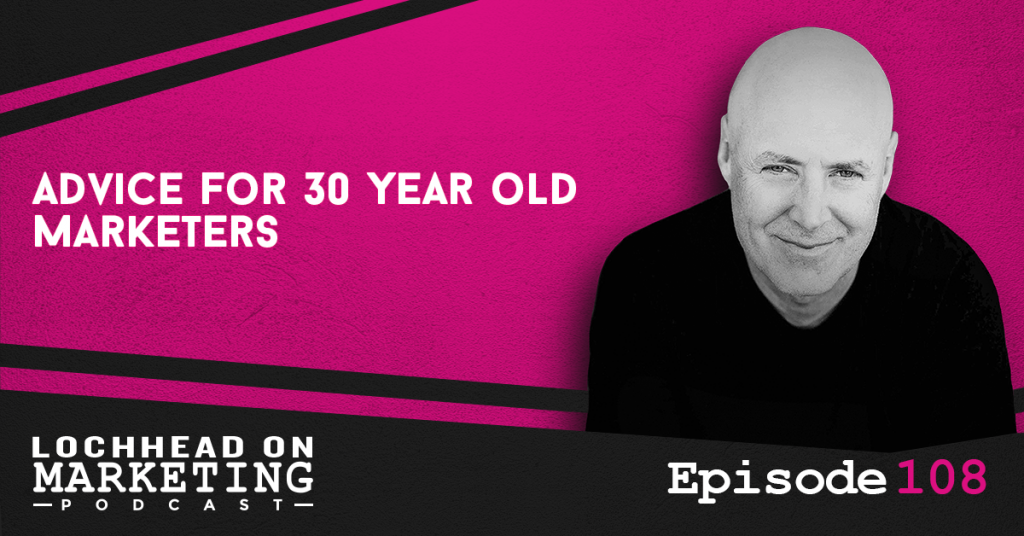
108 Advice for 30 Year Old Marketers
Podcast (lochheadonmarketing): Play in new window | Download (Duration: 7:14 — 5.0MB) | Embed
Subscribe: Apple Podcasts | Spotify | RSS | More
In this episode of Lochhead on Marketing, let us talk about some advice for 30 year old marketers.
I have been asked this question a bunch of times, so I just put together my response as a LinkedIn post. A lot of people though it was a great list, so I thought I’d share it with you.
Making the List
As said earlier, this list was originally a LinkedIn post, and it’s a list of practical advice for 30 year old marketers. There were some who asked if it was in a certain order, and one outright challenged me to do so.
I did not want to do that because I wanted to present them as ideas. Because what might be important for me might not be for others.
Sure enough in the comments, different things on the list resonated with different people.
Though there is an argument to be made about creating lists in certain order, so as to elicit something close to a call to action.
“It seems we live in a world of prescriptions, where people want to do lists and more and more inane sort of business and marketing advice. You know, the seven things Elon Musk does before breakfast. And we’ve gotten to a place where a lot of content about business, about self-help, about marketing is very pablumatic and sort of at a prescription level, do this, do that, etc.” – Christopher Lochhead
While we do create prescription type articles, mostly on what you should and shouldn’t do, that’s not how we work most of the time. Our job is to give people ideas, and with those ideas, they can come up with different combinations or new ways to approach things. We feel that having something close to a to-do list hinders that process.
The Advice for 30 Year Old Marketers
That said, here’s the list of Advice for 30 Year Old Marketers, in no particular order:
- Do legendary work
- Position yourself or be positioned
- You’re not too young to be a CMO, or start a company
- Stop giving a shit about what other people think of you, it’s a trap
- Thinking about thinking is the most important thinking
- Most marketers have been recruited into the cult of the brand
- Categories make brands, not the other way around
- Marketers who create new demand, are most in demand
- They are called category designers
- Nobody legendary is working on their “personal brand”
- The most influential people in the world are not “influencers”
- Only work on legendary teams
- If your company is not going to be a category queen, quit
- Be very careful who’s content you consume
- 90% of what we get taught about marketing is BS
- Learn to write
- Make friends with other Superstar 30 year old’s
- One day, you might rule the world together
- It goes by fast, soak up every second
Bio
Christopher Lochhead is a #1 Apple podcaster and #1 Amazon bestselling co-author of books: Niche Down and Play Bigger.
He has been an advisor to over 50 venture-backed startups; a former three-time Silicon Valley public company CMO and an entrepreneur.
Furthermore, he has been called “one of the best minds in marketing” by The Marketing Journal, a “Human Exclamation Point” by Fast Company, a “quasar” by NBA legend Bill Walton and “off-putting to some” by The Economist.
In addition, he served as a chief marketing officer of software juggernaut Mercury Interactive. Hewlett-Packard acquired the company in 2006, for $4.5 billion.
He also co-founded the marketing consulting firm LOCHHEAD; the founding CMO of Internet consulting firm Scient, and served as head of marketing at the CRM software firm Vantive.
We hope you enjoyed this episode of Lochhead on Marketing™! Christopher loves hearing from his listeners. Feel free to email him, connect on Facebook, Twitter, Instagram, and subscribe on Apple Podcast! You may also subscribe to his newsletter, The Difference, for some amazing content.
