
Lochhead on Marketing
098 Social Media Marketing Lie: You Have Be Everywhere on Every Platform 100 Times a Day
Podcast (lochheadonmarketing): Play in new window | Download (Duration: 14:57 — 10.3MB) | Embed
Subscribe: Apple Podcasts | Spotify | RSS | More
In this episode, let’s talk about one of the dumbest social media marketing lies out there: you have to be everywhere on every platform and you need to put out a hundred pieces of content today. This is terrible advice and it will exhaust you and your marketing team and will piss off your prospects and customers. Ultimately, it will not help you become a category queen and king.
Bio:
Christopher Lochhead is a #1 Apple podcaster and #1 Amazon bestselling co-author of books: Niche Down and Play Bigger.
He has been an advisor to over 50 venture-backed startups; a former three-time Silicon Valley public company CMO and an entrepreneur.
Furthermore, he has been called “one of the best minds in marketing” by The Marketing Journal, a “Human Exclamation Point” by Fast Company, a “quasar” by NBA legend Bill Walton and “off-putting to some” by The Economist.
In addition, he served as a chief marketing officer of software juggernaut Mercury Interactive. Hewlett-Packard acquired the company in 2006, for $4.5 billion.
He also co-founded the marketing consulting firm LOCHHEAD; was the founding CMO of Internet consulting firm Scient, and served as head of marketing at the CRM software firm Vantive.
Links:
Legendary copywriter Ben Settle
Category King of History Podcasts Dan Carlin
We hope you enjoyed this episode of Lochhead on Marketing™! Christopher loves hearing from his listeners. Feel free to email him, connect on Facebook, Twitter, Instagram, and subscribe on Apple Podcast! You may also subscribe to his newsletter, The Difference, for some amazing content.
097 You Are What You Subscribe To
Podcast (lochheadonmarketing): Play in new window | Download (Duration: 10:23 — 7.1MB) | Embed
Subscribe: Apple Podcasts | Spotify | RSS | More
Today, let’s talk a little more about your career. My brother from another mother and co-creator of our new newsletter category pirates, Nicholas Cole has an interesting insight: “you are what you subscribe to.” Christopher thinks he’s right.
So in this episode, find out what media Christopher consumes that he finds life-changing.
“The content we subscribed to, the content we consume, it affects how and what we think about. Our thoughts affect our actions and our actions affect our outcomes, both professionally and personally.” – Christopher Lochhead
F*ck The Hustle Porn Stars
If you’ve been a long time listener, you would know that Christopher is not a fan of these hustle porn stars. He does not believe in hustlin’ all your life. Instead, Christopher pushes for being different and legendary.
“Porn stars say no one ever worked himself to death. Well in Japan, they have a word for it. It’s called Karoshi and it translates into death by overwork. Maybe you can hustle all you want, but there’s a difference between hard work and smart work.” – Christopher Lochhead
Choose What You Consume
We have very limited spaces in our brains so Christopher encourages you to choose what you read and listen to. He gives out a few recommendations such as below:
The OGS
- Peter Drucker – The Effective Executive
- David Ogilvy
New Thought Leaders
- Malcolm Gladwell – The Masterclass
- John Wall and Christopher Penn – Marketing Over Coffee Podcast
- Mike Maples Jr. – Starting Greatness Podcast
- Paul Martino and Randy Komisar – No Bull: Life-Changing Conversations with Bill Campbell
B2B World
- Dave Gearhart – B2B Marketing Leaders Podcast
- Brian Burns – B2B Revenue Leadership Podcast
- Russell Brunson – The Secret Series (Books and Podcast)
A Couple of Key Questions
Those life-changing books and podcasts are just a couple to think about. Moreover, Christopher is encouraging you to sit down and ask yourself a couple of key questions:
“What’s the kind of content I love? What do I most want to learn in the next 12 months? What should I stop consuming? What should I start consuming? And remember, be very careful whose ideas you let into your head because your thoughts become your actions, your actions become your outcomes and your outcomes become your life.” – Christopher Lochhead
To know more about why you are what you subscribe to, download and listen to this episode.
Bio:
Christopher Lochhead is a #1 Apple podcaster and #1 Amazon bestselling co-author of books: Niche Down and Play Bigger.
He has been an advisor to over 50 venture-backed startups; a former three-time Silicon Valley public company CMO and an entrepreneur.
Furthermore, he has been called “one of the best minds in marketing” by The Marketing Journal, a “Human Exclamation Point” by Fast Company, a “quasar” by NBA legend Bill Walton and “off-putting to some” by The Economist.
In addition, he served as a chief marketing officer of software juggernaut Mercury Interactive. Hewlett-Packard acquired the company in 2006, for $4.5 billion.
He also co-founded the marketing consulting firm LOCHHEAD; was the founding CMO of Internet consulting firm Scient, and served as head of marketing at the CRM software firm Vantive.
We hope you enjoyed this episode of Lochhead on Marketing™! Christopher loves hearing from his listeners. Feel free to email him, connect on Facebook, Twitter, Instagram, and subscribe on Apple Podcast! You may also subscribe to his newsletter, The Difference, for some amazing content.
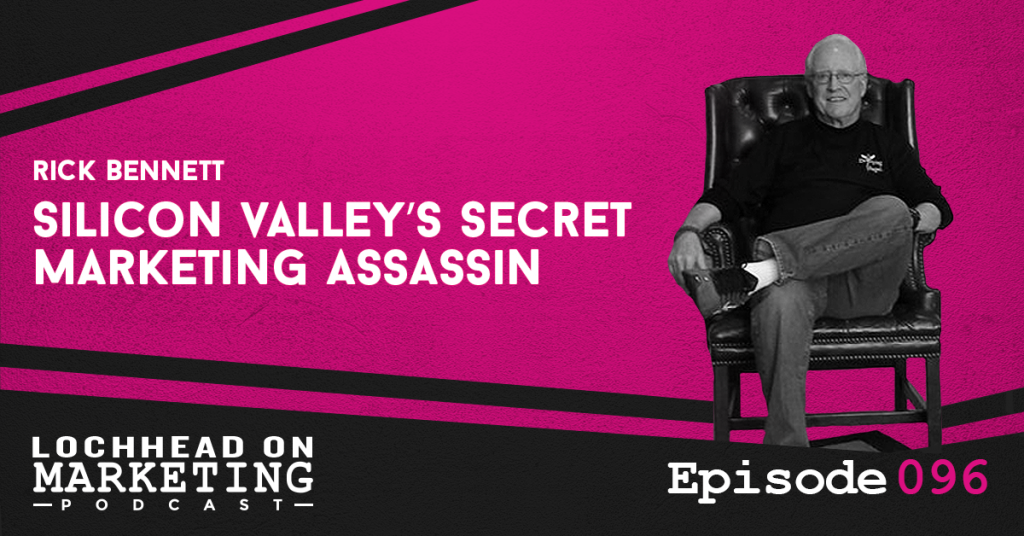
096 Silicon Valley’s Secret Marketing Assassin Rick Bennett
Podcast (lochheadonmarketing): Play in new window | Download (Duration: 1:06:59 — 46.0MB) | Embed
Subscribe: Apple Podcasts | Spotify | RSS | More
Advertising is a powerful thing in the world of business. Whether you have a start-up or a successful company, you still need an effective advertisement to propel your brand forward. Silicon Valley’s secret advertising weapon, Rick Bennett, is here with us today to give pieces of advice about advertising and marketing. Also, he talks about how being wise and having good decisions help us as human beings.
Technological Intimidation
Rick says that the best thing to do when advertising is to avoid saying anything that a competitor could say. You’ve got to rebut if a competitor tries to provoke you by saying he’s wrong and it’s not true. Also, he says that the trick is not to get sued for libel or slander.
“You have to use technological intimidation. You can only speak to the technological truth. We don’t call someone a liar. We can say, well, this isn’t true, and we prove why.” – Rick Bennett
Rhetorical War Gaming
Rick is a master at writing legendary headlines back in the day. Christopher asks him when is the right time to invest in an advertisement after creating a headline and then testing it. He says that rhetorical wargaming using SurveyMonkey to test a bunch of ideas is helpful and also giving a free product to the audience:
“Survey monkey is good, but the trick is the giveaway. You need to offer a free product that anybody can log on to and check out your AI. That could be very granular and atomic and just take off.” – Rick Bennett
How to Function Creatively
Christopher and Rick talk about the assault on the Capitol that happened on January 6, where several people died because of the riot. Christopher says that politics was about arguing to solve problems, and now it’s just about arguing to continue to argue. Rick agrees, and he says that we can’t change anybody’s mind, so we have to change the playing field.
“One idea that I have is that creativity and genius cannot exist in a state of anger. In other words, you get angry on either side, and you have destroyed your ability to function creatively. Creativity is a curse. That’s the way I kind of cloister myself in the pirate cottage here up in the mountainside, and I try not to let anything destroy my creativity as it is.” – Rick Bennett
To know more about Silicon Valley’s Secret Marketing Assassin Rick Bennett, download and listen to this episode.
Bio:
Rick Bennett specializes in guerrilla warfare marketing.
He’s been the secret advertising weapon to Silicon Valley entrepreneurs for over 30 years.
Two of his most spectacular successes are Oracle and Salesforce.com.
Links:
We hope you enjoyed this episode of Lochhead on Marketing™! Christopher loves hearing from his listeners. Feel free to email him, connect on Facebook, Twitter, Instagram, and subscribe on Apple Podcast! You may also subscribe to his newsletter, The Difference, for some amazing content.
095 How To Secure Your Financial Future

Podcast (lochheadonmarketing): Play in new window | Download (Duration: 18:53 — 13.0MB) | Embed
Subscribe: Apple Podcasts | Spotify | RSS | More
In 2019, CNBC reported that 27% of Americans “would have to borrow or sell something to pay for a $400 emergency. Further, Nation.com reports in 2018, 4% of American adults reported not having enough food and by July of 2020, that figure had exploded to 11% and they say it will probably continue to increase as the pandemic worsens.
Most recently, Pew Research finds that one in four American adults have had trouble paying their bills since the coronavirus outbreak started. So the reality is, this pandemic has exposed how financially vulnerable many of us are.
So in this episode, let’s talk about your career and how you can become financially free.
You Can Turn Your Situation Around
Christopher has his fair share of financial struggles growing up. He was raised in a single-parent household and experienced business failure in his early 20s. It was the most challenging financial situation of his life, as he describes.
“The goal here is a very simple one to understand when your investment income pays your living expenses, you’re financially free. That’s a very powerful day in a person’s life. So I want to share with you a few things I’ve learned along the way. It’s also important to know I am in no way, shape or form a financial advisor accountant or anything of the, like. I’m just a guy that’s learned a few things along the way, and I’ve been taught a few things by some legendary folks.” – Christopher Lochhead
Build A Financial Egg Nest
Ultimately, the objective is to build a financial nest egg. The concept is over time, you convert getting paid for your time to getting paid from your investments. In simpler terms, you have to find a way to earn income while you are asleep. As Tim Rhode, founder of One Life Fully Lived, calls it, its horizontal income.
“In order to create a nest egg that starts producing horizontal income, you can, A. Lower your expenses or B. Increase your after-tax income. If you do both, then you’ll have even more money to build your nest egg.” – Christopher Lochhead
Don’t Buy Shit You Can’t Afford
Christopher shares his observation among the younger generation nowadays and gives a reminder, to not buy shit you can’t afford. He also mentions listening to financial planning experts, as they say, credit card debt is a sure-fire way to keep yourself enslaved.
“Get out of credit card debt as quickly as you can. Don’t buy shit you can’t afford and, uh, and save up.” – Christopher Lochhead
To know more how to secure your financial future, download and listen to this episode.
Bio:
Christopher Lochhead is a #1 Apple podcaster and #1 Amazon bestselling co-author of books: Niche Down and Play Bigger.
He has been an advisor to over 50 venture-backed startups; a former three-time Silicon Valley public company CMO and an entrepreneur.
Furthermore, he has been called “one of the best minds in marketing” by The Marketing Journal, a “Human Exclamation Point” by Fast Company, a “quasar” by NBA legend Bill Walton and “off-putting to some” by The Economist.
In addition, he served as a chief marketing officer of software juggernaut Mercury Interactive. Hewlett-Packard acquired the company in 2006, for $4.5 billion.
He also co-founded the marketing consulting firm LOCHHEAD; was the founding CMO of Internet consulting firm Scient, and served as head of marketing at the CRM software firm Vantive.
Links:
Covid-19 and the Nightmare of Food Insecurity
Economic Fallout From COVID-19 Continues To Hit Lower-Income Americans the Hardest
Tribe of Millionaires: What If One Choice Could Change Everything?
Rich Dad Poor Dad: What the Rich Teach Their Kids About Money That the Poor and Middle Class Do Not!
We hope you enjoyed this episode of Lochhead on Marketing™! Christopher loves hearing from his listeners. Feel free to email him, connect on Facebook, Twitter, Instagram, and subscribe on Apple Podcast! You may also subscribe to his newsletter, The Difference, for some amazing content.
094 Clubhouse – Category Creation In Action, or Not So Much?
Podcast (lochheadonmarketing): Play in new window | Download (Duration: 11:33 — 7.9MB) | Embed
Subscribe: Apple Podcasts | Spotify | RSS | More
Many people reached out to Christopher and asked for more episodes on category design. In future episodes, he will dig into a specific category and/or brands, and analyze what’s going on and how that can be illustrative for the rest of us.
So for this episode, Christopher talks about a buzzy application in the social media world called Clubhouse. Today, let’s examine the question: is clubhouse a legendary category queen in the making or a dumb idea?
New Hot Category, As They Claim
If you check Clubhouse’s valuation, they seem to be doing well. They’re valued at a hundred million dollars or more. Clubhouse has done a great job in describing themselves or as we say, describe their category design.
According to their website, Clubhouse is a new type of social product based on voice that allows people everywhere to talk, tell stories, develop ideas, deepen friendships, and meet interesting new people around the world.
The Power of Category Design
Clubhouse has a very powerful profile but based on Christopher’s experience, the app is “kind of like a webinar scheduling platform with no video that has a shitty UX.” Regardless of our opinion about the app, they did a great job in telling a good story for investors and users.
“Clubhouse is doing a legendary job, convincing the world that they are the new, new thing, the new hot category.” – Christopher Lochhead
The Studio 54 Marketing
If you’ll remember Studio 54, it was the hottest hangout spot for celebrities in New York. Crowds would gather at the door, and people would do anything to get in, yet only a lucky few did. Clubhouse employed the same marketing mindset which made people want to have it more.
“They created scarcity and that’s exactly what clubhouse has done in addition to their category design. They’re doing Studio 54 marketing. They’re creating scarcity. As a matter of fact, when you get on, the only way you can get onto Clubhouse is: an existing clubhouse user needs to invite you.” – Christopher Lochhead
To know more if Clubhouse is category creation in action, or not so much, download and listen to this episode.
Bio:
Christopher Lochhead is a #1 Apple podcaster and #1 Amazon bestselling co-author of books: Niche Down and Play Bigger.
He has been an advisor to over 50 venture-backed startups; a former three-time Silicon Valley public company CMO and an entrepreneur.
Furthermore, he has been called “one of the best minds in marketing” by The Marketing Journal, a “Human Exclamation Point” by Fast Company, a “quasar” by NBA legend Bill Walton and “off-putting to some” by The Economist.
In addition, he served as a chief marketing officer of software juggernaut Mercury Interactive. Hewlett-Packard acquired the company in 2006, for $4.5 billion.
He also co-founded the marketing consulting firm LOCHHEAD; was the founding CMO of Internet consulting firm Scient, and served as head of marketing at the CRM software firm Vantive.
093 Are You Making This Sales Training Mistake?
Podcast (lochheadonmarketing): Play in new window | Download (Duration: 16:23 — 11.3MB) | Embed
Subscribe: Apple Podcasts | Spotify | RSS | More
In this episode, let’s talk about sales training slash sales enablement. Companies make a very big mistake on sales training. Christopher shares his thoughts about that mistake and how not to do that.
Bio:
Christopher Lochhead is a #1 Apple podcaster and #1 Amazon bestselling co-author of books: Niche Down and Play Bigger.
He has been an advisor to over 50 venture-backed startups; a former three-time Silicon Valley public company CMO and an entrepreneur.
Furthermore, he has been called “one of the best minds in marketing” by The Marketing Journal, a “Human Exclamation Point” by Fast Company, a “quasar” by NBA legend Bill Walton and “off-putting to some” by The Economist.
In addition, he served as a chief marketing officer of software juggernaut Mercury Interactive. Hewlett-Packard acquired the company in 2006, for $4.5 billion.
He also co-founded the marketing consulting firm LOCHHEAD; was the founding CMO of Internet consulting firm Scient, and served as head of marketing at the CRM software firm Vantive.
We hope you enjoyed this episode of Lochhead on Marketing™! Christopher loves hearing from his listeners. Feel free to email him, connect on Facebook, Twitter, Instagram, and subscribe on Apple Podcast! You may also subscribe to his newsletter, The Difference, for some amazing content.
092 How To Manage Digital Reputations w/ Josh Greene

Podcast (lochheadonmarketing): Play in new window | Download (Duration: 48:31 — 33.3MB) | Embed
Subscribe: Apple Podcasts | Spotify | RSS | More
It is super important to know how social media and the online-world itself work, especially if you’re a business owner or an entrepreneur. This holds true because we are living in a digital-first world, where you can search for anything on the internet. Managing your digital reputation is indeed challenging and sometimes complicated.
So today our guest, Josh Greene, CEO of The Mather Group, explains how search engines work and what you can do to optimize them for your benefit.
Positive Google Outcome
Christopher asks Josh what he would advise him to get a positive Google outcome. Josh says that if you are doing a lot of “leading” in an industry, that will ultimately lead to good results in the search engines. For those who are not quite famous, he advises “sending Google a signal” to treat their content a certain way. Entrepreneurs should post and write about themselves (bio) so search engines can recognize them.
“If you write books, if you start a podcast, if you have a Twitter feed that lots of people find useful, or if your videos are getting lots of views, all of those things play a big role in what’s showing up in the Google search results.” – Josh Greene
Google Search Ranking System
Having a common name is hard when you’re trying to get a sweet spot for yourself in a search engine. Christopher asks Josh what are the highest order bits in terms of teaching Google to rank yourself. Josh says that the first thing you could do is take inventory of what your assets currently are and focus on your digital presence:
“That’s a nice part for people who are very active in their field and sort of well respected because there’s a sort of equivalent almost in terms of how Google’s algorithm is viewing things.” – Josh Greene
Social Media Platforms
Social media marketing is one of the easiest ways to promote a product or a business. Christopher asks Josh how to decide which social media platform to use if he’s only going to invest his time in one or two of these. Josh says that he should consider asking himself first if it plays to his strengths and who’s the audience he’s trying to reach with it.
“So, it could be that you’re a fantastic guitarist. Instagram is a nice format for showing off your guitar playing chops. Twitter can be useful because you can curate news to a particular audience that might be following you. And if you’re in a particular corporate role, sometimes LinkedIn can be really useful because you don’t need to publish a ton to get a lot of eyeballs on something.” – Josh Greene
To know more about how to manage digital reputations with Josh Greene, download and listen to this episode.
Bio:
Josh Greene is the CEO for The Mather Group, a digital agency, that helps companies manage how they’re found online, through Wikipedia and Search Engine Optimization, and drives targeted high value leads for B2B companies.
Prior to The Mather Group, Greene was the VP of Marketing for both 1-800-PACK-RAT and Zippy Shell where he was responsible for all marketing including online, offline, and the launch of national television campaigns.
Prior to 1-800-PACK-RAT, Greene was the Vice President of Member Services for Shop.org where he oversaw membership recruitment and retention initiatives.
Additionally, Greene collaborated with NRF’s government relations staff to execute policy and advocacy strategies on behalf of Shop.org members.
He also served as a liaison to Shop.org’s Policy Advisory Group, developed industry initiatives, and managed Shop.org’s Ray M. Greenly Scholarship fund.
Greene joined Shop.org from Discovery Communications, where he was director of online marketing and business development.
At Discovery, Greene oversaw online marketing, direct response television, corporate gifting, and partner programs for DiscoveryStore.com.
Prior to Discovery Communications, Greene was director of e-marketing for Time Warner Cable and director of e-marketing for Road Runner.
He’s been a frequent speaker at industry events including ad:tech, SES, Channel Advisor’s Catalyst conference, and others.
Links:
We hope you enjoyed this episode of Lochhead on Marketing™! Christopher loves hearing from his listeners. Feel free to email him, connect on Facebook, Twitter, Instagram, and subscribe on Apple Podcast! You may also subscribe to his newsletter, The Difference, for some amazing content.
091 The Marketing Multiplier Effect
Podcast (lochheadonmarketing): Play in new window | Download (Duration: 12:20 — 8.5MB) | Embed
Subscribe: Apple Podcasts | Spotify | RSS | More
On episode 90, we talked about how complexity is the enemy of revenue and how to shave the marketing dog down. Now let’s talk about what we do once we shaved the dog down. We talk about the powerful marketing execution concept called the multiplier effect. The concept means taking our precious marketing dollars and getting maximum impact for them.
“Imagine you’re going to make a $10,000 investment in some kind of marketing initiative. The question is how do you make it feel like a hundred or a hundred thousand dollar investment? How do you make it feel like a million or a million? How do you make it feel like 10?” – Christopher Lochhead
Disconnect in Departments
Once you “shaved the marketing dog down,” you’ll be down to a fewer number of marketing executions. However, there is also a downside to this cut-down. Companies often find a disconnect between the different departments. Christopher addresses this disconnect in this episode.
“Legendary marketing makes people feel like the company or the brand is a person. Everything from that person is authentic to them. That is to say, it’s, it’s rooted in a true North and all of their actions are deeply coordinated and effective.” – Christopher Lochhead
Have A Few, Clear Target/s
Christopher advises marketers to have a few, clear targets to have a more effective marketing campaign. After this, he encourages marketers to have the multiplier effect mindset.
“So here’s how the mindset works. Every execution must multiply the value of every other execution. After you shaved the dog, it’s critical to pick an anchor execution for your campaign or your lightning strike.” – Christopher Lochhead
CMOs Should Tie Everything Together
The CMOs job is to tie it all together. Christopher advises CMOs their duties and what are the interesting questions to ask when looking at a particular marketing execution.
“How does this tie? That is to say, how does this execution multiply the value of the anchor execution? How does this tie and remember, just to underscore it, there can only be one anchor.” – Christopher Lochhead
To know more about the marketing multiplier effect, download and listen to this episode.
Bio:
Christopher Lochhead is a #1 Apple podcaster and #1 Amazon bestselling co-author of books: Niche Down and Play Bigger.
He has been an advisor to over 50 venture-backed startups; a former three-time Silicon Valley public company CMO and an entrepreneur.
Furthermore, he has been called “one of the best minds in marketing” by The Marketing Journal, a “Human Exclamation Point” by Fast Company, a “quasar” by NBA legend Bill Walton and “off-putting to some” by The Economist.
In addition, he served as a chief marketing officer of software juggernaut Mercury Interactive. Hewlett-Packard acquired the company in 2006, for $4.5 billion.
He also co-founded the marketing consulting firm LOCHHEAD; was the founding CMO of Internet consulting firm Scient, and served as head of marketing at the CRM software firm Vantive.
We hope you enjoyed this episode of Lochhead on Marketing™! Christopher loves hearing from his listeners. Feel free to email him, connect on Facebook, Twitter, Instagram, and subscribe on Apple Podcast! You may also subscribe to his newsletter, The Difference, for some amazing content.
090 Complexity Is The Enemy of Revenue: Why It’s Time to Shave The Marketing Dog
Podcast (lochheadonmarketing): Play in new window | Download (Duration: 14:06 — 9.7MB) | Embed
Subscribe: Apple Podcasts | Spotify | RSS | More
If you’re currently doing a big initiative, say a new product launch, a new campaign, a sales kickoff or a lightning strike, let’s talk about why you are also, most probably, making a huge mistake. Shit sometimes, gets too complex and we know that complexity is the enemy of revenue. So on this episode, let’s talk about why it’s time to shave the marketing dog.
Doing Too Much
There’s 99.9% chance you are doing too much in marketing. Christopher candidly shares that sometimes in life, it is not about winning the activity. For contests, as a matter of fact, there is an inverse relationship between activity and results.
“I see this a lot in marketing, a lot of activity, a lot of moving, a lot of bands, bouncing and dancing, and there’s stupidities in marketing today. I hear stuff like, ‘Oh, you need to be everywhere. You need to be on every channel. You need to be putting out 200 pieces of content today across every channel.’ That stuff is ridiculous. All that stuff is bullshit.” – Christopher Lochhead
Where To Shave The Dog
Whenever Christopher is doing anything marketing related, he loves to pose the question, “where do we shave this dog?” He encourages every marketer to do a forced ranking of all the activities and choose top 3 (or more) that will guarantee the same level of results from doing a couple.
I learned everything I know about design from a couple of legendary designers and one of them is John Bielenberg. He’s an incredible business and corporate marketing designer. He has a perspective, he calls thinking wrong. The idea is this, when you do anything creative, ask yourself ‘what is 180 degrees from what everybody else would do? What is wrong? What would be the wrong way to go do this?’” – Christopher Lochhead
Activities That Multiply Outcome
Christopher also shares another thinking of pursuing activities that multiple the outcomes of another former activity. One should always ask, “does this component of our plan, materially multiply our chances of achieving the outcome we want from this marketing activity?”
“Shave the dog. Shave that doggy down. Practice getting everything out. Consider getting even more radical.” – Christopher Lochhead
To know more why Complexity Is The Enemy of Revenue and Why It’s Time to Shave The Marketing Dog, download and listen to this episode.
Bio:
Christopher Lochhead is a #1 Apple podcaster and #1 Amazon bestselling co-author of books: Niche Down and Play Bigger.
He has been an advisor to over 50 venture-backed startups; a former three-time Silicon Valley public company CMO and an entrepreneur.
Furthermore, he has been called “one of the best minds in marketing” by The Marketing Journal, a “Human Exclamation Point” by Fast Company, a “quasar” by NBA legend Bill Walton and “off-putting to some” by The Economist.
In addition, he served as a chief marketing officer of software juggernaut Mercury Interactive. Hewlett-Packard acquired the company in 2006, for $4.5 billion.
He also co-founded the marketing consulting firm LOCHHEAD; was the founding CMO of Internet consulting firm Scient, and served as head of marketing at the CRM software firm Vantive.
We hope you enjoyed this episode of Lochhead on Marketing™! Christopher loves hearing from his listeners. Feel free to email him, connect on Facebook, Twitter, Instagram, and subscribe on Apple Podcast! You may also subscribe to his newsletter, The Difference, for some amazing content.
