
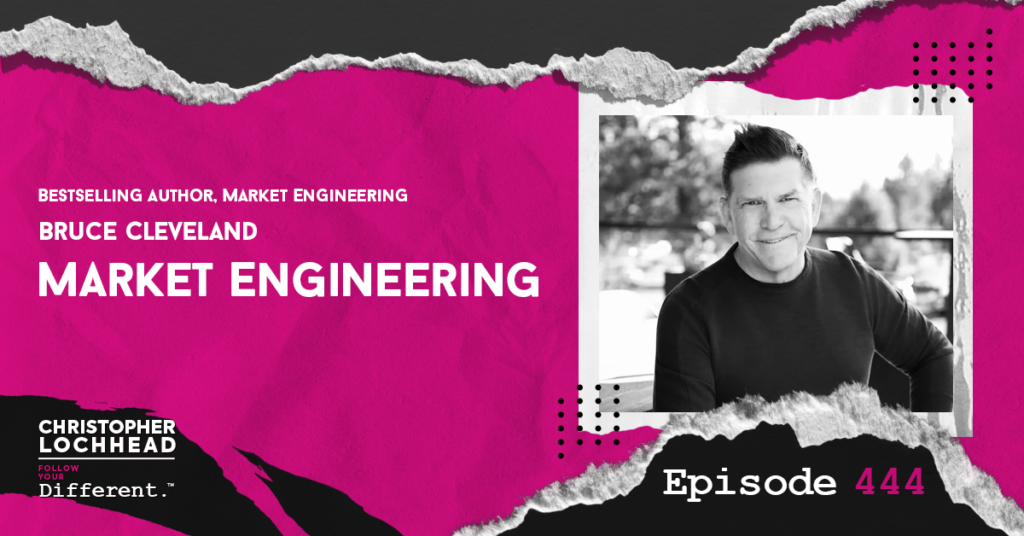
444 Market Engineering with Bruce Cleveland
Podcast: Play in new window | Download (Duration: 1:01:56 — 42.5MB) | Embed
Subscribe: Apple Podcasts | Spotify | Pandora | RSS | More
On this episode of Christopher Lochhead: Follow Your Different, Bruce Cleveland, legendary entrepreneur and venture capitalist, joins us to discuss his powerful new book, “Market Engineering: Because Markets Don’t Build Themselves.” The conversation brought together two former competitors who have since become allies in a shared mission: helping founders and executives understand that markets, like products, can be deliberately designed and engineered. Cleveland’s insights are drawn from decades of operating experience at companies like Siebel and Apple, as well as his work as a venture capitalist guiding early-stage startups.
The core argument is simple but often ignored. Over 90% of startups fail not because their products are bad, but because they never take responsibility for shaping the market around those products. Cleveland and Lochhead agree that the companies who teach the market how to think about a problem, and then how to solve it, are the ones who become category kings and queens.
You’re listening to Christopher Lochhead: Follow Your Different. We are the real dialogue podcast for people with a different mind. So get your mind in a different place, and hey ho, let’s go.
Bruce Cleveland on What Market Engineering Actually Means
Bruce Cleveland defines market engineering as a five-part discipline that includes category design, positioning, messaging, storytelling, and thought leadership. When these elements are combined intentionally and consistently, they create gravitational pull. Customers seek you out, attend your events, and associate your brand with the future they want to be part of.
Cleveland draws a sharp distinction between marketing and market engineering. He uses the analogy of a short-order cook at Denny’s versus a chef at a Michelin-star restaurant. Both have the same basic ingredients, but the outcomes are vastly different. The difference is knowing how to combine those ingredients with precision, purpose, and craft.
The Book as an Instruction Manual, Not Just Inspiration
One of the most refreshing aspects of Bruce Cleveland’s approach is his insistence on practicality. He openly criticizes business books that fire readers up but leave them with no clear path forward. “Market Engineering” was written as a prescriptive guide, walking readers through specific frameworks like the Market Blueprint, Messaging Matrix, and Market Charter.
To take this even further, Cleveland built an AI-powered platform called the Market Engineering Virtual Studio, trained on his own methodology using a neural symbolic recursion model named Finn. The platform allows users to actually build the documents and artifacts described in the book, turning static ideas into dynamic action. Cleveland and Lochhead both agree this model, combining a book, an AI companion, and a community, represents the future of business education.
Why Former Competitors Are Now Building the Same Category Together
Perhaps the most telling moment in the conversation is when Lochhead reflects on the fact that he and Bruce Cleveland spent years as direct competitors, yet now champion nearly identical ideas. Rather than seeing this as a conflict, both men view it as validation. A category only exists when multiple credible voices contribute to defining it. Their combined efforts have helped make category design and market engineering part of the mainstream business conversation.
Cleveland also speaks candidly about why he works primarily with pre-seed and early-stage companies that have limited capital. He prices his tools and services accessibly on purpose, takes small equity positions, and focuses on creating real economic impact. His philosophy is that helping startups succeed contributes more to society than any check he could write to a traditional charitable cause. For Bruce Cleveland, market engineering is not just a framework. It is a form of giving back.
To hear more from Bruce Cleveland on the benefits of Market Engineering, download and listen to this episode.
Bio
Bruce Cleveland’s career in Tech spans more than 40 years as a venture investor and operating executive.
He was a first investor and a board member of Marketo, which held an IPO in 2013 and was acquired in 2018 by Adobe for $4.75B.
He was an early-stage investor in other notable companies such as C3.ai, Doximity, Vlocity, and Workday. Bruce also held senior executive roles in engineering, product management and product marketing at Apple, AT&T, C3.ai, Oracle and Siebel Systems.
His book, Traversing the Traction Gap, is a prescriptive guide for startups and new product initiatives within larger companies helping teams to use ‘market engineering’ techniques to successfully transition from Ideation to Scale.
He attended the US Military Academy, West Point, New York, and received a BS in business administration from CSU, Sacramento. He lives in the San Francisco Bay Area.
Connect with Bruce Cleveland!
LinkedIn | X (Formerly Twitter) | Website
Check out his book here: Market Engineering: Because Markets Don’t Build Themselves
We hope you enjoyed this episode of Christopher Lochhead: Follow Your Different™! Christopher loves hearing from his listeners. Feel free to email him, connect on Facebook, X (formerly Twitter), Instagram, and subscribe on Apple Podcast / Spotify!
